
Most searches for extraterrestrial intelligence share one limitation: they look at a small piece of sky and hope something happens there. LaserSETI starts from the opposite assumption. It watches as much of the sky as it can, all the time, and waits for a flash. On Oct. 22, the SETI Institute and the Royal Commission for AlUla (RCU) said the project's newest stations are running. Two detectors in Saudi Arabia's AlUla Manara dark-sky site are installed, commissioned and collecting data.
The SETI Institute's announcement calls AlUla the network's fifth site worldwide and its first and only site in Asia. The other four are in California, Hawai'i, Arizona and Puerto Rico. The stations were installed on Aug. 19, 2026, and the public announcement came two months later.
"Two years ago, we announced our intention to bring LaserSETI to AlUla," said Franck Marchis, the SETI Institute's Director of Citizen Science. "Today, the instruments are installed, commissioned and observing the sky."
From one pixel to the whole sky
The design makes more sense once you know what came before it. According to the SETI Institute's LaserSETI project page, earlier optical SETI projects relied on photomultiplier tubes. These are sensitive light detectors, but each one is essentially a one-pixel camera. A photomultiplier on a telescope sees only the patch of sky the telescope is pointed at, so for nearly all of the sky, nobody was watching.
LaserSETI uses two-dimensional solid-state detectors instead, the same general kind of sensor sold for video cameras. That trade gives up some single-point sensitivity in exchange for a huge gain in sky coverage. The project page says the idea was originally conceived by Alan Holmes of the Santa Barbara Instrument Group and then developed and built out by Eliot Gillum at the SETI Institute, who is now the project's director.
The key physical assumption is that an artificial laser flash would be monochromatic, meaning concentrated at a single wavelength. Stars are not. Their light covers a complete spectrum from blue to red. Each LaserSETI unit puts a diffraction grating behind its lens so that this difference shows up in the image. As Universe Today describes it, the grating separates starlight, which produces a complete spectrum, from a laser, which shows up at a characteristic wavelength. A short pulse at one wavelength should therefore look different from a twinkling star.
Built from parts you can buy
The hardware is deliberately modest. According to Universe Today, the detectors use cameras with commercially available lenses that each image about 75 degrees of sky. The solid-state detectors are off-the-shelf units, and some components are 3D-printed. Only the transmission grating and the stainless-steel enclosure are custom-made. Each unit has its own powerful computer that analyzes incoming data in real time and allows real-time alerts, which also avoids the need for expensive data storage.
On-site analysis is not just a convenience. The signal being searched for is a short flash. Without immediate, local processing, a network watching the sky continuously would produce a steady flood of video that someone would have to search afterward. Handling it at the edge makes it practical to flag candidate events as they happen.
That kind of cross-checking is behind Gillum's description of LaserSETI as a global observatory rather than a single telescope. In the announcement he said every new location improves the network's ability to monitor the sky continuously and to compare observations of unusual events from different parts of the world. A flash recorded at one station alone is hard to interpret. A flash recorded by detectors separated by continents would be a much stronger result. Each new site adds sky coverage, and it also adds another independent witness.
Why AlUla
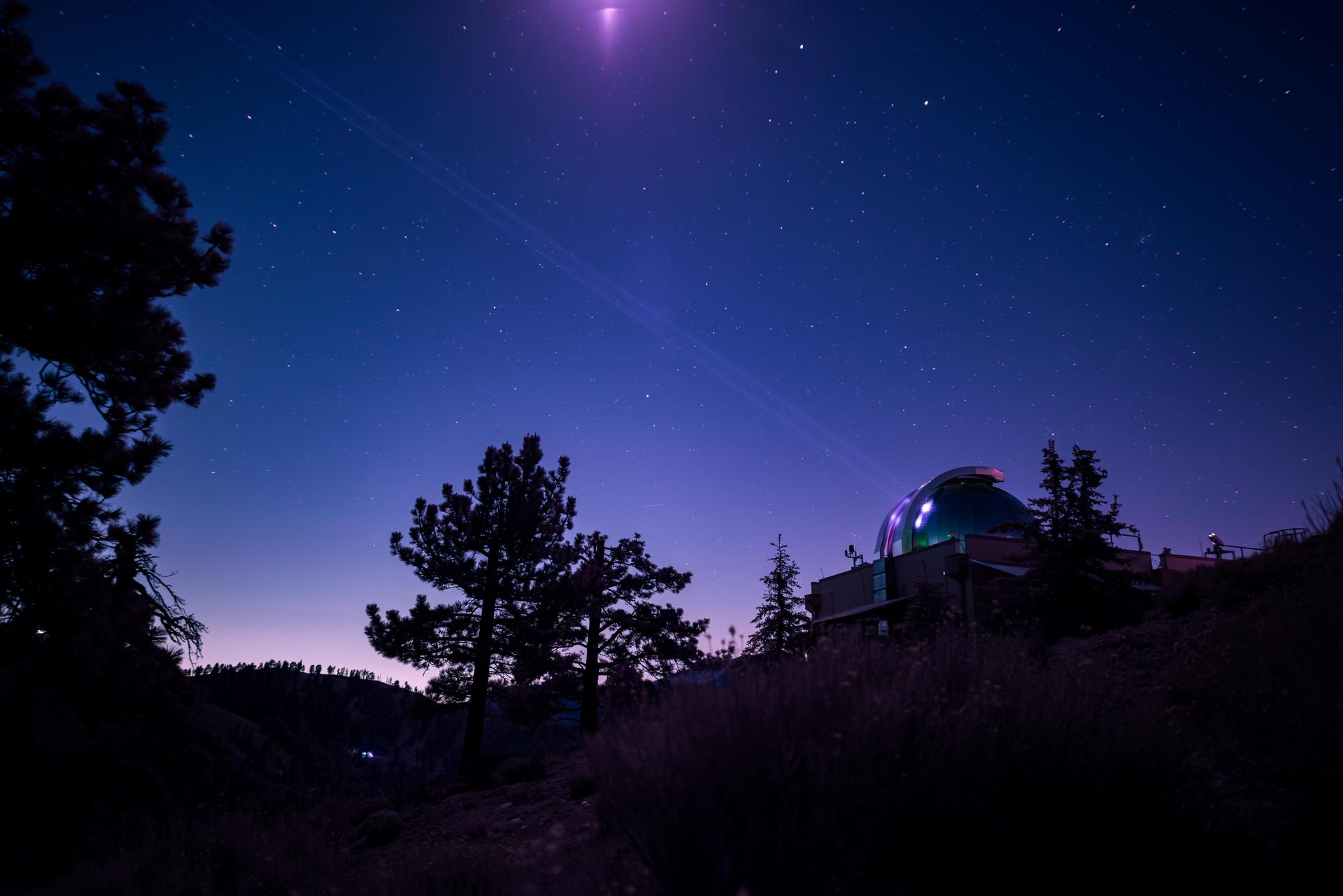
The stations sit at AlUla Manara, a site Universe Today places on a remote plateau about 74 kilometers north of AlUla in northwest Saudi Arabia. It describes AlUla as a Dark Sky Park. A 2024 report in GCC Business News put the observatory an hour's drive from the center of AlUla. The site's plans go beyond LaserSETI: Universe Today reports that it will eventually host a 4-meter telescope and a pair of 2-meter telescopes, if plans are successful. It also notes that AlUla is Saudi Arabia's first UNESCO World Heritage Site.
The arrangement goes back two years. GCC Business News reported in August 2024 that the RCU and the SETI Institute signed a collaboration agreement. Under it, the SETI Institute would facilitate the installation of a LaserSETI instrument at the AlUla Manara Observatory as part of a broader network scanning the northern-hemisphere night sky from various locations. The result is two stations, now running. Naif Al Malik, AlUla Manara's Executive Program Head, was also quoted in the SETI Institute's announcement, saying the commissioning marks an important milestone in the collaboration.
Why It Matters
The reason to look for lasers at all comes from bandwidth. The LaserSETI project page says messaging by light can in principle convey far more bits per second than radio, typically about half a million times as many. A civilization sending large amounts of information might reasonably choose light. Optical SETI, meanwhile, has so far used instruments that examined very little of the sky.
LaserSETI is betting that coverage matters. A very brief flash from a random direction is exactly what a narrow-field instrument will almost always miss. The project page notes that because the devices are wide-angle, a relatively small number of them can cover the entire night sky, keeping costs down. Watching wide areas of sky continuously, and comparing events across separate stations, is a reasonable way to look for that kind of signal. Building the network from mostly commodity parts also helps keep each added site affordable.
It is worth being clear about what the stations do not claim. None of the sources report a detection. The AlUla stations add another location and more coverage to an experiment that may return nothing for a long time. A null result would still be informative, because every night of continuous wide-field observation with no flashes limits how common bright, brief laser signals could be. The network now has a site in Asia, and its coverage is wider than it was before Aug. 19.
Sources
- SETI Institute and Royal Commission for AlUla Bring Two LaserSETI Stations to Saudi Arabia (SETI Institute, Oct. 22, 2026)
- Saudi Arabia Joins the Search for Alien Civilizations (Universe Today, Oct. 23, 2026)
- LaserSETI project page (SETI Institute)
- AlUla Manara Observatory to transform Saudi as leading astro-tourism destination (GCC Business News)
