
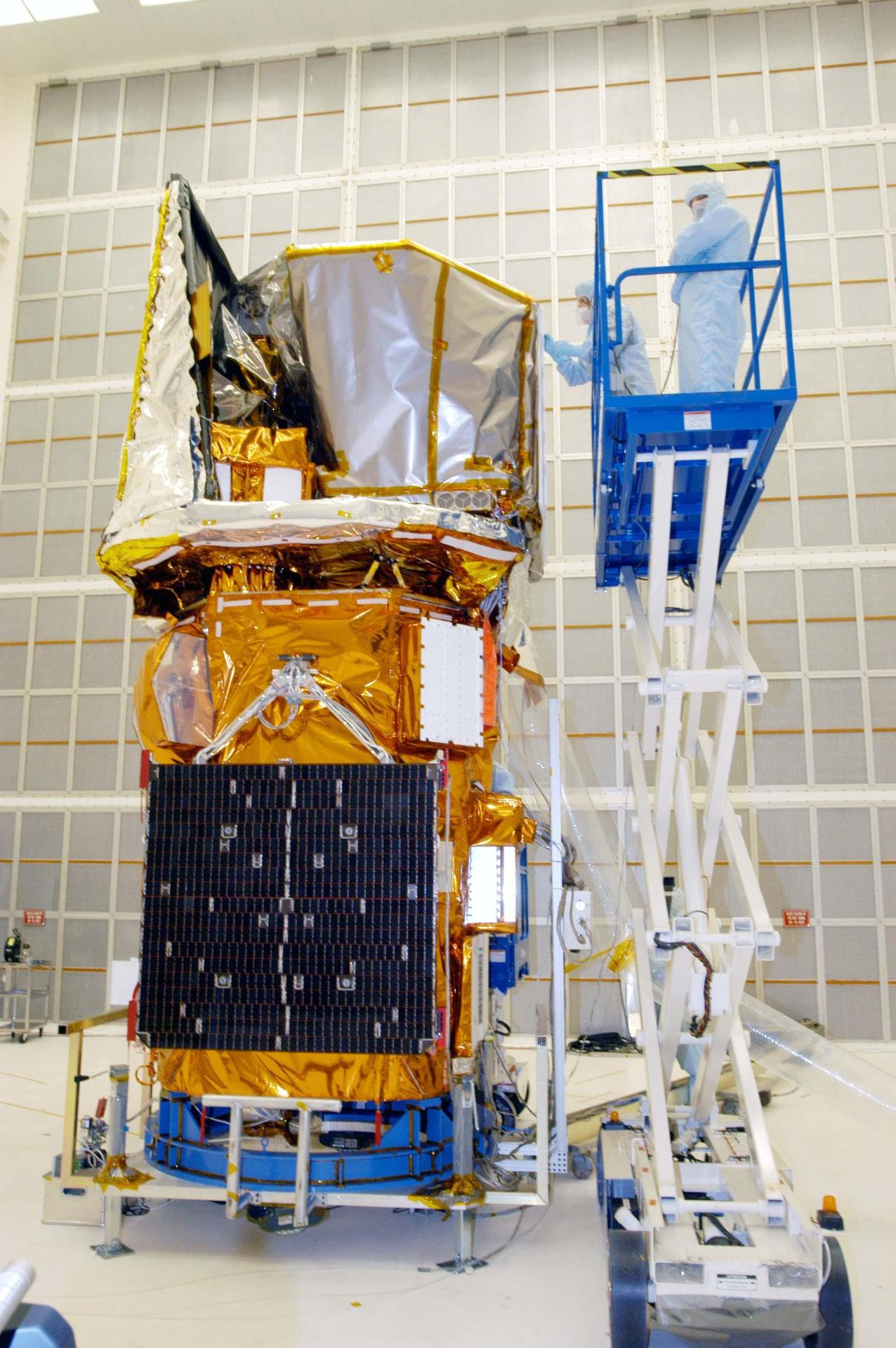
Most spacecraft don't end in a dramatic failure. They run out of something: fuel, power, or in Swift's case, altitude. NASA announced on Oct. 23 that the Neil Gehrels Swift Observatory has finished its science operations. Swift was built for a two-year primary mission and kept working for more than ten times that long. Its last observation was on Oct. 20. NASA expects the spacecraft to re-enter the atmosphere within the next few weeks.
The direct cause is simple. Swift now orbits below 171 miles (275 km). At that height, the thin upper atmosphere drags on the spacecraft hard enough that it can no longer hold its pointing steady. An observatory that can't point reliably can't do science.
How the end came
According to EconoTimes, the spacecraft went into safe mode on Oct. 20, when it could no longer make up for the drag. The operations team at Penn State then commanded an end to science work. NASA blamed the faster orbital decay partly on recent solar activity, which increased atmospheric drag. Operations choices also played a part: resuming observations after a pause added drag at a point when the margin was already thin.
There was supposed to be a way out. Katalyst Space Technologies had a $30 million award for an attempt to boost Swift's orbit, which would have been an unusual commercial rescue of an aging government science satellite. That plan collapsed. On Aug. 18, NASA said Katalyst's LINK spacecraft would not capture or boost Swift, citing an attitude-control issue. After that, gravity and the atmosphere decided the timeline.
The failed rescue is worth noting because it was a real test of an idea the space industry has promoted for years: in-orbit servicing as a practical way to extend expensive missions. This time it didn't work. Shawn Domagal-Goldman, director of NASA's Astrophysics Division, said the agency is now exploring how to use and augment its existing space telescopes, including fast-to-orbit commercial capabilities and new missions, to support rapid response in a post-Swift world.
What Swift actually did
Swift launched on Nov. 20, 2004, with a narrow, demanding job: catch gamma-ray bursts, the brief and extremely energetic explosions that flare somewhere in the sky and fade fast. That job required speed more than anything else. The observatory carried three co-aligned instruments, all pointed the same direction, according to the Swift Mission Operations Center at Penn State:
- BAT, the Burst Alert Telescope, which watched a wide patch of sky for new bursts.
- XRT, the X-Ray Telescope, which followed up with sharper X-ray positions and measurements.
- UVOT, the Ultraviolet/Optical Telescope, which captured the afterglow at longer wavelengths.
The process worked like this. BAT spots a burst, the spacecraft turns itself toward it, and the narrow-field instruments start observing. Principal investigator S. Bradley Cenko of NASA's Goddard Space Flight Center said the job was to detect and locate each burst, tell other observatories where it was, and swing the telescopes around before the afterglow faded, which typically took Swift about a minute. Penn State built XRT and UVOT together with partners at the University of Leicester, the Mullard Space Science Laboratory and the Brera Observatory.
The totals are large. Swift observed more than 2,000 gamma-ray bursts and more than 1,400 supernovae, and its data contributed to about 7,000 scientific papers. NASA renamed the observatory in 2018 for Neil Gehrels, who led the mission as its first principal investigator.
Eleven photons that changed a field
One of Swift's most important results rested on very little data. In May 2005, the observatory caught GRB 050509B, a burst that lasted only 0.03 seconds. Short bursts like that had been a long-standing puzzle, because until Swift it had been impossible to locate them quickly and precisely enough to observe their afterglows. Swift turned fast enough to catch one. It detected 11 X-ray photons, making this the first short burst with a detected afterglow.
That was enough to get a position, and the position mattered. The observations validated long-standing theoretical models showing that short gamma-ray bursts likely come from mergers of two neutron stars. Few datasets have done so much with so few photons.
Not just a burst machine
Over time, Swift's ability to change targets quickly made it useful well beyond gamma-ray bursts. Its flexible planning system let astronomers request target-of-opportunity observations that could be commanded from the ground in as little as a few minutes, and the system could schedule up to 75 independent targets a day. The Penn State operations site notes more than 1,700 target-of-opportunity requests in 2020 alone. That works out to nearly five requests a day, each one a scientist asking for fast coverage of a flare, outburst or new transient.
Penn State ran the Mission Operations Center near University Park, with Mission Director John Nousek overseeing the flight operations and science operations teams. Nousek credited the unique speed of the hardware, the rapid mission operations and the close teamwork of those two teams with placing Swift at the crossroads of burgeoning areas of research. That kind of day-to-day operations work rarely gets attention, but it is a big part of why the mission lasted ten times its planned lifetime.
Why It Matters
When Swift goes, the problem isn't lost data. The data will remain. EconoTimes reports that Swift's public archive covers nearly 22 years and holds more than 1.5 million UVOT images, about 12 TB in total. Researchers will be working through it for years.
What astronomy loses is a capability: an observatory that could see something flare and have X-ray and ultraviolet instruments on it within about a minute. Time-domain astronomy depends more and more on catching events while they are happening, from neutron-star mergers to supernovae to sudden outbursts from black holes. NASA says it will keep prioritizing new options to react rapidly to cosmic events, using current missions to help fill the gap in the meantime. That is an honest description of where things stand. The replacement is still a plan, not a spacecraft.
Swift's ending also carries a lesson for the people who will design and operate future missions. Solar activity sped up its orbital decay, and the commercial boost that might have saved it didn't happen. Low-orbit observatories are always fighting the atmosphere, and the Sun controls how hard that fight is. Swift did far more than its builders planned, but a mission planned for two years still came down to the margins of a very old orbit.
