
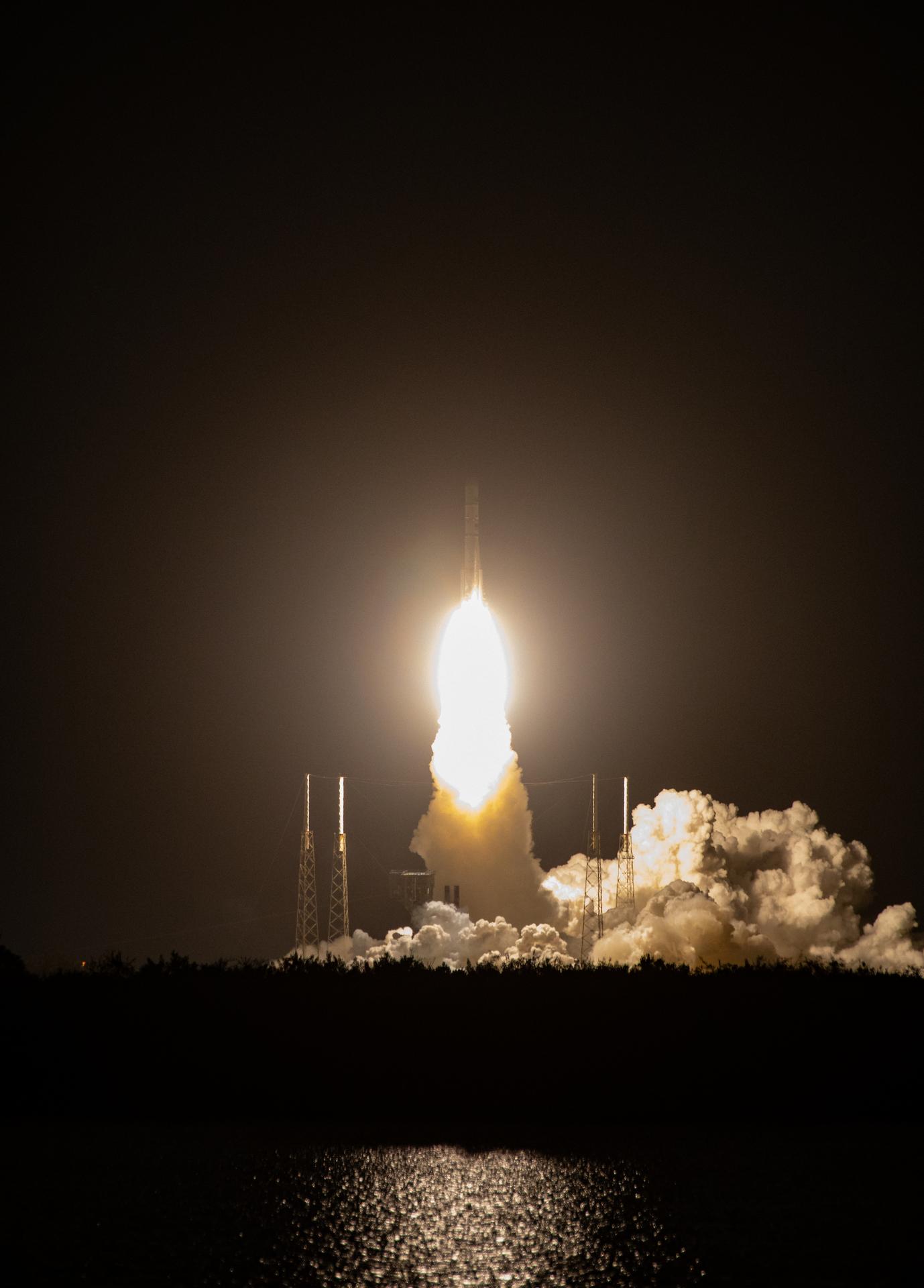
At 8:56 p.m. EDT on August 12, 2026, United Launch Alliance's Vulcan rocket lifted off from Space Launch Complex-41 at Cape Canaveral Space Force Station, closing out a years-long certification process and opening a new chapter for the Pentagon's launch fleet. The mission, designated USSF-106, was Vulcan's first flight under the National Security Space Launch (NSSL) program — the culmination of two mandatory commercial certification flights and roughly $1 billion in Space Force investment in the rocket's development.
The payload riding inside Vulcan's 51-foot fairing, emblazoned with the USSF-106 mission logo, was not a communications satellite or a spy satellite in the traditional sense. It was the Navigation Technology Satellite-3, or NTS-3, an experimental spacecraft built by L3Harris for the Air Force Research Laboratory. Its job: prove out technology that could one day help the U.S. military route around a scenario that has become increasingly plausible in recent conflicts — the jamming or spoofing of GPS signals.
Roughly seven hours after liftoff, Vulcan's Centaur V upper stage released NTS-3 into geosynchronous orbit — a milestone USSF-106 mission director Col. Jim Horne marked by saying "the first Vulcan NSSL mission delivered its payloads safely into space." ULA characterized the flight profile as one of the longest in company history, with the mission extending more than 22,000 miles above Earth before separation.
A Rocket Built for the Heaviest Jobs
USSF-106 flew Vulcan in its most powerful configuration, known as VC4S: a Centaur V upper stage paired with four GEM 63XL solid rocket boosters strapped to the first stage. According to ULA, the combination produced nearly 3 million pounds of liftoff thrust — 13.3 meganewtons — enough to push the 202-foot, 1.7-million-pound fueled vehicle off the pad and onto a trajectory that would ultimately place its payload in geosynchronous orbit, roughly 22,000 miles up.
That configuration matters beyond this single mission. Vulcan was designed to replace both ULA's Atlas V and Delta IV Heavy rockets, consolidating the company's national-security launch business into a single, modular vehicle whose booster count can be scaled to the mission's needs. ULA currently holds about 60% of the missions awarded under NSSL Phase 2, the Space Force's framework for buying launches through the middle of the decade, with Col. Doug Pentecost, Space Systems Command's deputy program executive officer for assured access to space, among those overseeing the program on the government side. Space Systems Command, which manages roughly $15.6 billion in annual space acquisition spending, is betting heavily on Vulcan reaching a steady operational tempo now that its NSSL debut is behind it.
What NTS-3 Actually Does
NTS-3 is not a replacement for GPS. It's an experiment — the first dedicated U.S. navigation-satellite technology demonstration in nearly 50 years, part of the Air Force's "Vanguard" line of prototype programs meant to mature technology quickly rather than field an operational constellation.
The satellite's architecture is built around three pieces working together: the space platform itself, a ground control system, and reprogrammable software paired with agile user receivers. That combination is the point. Traditional GPS satellites fly with fixed hardware and signal formats baked in before launch; if an adversary develops a new jamming or spoofing technique, there's little the satellite can do about it beyond ground-based workarounds. NTS-3 flips that model. Its signals, electronically steerable antenna, and advanced timekeeping systems can be updated in orbit through software changes rather than requiring a hardware swap or a new satellite altogether.
In practice, that means NTS-3 can experiment with new waveforms, adjust its antenna's signal shape to focus power where it's needed — or away from where an adversary is trying to jam it — and test alternative timing and positioning approaches, all without leaving orbit. If a particular signal design proves resistant to a given jamming technique, engineers can push it to the satellite and try it in real conditions rather than waiting years for a new spacecraft.
Unlike GPS's medium Earth orbit constellation, NTS-3 operates from geostationary orbit, a vantage point that allows it to augment GPS coverage and help protect the broader system's signals from interference, rather than replacing any single satellite in the existing fleet.
Why It Matters
GPS underpins far more than car navigation. Precision munitions, aircraft navigation, financial transaction timestamps, and power-grid synchronization all depend on the constellation's positioning, navigation and timing (PNT) signals — and that dependence is exactly why adversaries have invested in jamming and spoofing capabilities that have shown up in recent conflict zones, degrading or faking GPS signals over contested territory. A military that can't trust its own navigation and timing data in a fight is a military that loses precision and coordination at the moment it needs them most.
NTS-3 is the Pentagon's hedge against that vulnerability: a testbed for proving that future PNT satellites don't have to be sitting ducks with fixed, predictable signals. If the reprogrammable approach works, the technology could inform how the next generation of GPS satellites — or a dedicated resilience layer flying alongside them — is designed, giving the U.S. the ability to adapt its navigation infrastructure in orbit as new threats emerge rather than waiting out a decade-long acquisition cycle.
The mission also matters for a more immediate reason: it validates Vulcan itself for national-security use. With ULA holding the majority of NSSL Phase 2 missions and the Space Force having sunk roughly $1 billion into the rocket's development, a clean NSSL debut — successfully carrying a sensitive Air Force Research Laboratory payload through a seven-hour, 22,000-mile journey to geosynchronous orbit — is exactly the kind of proof point the program needed before committing more of its most demanding payloads to the vehicle.
Sources
- U.S. Space Force Space Systems Command, United Launch Alliance successfully launch USSF-106 mission aboard Vulcan rocket
- AFRL leaps forward in NTS-3 spacecraft development
- Air Force navigation satellite to launch on Vulcan's first national security mission
- USSF-106: Vulcan ready for its first U.S. national security launch
