
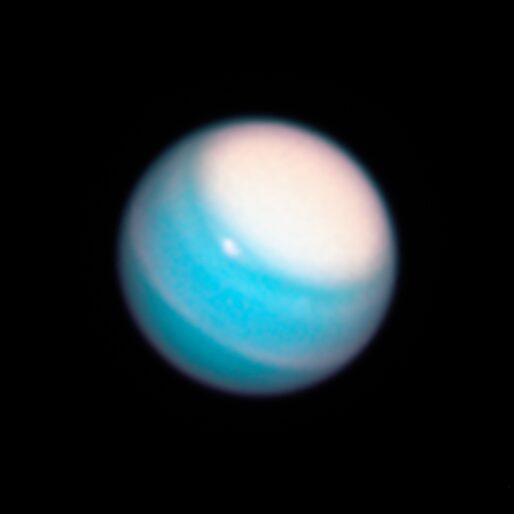
Most planets with a magnetic field share a basic shape. Earth, Jupiter and Saturn each have a field that looks roughly like a bar magnet's: a strong dipole lined up fairly closely with the planet's spin axis. Uranus and Neptune don't fit that pattern. When Voyager 2 flew past the two ice giants, it found fields that were steeply tilted, shifted away from the planets' centers, and tangled in ways that don't look much like a bar magnet.
Planetary scientists have spent decades trying to explain those readings. A new study in Communications Physics, published November 3, puts forward a fairly simple cause: how well the material inside these planets conducts electricity at different depths.
How Far Off the Norm?
The numbers show how unusual these fields are. Earth's magnetic dipole is tilted about 11 degrees from its rotation axis. Uranus's is tilted 59 degrees, and Neptune's 47, according to the University of Texas at Austin's Jackson School of Geosciences, which led the work. Universe Today notes that Uranus's field is tilted almost 60 degrees and is also offset from the planet's center, while Neptune's field is tilted about 47 degrees and is weaker.
Tilt is only part of it. The study looked at how a planet's surface magnetic energy is split between the tidy axial dipole and everything else. At the other planets with active dynamos, the axial dipole holds 74 to 98 percent of that energy. At the ice giants it holds only 12 percent. Most of the field's energy sits in more complicated, non-dipolar, non-axisymmetric parts. In other words, the field is not just a tilted bar magnet. Its structure is fundamentally different.
The Proposed Cause: A Conductivity Gradient
A planetary magnetic field comes from a dynamo: electrically conducting fluid moving inside the planet and generating and sustaining the field. In the ice giants, Universe Today reports, the field is thought to come from layers of ionic or superionic water, ammonia and methane, not from a liquid-iron core like Earth's.
The research team, led by UT Austin with collaborators at UCLA, Imperial College London and Northumbria University, focused on how that conducting layer changes with depth. Lead author Chi Yan explained that extreme pressure inside these planets, which are about four times wider than Earth, may break water molecules into ions. As a result, the material becomes increasingly electrically conductive the deeper you go.
That gradient is the key ingredient. The authors, including Yan, Krista Soderlund and Jonathan Aurnou, ran numerical dynamo models that include a radial conductivity profile, meaning conductivity that varies with distance from the planet's center instead of being uniform throughout the dynamo region. Those models produced fields that match what Voyager 2 saw: non-dipolar, non-axisymmetric, and lacking the strong, well-aligned dipole of the other planets.
The authors conclude that the radial profile of electrical conductivity, which is controlled by interior composition and temperature, is a critical ingredient in producing fields like those of Uranus and Neptune.
A Field That May Not Hold Still
The models also point to something with practical consequences. The non-dipolar dynamos in the study showed substantial changes over time. The rate of change was not steady: it fluctuated and could become temporarily slow, so the field might look stable for a while before shifting again.
This matters because of how little data exists. As Universe Today points out, Voyager 2 measured each planet only once, during a single flyby. Everything known about the ice giants' magnetic fields comes from those two brief passes. If the fields really are as variable as the models suggest, the authors argue that changes since the flybys are plausible. More than three decades have gone by.
It's a sobering idea. The standard picture of Uranus's and Neptune's fields may be closer to an old snapshot than a lasting portrait. Because the models show the rate of change can be temporarily slow, the fields might also look much the same today. With one measurement per planet, there's no way to tell yet.
Why It Matters
This work has two main consequences: how astronomers read observations made now, and how future spacecraft are designed.
The first concerns aurorae. Auroral emissions depend on the shape and orientation of a planet's magnetic field, which guides charged particles into the upper atmosphere. Researchers who study the ice giants' aurorae from afar usually interpret them using the field geometry Voyager 2 measured. If that geometry has drifted, those interpretations could be off. The study flags auroral observations as one area where a field that changes over time would matter.
The second is mission planning. The authors say the potential for change can inform planning for future missions to the Uranian and Neptunian systems. A mission that assumes a fixed Voyager-era field could, in principle, arrive to find something different. That is an inference rather than something the study states, but it is not necessarily bad news: the researchers say future in situ or auroral measurements could confirm whether such variations occur.
There is also a broader point. The authors say that understanding why Uranus and Neptune have such unusual fields provides insight into dynamo processes across planets and stars. A model that links their fields to the conductivity of their interiors gives researchers something concrete to test. Whether that explanation holds up will depend on new data, and the researchers say additional missions back to the ice giants are necessary to understand the planets' interiors.
Sources
- Electrical conductivity structure drives anomalous and potentially time-varying magnetic fields at Uranus and Neptune (Communications Physics)
- Wacky Magnetic Fields of Ice Giants Explained (UT Austin Jackson School of Geosciences)
- The Ice Giants' Magnetic Fields are Very Strange Compared to Earth's (Universe Today)
