
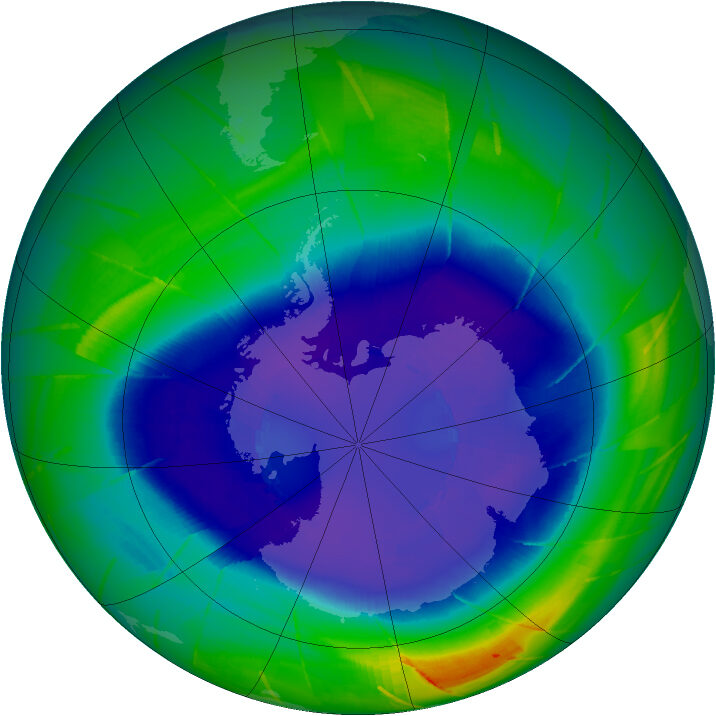
This year's ozone hole over Antarctica was big. On September 18, 2026, the region of severe ozone depletion over the South Pole reached 10.5 million square miles (27.1 million square kilometers), according to NASA and NOAA. Scientists called it the largest hole in a decade, and by its mean size over the peak season it ranked seventh largest in 48 years of monitoring.
Taken alone, that number could look like a reversal. The researchers who track the hole say it isn't one. The 2026 hole was wide but comparatively shallow. Its size came mostly from the weather in the stratosphere, not from a resurgence of the chemicals that cause the damage. The long-term recovery is still on schedule.
The Numbers
NASA and NOAA measure the hole's season using a fixed window. From September 7 to October 13, the 2026 hole averaged about 9.6 million square miles (25 million square kilometers). The single-day peak on September 18 was about 90 percent of the size of the record, set in September 2000, ABC7 reported.
The jump from last year is striking. In 2025 the hole ranked fifth smallest since 1992. In one season it went from one of the smallest in three decades to one of the largest on record.
Depth tells a different story than area. NOAA launches ozone-measuring balloons from the South Pole Baseline Atmospheric Observatory, and the lowest reading this season was 105 Dobson units on October 17. The South Pole balloon record low is 92 Dobson units, measured in October 2006. The NASA Earth Observatory notes that the deepest hole ever recorded hit 73 Dobson units on September 30, 1994. By those measures, 2026 was large but not especially severe. NASA says it was "not as deep as other large holes."
What "Hole" Actually Means
It helps to be precise about the term. The ozone hole is not a literal gap in the atmosphere, as FOX Local pointed out. Scientists define it as the area where total column ozone falls below 220 Dobson units, a threshold well below historical norms for the region. "Size" means the area of the region under that line. "Depth" means how far below the line the thinnest part falls.
This year's measurements came from the Ozone Mapping and Profiler Suite (OMPS) on NOAA-20. Earlier parts of the record come from a series of instruments: TOMS, then OMI, then the OMPS on Suomi NPP. Stitching these together gives the multi-decade record that makes the "seventh largest" ranking possible.
Blame the Vortex
Ozone depletion over Antarctica depends on two things: the chemistry of chlorine and bromine compounds, and the very cold, isolated air inside the polar vortex. The vortex is a band of strong winds that circles the continent in the southern winter and spring. It traps frigid air where polar stratospheric clouds form, and those clouds provide the surfaces on which ozone-destroying reactions speed up.
In 2026 the vortex was unusually large and powerful. Amy Butler of NOAA's Chemical Sciences Laboratory traced the cause to weak planetary-scale wave activity in August and September. These large atmospheric waves normally carry heat and momentum toward the pole and disturb the vortex. When they are weak, the vortex stays cold and intact and has room to grow. This year it did.
Paul Newman, a scientist with the University of Maryland, Baltimore County and NASA Goddard, framed it this way. The hole has been forming later in the season in recent years, which he called a sign of healing. A strong vortex, though, can stretch the depletion season and enlarge the affected area even as the chemical load drops. Newman added that if the stratosphere still held year-2000 levels of ozone-depleting substances, this year's hole could have been 1 to 2 million square miles larger.
That counterfactual is the main point of this year's data. The 2026 weather was favorable for a very large hole, and the result was still smaller than it could have been with year-2000 levels of ozone-depleting substances.
Why It Matters
The ozone layer absorbs much of the Sun's harmful ultraviolet radiation, and the Antarctic hole is the clearest annual check on how it is doing. It is also the main real-world test of whether international environmental agreements can work.
The Montreal Protocol, adopted in 1987, phased out chlorofluorocarbons and related compounds. According to the NASA Earth Observatory, about 80 percent of the chlorine in the stratosphere comes from human sources. That is why the treaty could have such a large effect on the problem. These chemicals persist in the atmosphere for decades, so recovery is slow. Current projections have Antarctic ozone returning to 1980 levels in the 2070s.
Years like 2026 show why one season's ranking is a weak indicator. Year-to-year variability in stratospheric dynamics, such as wave activity and vortex strength, can swamp the gradual chemical improvement from one year to the next. A small hole in 2025 did not mean the problem was solved, and a large one in 2026 does not mean it is getting worse. The trend in the underlying chemistry is what matters, and the scientists tracking it say that trend still points toward recovery.
The 2026 season also makes clear what is at stake in continued monitoring. Telling a weather-driven big year apart from a chemistry-driven one depends on overlapping evidence: satellite mapping of area, balloon profiles of depth, and atmospheric measurements of the chlorine load. Without the decades-long record built from TOMS through OMPS, a headline like "largest in a decade" would be much harder to put in context.
The Bottom Line
The 2026 Antarctic ozone hole was the largest in a decade and ranked seventh largest in 48 years of monitoring. An unusually stubborn polar vortex, held in place by weak atmospheric waves, drove its size. It was not especially deep, it formed later than holes did in earlier decades, and by NASA's estimate it was 1 to 2 million square miles smaller than it could have been if ozone-depleting substances were as prevalent as in 2000. The patient is still recovering. This was just a bad-weather year.
Sources
- NASA, NOAA Track 2026 Antarctic Ozone Hole (NASA, Nov. 4, 2026)
- Ozone Hole Reaches Its 2026 Maximum (NASA Earth Observatory, Nov. 9, 2026)
- Ozone hole in 2026 is largest in a decade, but long-term recovery remains on track: Report (ABC7, Nov. 4, 2026)
- The hole in our ozone layer got larger in 2026; biggest in a decade (FOX Local, Nov. 5, 2026)
