
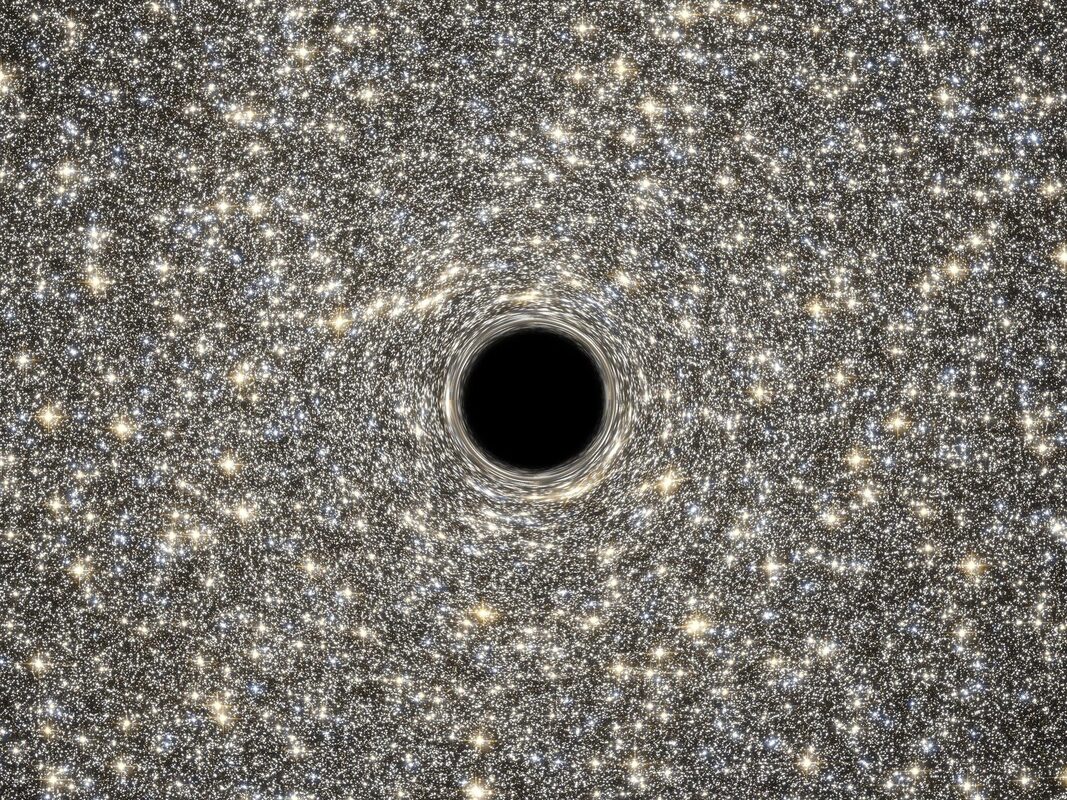
Astronomers have spent decades building a tidy rule of thumb: the bigger the galaxy, the bigger the black hole sitting at its center. Stellar mass and black hole mass track each other closely enough across the universe that the relationship is practically a law of galaxy formation. A new study, posted to arXiv on September 18, 2026, has found a galaxy that appears to break it — and not by having a black hole that's too big, but possibly by not having one where it should be at all.
The paper, titled "The JWST Ultramassive Galaxy Sample -- II. Supermassive Black Hole Masses for 8 Extreme Early-Type Galaxies via Jeans Anisotropic Modelling of High-Resolution Integral-Field NIRSpec Stellar Kinematics," comes from Michele Cappellari, Dieu D. Nguyen, and Susan A. Kassin, and has been submitted to Monthly Notices of the Royal Astronomical Society. It's the second installment in a survey targeting some of the most extreme galaxies known: eight nearby early-type galaxies each with a stellar mass exceeding two trillion Suns.
Weighing a black hole without seeing it
You can't put a supermassive black hole on a scale. Instead, astronomers infer its mass by watching how it warps the motion of stars near a galaxy's center. A black hole's gravity should whip nearby stars into faster, more chaotic orbits, producing a sharp uptick in stellar velocity dispersion — essentially a measure of how much the speeds of stars vary — right at the galactic core. Map that dispersion carefully enough, and a technique called Jeans Anisotropic Modelling can convert the pattern into a black hole mass estimate.
The trouble is that this only works if the data resolves the very center of the galaxy in fine detail, which for anything beyond our immediate cosmic neighborhood has usually been out of reach. That's where JWST's NIRSpec instrument comes in. Working in integral-field mode, NIRSpec captures a full spectrum at every point across a galaxy's core simultaneously, letting the team build detailed stellar-kinematics maps of galaxies whose central regions would have been an unresolved blur for earlier telescopes.
Applying that method to all eight ultramassive galaxies in the sample, the team confirmed what the mass-tracks-mass relationship would predict for most of them: big galaxy, big black hole. But one galaxy didn't play along. Instead of the expected spike in velocity dispersion at its center, the data showed a dip — stars near the core were moving in a calmer, more orderly way than stars farther out, the opposite of what a dominant central black hole should produce.
A black hole that got kicked out?
A velocity-dispersion dip is a strange enough signature that the authors reach for a genuinely violent explanation: the galaxy's central black hole might not be there anymore. The paper points to two mechanisms capable of physically ejecting a supermassive black hole from a galaxy's core. One is a three-body interaction, in which three black holes end up in the same nucleus after successive galaxy mergers, and the resulting gravitational slingshot flings the least massive one out at high speed. The other is a gravitational-recoil kick, a relativistic effect in which the asymmetric burst of gravitational waves released when two black holes finally merge imparts a recoil to the newly merged object — potentially strong enough, the paper notes, to leave the black hole displaced and wandering outside the compact region NIRSpec could observe.
Either scenario fits the broader picture painted by the study's title finding: not all ultramassive galaxies host ultramassive black holes. Given that these eight galaxies are among the most massive early-type galaxies in the nearby universe, and early-type galaxies typically get that way through repeated mergers, an ejected or displaced black hole is a plausible consequence of an especially chaotic merger history rather than an isolated fluke.
Why It Matters
The tight correlation between galaxy mass and black hole mass has been one of the load-bearing pillars of galaxy-formation theory, used to argue that galaxies and their central black holes grow together, each regulating the other through feedback. A confirmed exception — a massive galaxy with a missing or badly undermassive black hole — doesn't demolish that picture, but it does mean the relationship has exceptions violent enough to physically remove the black hole from the equation. That matters for anyone modeling how galaxies assemble, because it suggests galaxy mergers can be disruptive enough to sever the coupling between a galaxy and its black hole rather than simply combining the two.
It's also a demonstration of what JWST's spectroscopic instruments make newly possible. Resolving stellar motion at the sub-arcsecond precision needed to catch a central dip, rather than just a poorly sampled average, was not realistic for ground-based surveys of galaxies this distant. As more of the ultramassive sample and others like it get the same NIRSpec treatment, astronomers should get a much better empirical sense of how common — or rare — a "missing" black hole really is, and what that says about the mergers that built the universe's biggest galaxies.
Who did the work
The study's lead author, Michele Cappellari, is Professor of Astrophysics at the University of Oxford's Department of Physics, where he is part of the Galaxy Formation and Evolution research group; his work centers on galaxy evolution and supermassive black holes, making the ultramassive galaxy survey a direct extension of his research focus. Co-author Susan Kassin is an Associate Astronomer at the Space Telescope Science Institute and a JWST NIRSpec instrument scientist who leads the working group developing post-pipeline spectroscopy data-analysis tools — the software backbone for turning NIRSpec's raw integral-field data into the stellar-kinematics maps the black hole mass measurements depend on.
