
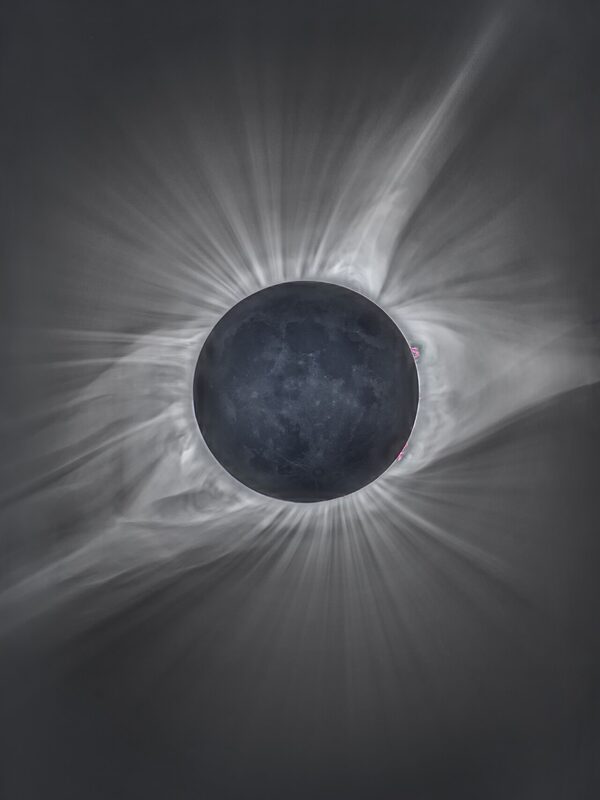
Total solar eclipses are not rare so much as rarely convenient. The Moon's shadow touches Earth every couple of years, but it usually does so over ocean or remote land. On August 12, 2026, the geometry cooperates with geography in a way Europe has not enjoyed in a generation: the path of totality will sweep across Greenland, Iceland, a sliver of northern Russia, the North Atlantic, and northern Spain, with a final touch on the very northwestern tip of Portugal. It will be the first total solar eclipse to cross mainland Europe since August 1999.
An unusual path
This eclipse traces a strange route. Most eclipse tracks run broadly west to east as the Moon's shadow chases the spin of the Earth. The 2026 path, by contrast, begins by running east to west across the high Arctic — from Russia toward Greenland, just missing the North Pole — before bending south toward Iceland and Spain. The timing shifts with location: a remote stretch of northern Russia sees totality around midday; Greenland and Iceland go dark in the late afternoon or early evening; and by the time the shadow reaches Spain, the eclipse arrives in the late evening, shortly before sunset, with the blackened Sun hanging low over the horizon.
Totality will be brief. At its maximum the total phase lasts about two minutes and eighteen seconds — long enough to be unforgettable, short enough that anyone in the path will want to be ready before it begins. The longest duration over land falls in Iceland, near the dramatic sea cliffs of Látrabjarg on the country's western edge.
Two headline destinations
For eclipse chasers, two regions stand out. Iceland will see its first total solar eclipse since June 1954, and the prospect of the Moon's shadow falling over the island's volcanic landscapes has already begun drawing plans. Northern Spain offers the other marquee experience, with the path of totality crossing from the Atlantic coast to the Mediterranean and over the Balearic Islands — and the added drama of a low, near-sunset Sun, which can make for spectacular photographs of a black Sun sitting just above the landscape.
Both destinations come with the eternal eclipse gamble: weather. A total eclipse clouded out is a total eclipse missed, and August skies over Iceland and the Atlantic coast are far from guaranteed. Seasoned chasers will be watching forecasts and ready to move.
Who else gets a show
Even outside the narrow path of totality, a much larger swath of the Northern Hemisphere will catch a partial eclipse, with the Sun appearing to take a bite out of itself. That partial view will reach across much of Europe, parts of northern Africa, most of Canada, and a broad stretch of the northern United States, from Alaska down to North Carolina. A partial eclipse is a genuine spectacle in its own right — but it requires proper eye protection throughout, since the Sun is never fully covered.
For the truly dedicated, this eclipse is also the opening act of a remarkable back-to-back. Almost exactly a year later, on August 2, 2027, another total eclipse will cross North Africa and the Middle East — passing over Luxor in Egypt with more than six minutes of totality, among the longest eclipses of the century. Eclipse chasers are already plotting both, and the 2026 event over Iceland and Spain is where many will start. Two consecutive summers, two very different shadows: one a brief, low-Sun spectacle at the edge of Europe, the other a long midday darkness over the desert.
That distinction is the one rule worth repeating. During the brief minutes of totality inside the path, and only then, it is safe to look at the eclipsed Sun with the naked eye. At every other moment, and everywhere in the partial zones, certified eclipse glasses or safe solar filters are essential. With more than a year to plan, August 12, 2026 is already a date circled on a lot of calendars — and a rare chance for Europe to stand, for two minutes, in the shadow of the Moon.
