
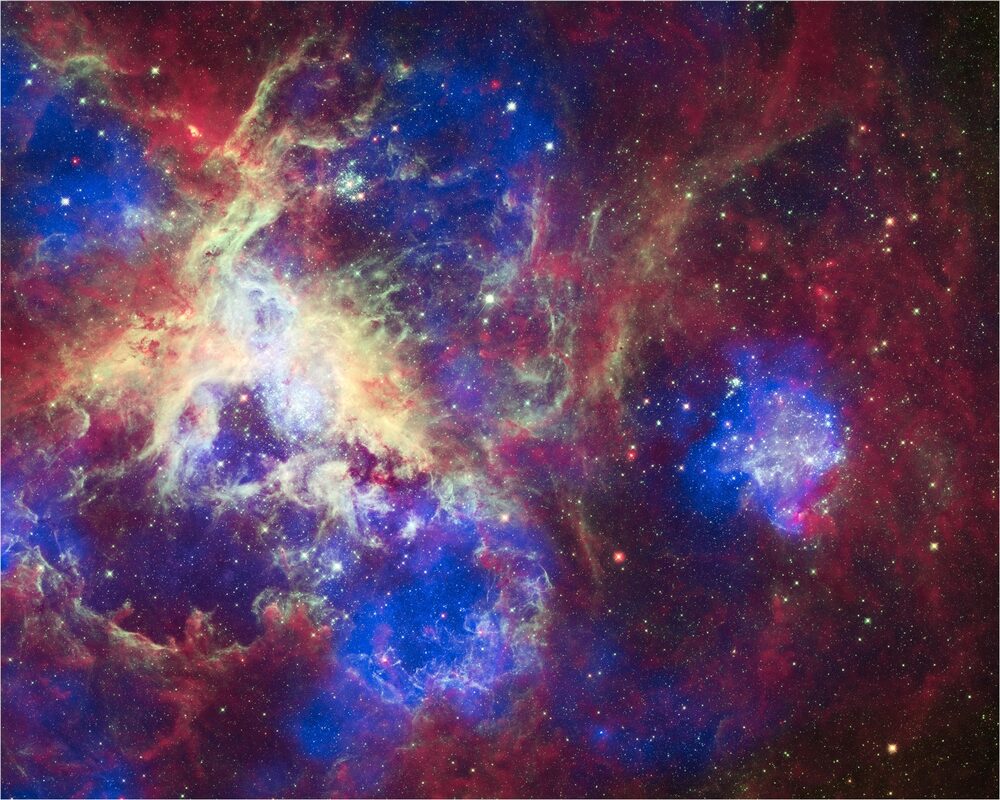
NASA released a new composite image on August 11, 2026, of the Tarantula Nebula, and the agency's own description of it is unusually apt: it looks like sheets of colored cellophane stacked on top of each other. That layered effect isn't a stylistic choice — it's the direct result of combining data from three space telescopes that each see a completely different physical process happening in the same patch of sky.
The target is 30 Doradus, better known as the Tarantula Nebula, a sprawling star-forming region roughly 160,000 light-years away in the Large Magellanic Cloud, one of the Milky Way's satellite galaxies. It's long been one of astronomers' favorite nearby laboratories for watching massive stars form, live fast, and die violently, precisely because it's close enough to resolve in detail and active enough to study in every wavelength that matters.
In the new image, Chandra's X-ray data appears in blue, tracing gas that young, massive stars have shock-heated to millions of degrees through their powerful stellar winds. Webb's infrared data shows up in red, revealing thousands of young stars along with swaths of cooler dust that will one day provide the raw material for new stars and planets. Hubble's optical data fills in green, capturing the glowing gas and the stars themselves. The result is a honeycomb-like structure of gas and dust, described by the Chandra X-ray Center, that hosts thousands of embedded young stars — the kind of visual complexity that only comes from stacking fundamentally different kinds of light on top of each other.
The Mystery the Composite Helped Crack
The image alone would have been a solid release on its own, but it arrived alongside a paper in the Astrophysical Journal, led by Jennifer Rodriguez of Ohio State University, that used the multi-wavelength data to resolve a long-standing puzzle: the Tarantula Nebula simply doesn't have as much X-ray-emitting hot gas as star-formation models say it should.
That's a real problem for astrophysicists, because the diffuse X-ray glow from shock-heated gas is supposed to be a fairly direct tracer of how much energy young, massive stars are pumping into their surroundings. If a region's stars are pumping out that kind of energy but the X-ray signature isn't showing up at the expected strength, something is draining it away before it can be observed — or the models are missing a mechanism entirely.
Rodriguez's team, with co-authors from Columbia University, San Diego State University, the Space Telescope Science Institute, NASA Goddard Space Flight Center and Ohio State, identified three separate ways the nebula's hot gas loses energy before it can generate the expected X-ray glow:
- Leakage through the shell walls. The Tarantula Nebula's structure isn't a sealed bubble — it's built from cavities and shells carved out by stellar winds and supernovae, and those walls aren't airtight. According to the Chandra X-ray Center, up to half of the nebula's hot gas is escaping through gaps in those shell walls rather than staying contained and radiating X-rays where telescopes can see it.
- Mixing between hot and cold gas. Where scorching, shock-heated gas comes into contact with the nebula's much cooler surrounding material, the two mix and the hot gas cools down, dropping out of the X-ray-emitting temperature range.
- Thermal conduction at gas boundaries. At the interfaces between hot and cold gas, heat simply conducts away from the hot component into the cold one, again pulling energy out of the population of gas that would otherwise be glowing in X-rays.
Individually, none of these mechanisms is a new idea in astrophysics — but pinning down how much each one contributes required exactly the kind of layered, multi-wavelength dataset the new composite represents. The team also drew on archival data from NASA's retired Spitzer Space Telescope for comparison, extending the analysis back to infrared observations made before Webb existed.
Why It Matters
Massive stars are the universe's power plants and demolition crews rolled into one: their winds and eventual supernovae inject enormous amounts of energy and momentum into the gas around them, shaping how future generations of stars form and how galaxies evolve over time. Models of that feedback process lean heavily on X-ray observations of regions like 30 Doradus as a calibration point — essentially, a way to check whether theoretical predictions of stellar energy output match what's actually observed in a real star-forming environment.
If those models had been substantially overestimating how much X-ray glow massive-star feedback should produce, that would have meant a fundamental gap in how astronomers account for energy loss in these systems, with knock-on effects for everything from simulations of galaxy formation to estimates of how efficiently star clusters disperse the gas around them. By identifying and quantifying the specific loss mechanisms — leakage, mixing, and conduction — Rodriguez's team gives modelers a way to close that gap rather than just flagging that it exists. It's also a demonstration of why observatories built for entirely different wavelengths are more powerful used together than separately: no single telescope in this study could have identified all three mechanisms on its own.
