
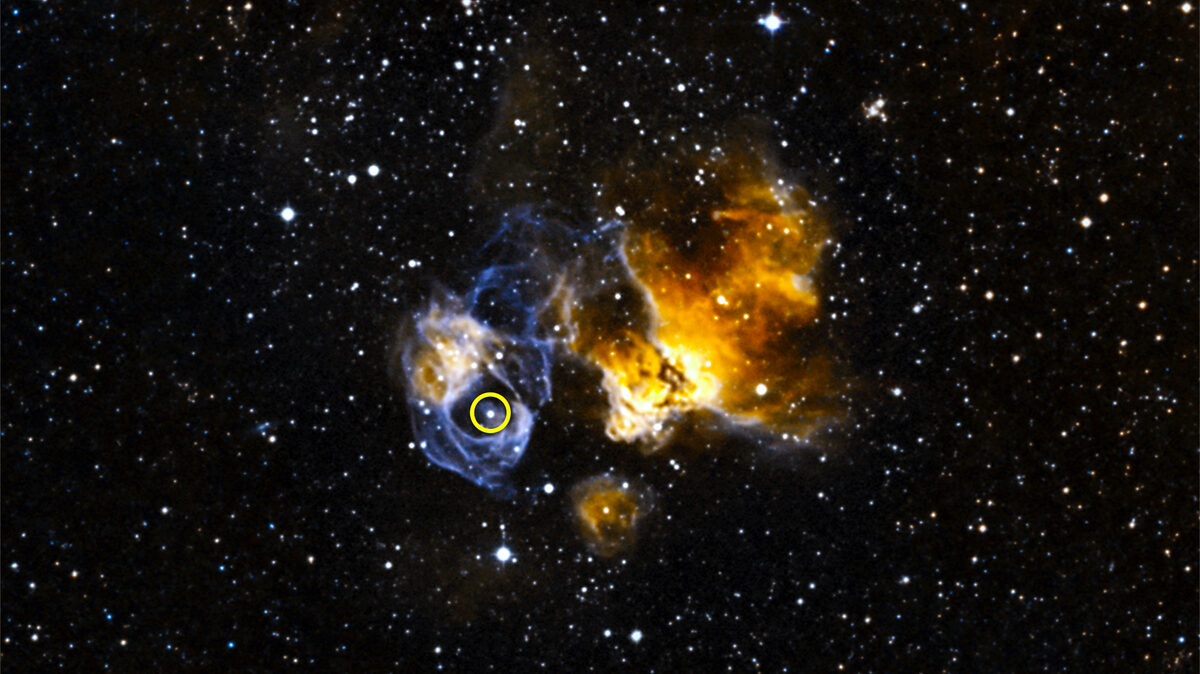
For more than a decade, a star in the galaxy NGC 4559 has been throwing a very strange, very regular tantrum. Roughly every 113 days, it flares up, dims back down, and waits — like clockwork — to do it again. Astronomers call this class of object a "supernova impostor": something bright enough and violent enough to look like a star ripping itself apart, except the star survives. AT 2016blu has now erupted at least 27 times since 2012 without ever actually exploding.
The mystery was never really whether the star would blow up. It was why something that isn't dying keeps having near-death experiences on a schedule precise enough to set a calendar by. A team led by Mojgan Aghakhanloo, a VITA-Origins Fellow at the University of Virginia, thinks it has the answer: AT 2016blu isn't one star acting erratically. It's two stars, one of them invisible, and the invisible one is stealing from the visible one.
A Star You Can Set a Watch By
AT 2016blu sits in NGC 4559, a galaxy about 29 million light-years from Earth. The luminous blue variable at the center of the drama is a beast in its own right — a star with a mass of at least 33 times the Sun's, the kind of object that lives fast, sheds huge amounts of material, and is generally expected to end its life as a supernova sometime in the astronomically near future.
What makes AT 2016blu unusual isn't just that it flares. It's that the flares are quasiperiodic, repeating on a roughly 113-day cycle. That kind of regularity doesn't come free in nature — it's the signature of an orbit. According to the new study, published in The Astrophysical Journal and posted to arXiv on August 20, 2026, the pattern is best explained by an eccentric binary: two objects orbiting each other on a stretched-out ellipse, with the outbursts triggered each time they swing close together at periastron, the point of closest approach.
The luminous blue variable is one half of that pair. The other half, until now, was invisible.
Catching the Thief in the Act
Because the outburst cycle had already repeated 26 times by early 2026, Aghakhanloo's team could do something rare in transient astronomy: predict the future. "We knew when the next outburst should be," Aghakhanloo said, describing the moment that let the team schedule a targeted observation rather than waiting to get lucky.
They requested a Chandra X-ray Observatory Target-of-Opportunity campaign timed to catch the 27th outburst, which arrived in March 2026 as forecast. That single, deliberately-timed observation did what years of visible-light monitoring couldn't: it caught the star in X-rays for the first time ever.
The measurement was unambiguous. Chandra recorded an X-ray luminosity of log L_X ≈ 38.64 ± 0.11 erg/s — a level that visible starlight alone cannot produce. Ordinary stellar winds and eruptions from a massive star, however violent, don't glow that brightly in X-rays. What does is matter falling onto something extremely dense and compact — a neutron star or a stellar-mass black hole — releasing gravitational energy as it's dragged in. The team calculated an accretion rate of at least 8×10⁻⁸ solar masses per year, consistent with exactly that kind of infall.
What Was Actually Happening All Along
Put together, the picture reframes everything about AT 2016blu. The "impostor" outbursts were never the luminous blue variable acting alone. They were the visible signature of a hidden compact object swinging close to its companion at periastron and accreting material shed by the star, converting captured gas into a burst of X-ray and visible-light emission each time the orbit brings the two close together.
That makes AT 2016blu the first known luminous blue variable impostor whose outbursts are driven by accretion onto a compact companion, and it places the system in the category of high-mass X-ray binaries — pairings of a massive, luminous star with a neutron star or black hole, more commonly known from steadier, less theatrical X-ray sources than a supposed supernova impostor.
It also means the "impostor" label, while accurate in the narrow sense that no supernova occurred, was hiding a far stranger story: not a star crying wolf, but a star being fed on.
Why It Matters
Luminous blue variables are usually treated as a brief, unstable phase a very massive star passes through on its way to a supernova — a place to study what a dying giant looks like just before the end. AT 2016blu shows that at least one of them is also living inside a binary with a compact companion already formed, meaning a black hole or neutron star can coexist with, and actively feed on, a star that hasn't even exploded yet. That has implications for how astronomers interpret other "impostor" events: some fraction of them may not be failed supernovae or misclassified eruptions at all, but binaries in disguise, and periodic accretion — rather than instability in the star itself — may be the real trigger.
The predict-then-observe method used here is also a template. Rather than waiting for a transient to be caught by chance, the team used years of archival photometry to forecast a specific future event and pointed a major space telescope at exactly the right moment. As Aghakhanloo put it, the payoff is a front-row seat: "It's like having a front row seat to seeing what the star is doing before it dies." With a massive, unstable star and a compact companion locked in a 113-day dance, AT 2016blu now offers a rare, repeatable laboratory for watching high-mass binary evolution — and the run-up to a real supernova — in something close to real time.
