
The Big Bang produced hydrogen, helium, and traces of lithium. Everything else — the carbon in organic molecules, the oxygen you breathe, the calcium in bone, the iron in blood, the gold in jewelry — was made later, inside stars and in the catastrophic events that end them. The process is called nucleosynthesis, and it operates through several distinct mechanisms that generate different sets of elements in different stellar environments.
The simplest nucleosynthesis occurs in main-sequence stars burning hydrogen into helium. In the Sun and similar stars, the proton-proton chain converts four hydrogen nuclei into one helium nucleus, releasing energy as the mass difference converts to radiation. In more massive stars, the CNO cycle (carbon-nitrogen-oxygen) does the same job more efficiently at higher temperatures, using carbon as a catalyst. This is where all the helium in the universe — except the primordial fraction — was made, and it is the steady-state energy source of every star on the main sequence.
Carbon through iron: the stellar interior chain
When hydrogen runs out in a star's core, the core contracts, heats, and ignites helium fusion — the triple-alpha process, in which three helium nuclei fuse into carbon-12. This process, proposed by Fred Hoyle in 1954 to explain how enough carbon could be produced in stars, depends on an excited nuclear state of carbon at precisely the right energy to make the reaction efficient. The existence of this resonance — predicted by Hoyle before it was measured — is one of the most dramatic examples of theoretical physics anticipating experiment. Carbon and oxygen produced in helium-burning can subsequently fuse in still-hotter cores to produce neon, sodium, magnesium, silicon, sulfur, and ultimately iron and nickel, which represent the endpoint of exothermic fusion: iron-56 has the highest binding energy per nucleon, and fusing it releases no energy. When a massive star's core is iron, it has reached the end of its nuclear fuel supply, and it collapses.
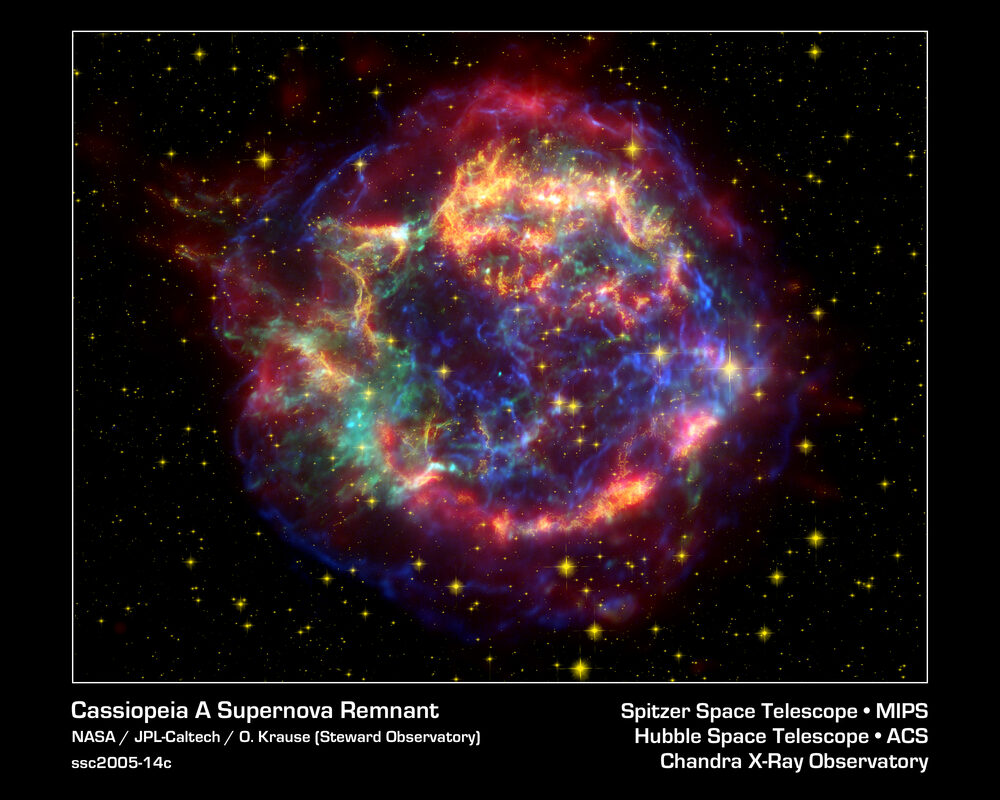
Core-collapse supernovae produce both energy and neutrons in extraordinary quantities. The neutron flux during the collapse and the subsequent explosion drives the r-process — rapid neutron capture — in which atomic nuclei absorb neutrons faster than they can decay. The r-process produces the neutron-rich isotopes that decay to become the heavy elements: barium, europium, gold, platinum, uranium. The neutron star merger mechanism confirmed by GW170817 also drives the r-process; both sites contribute to the cosmic abundance of heavy elements, with mergers likely dominant for the heaviest isotopes.
The s-process and AGB stars
A slower neutron-capture process, the s-process, occurs in the outer shells of asymptotic giant branch stars — evolved low- and intermediate-mass stars in the late stages of their lives. The s-process produces a different set of elements: strontium, barium, lead, and bismuth at the heavy end. The neutron flux in AGB stars is low enough that unstable isotopes can decay before capturing another neutron, so the s-process path follows the valley of nuclear stability rather than detouring through highly neutron-rich nuclei as the r-process does. The distinction between s-process and r-process abundances in stellar spectra allows astronomers to identify which nucleosynthetic environment dominated a given star's chemical history.
The implication of all this is one that Carl Sagan made famous but that holds up under quantitative scrutiny: the atoms in your body were made in stars. The carbon atoms — many of them — were produced in AGB stars and supernovae billions of years ago, scattered into the interstellar medium, condensed into a molecular cloud, incorporated into the solar nebula, accreted into the Earth, and eventually assembled into organic molecules. The oxygen was produced in massive stars and distributed by stellar winds and supernovae. The iron in hemoglobin was synthesized in stars several generations older than the Sun and recycled through at least one supernova explosion before it became part of Earth's crust. The heavens are not metaphorically above us. In a quite literal chemical sense, we came from there.
