
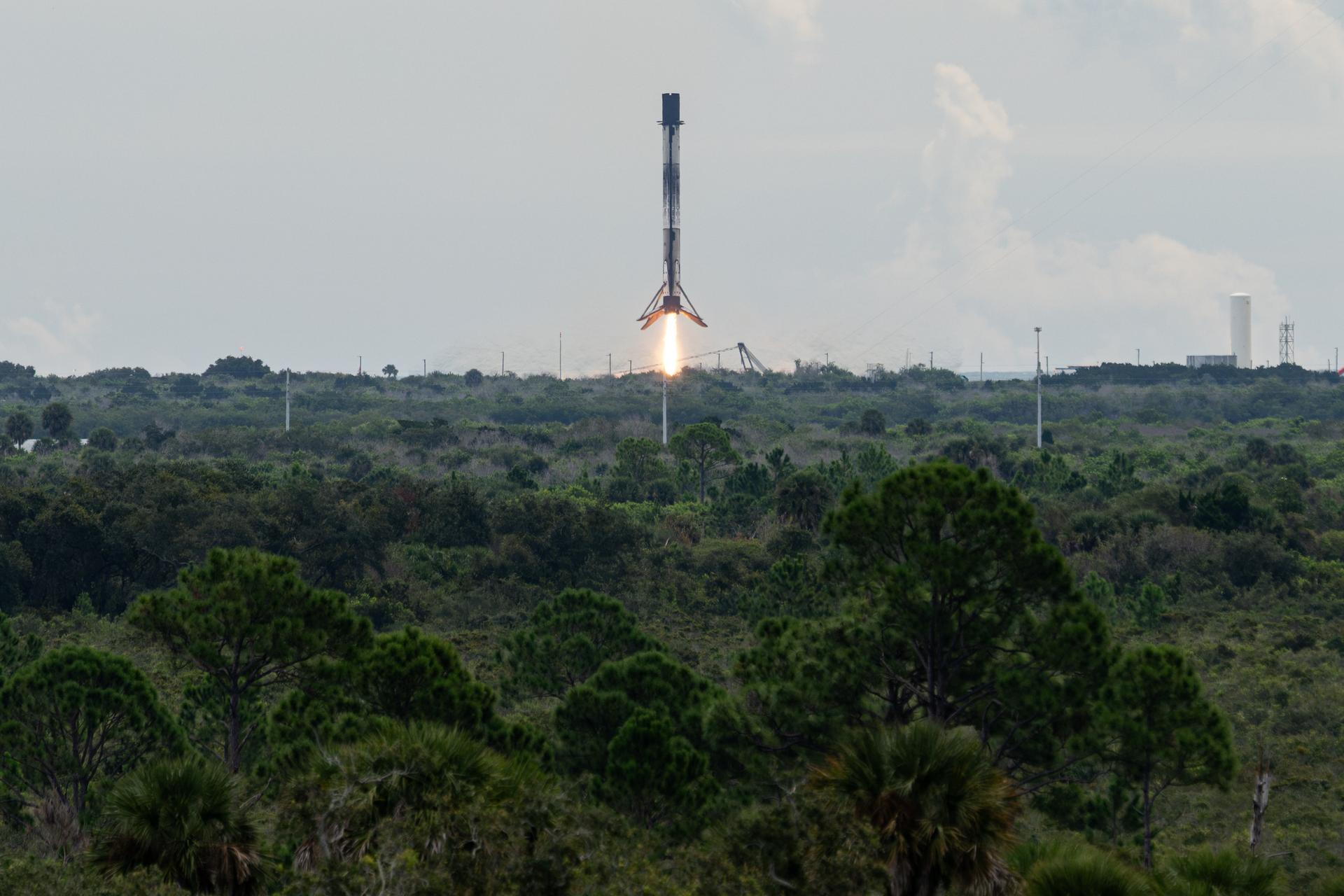
At 8:08 a.m. PST on Nov. 24 (1608 UTC), a Falcon 9 lifted off from Space Launch Complex 4E at Vandenberg Space Force Base in California carrying a payload the U.S. Space Force has chosen not to describe. The mission is called USSF-266. The government has not said what it carried, how many satellites were aboard or where they went.
What is public is the pattern around it. According to Spaceflight Now, USSF-266 was the fifth government mission SpaceX launched in November: four for the Space Force and one for the National Reconnaissance Office (NRO). It was also the third flight in what observers call the "TH" series, and it came a few months after the Space Force handed SpaceX a $1.6 billion order to launch a portfolio it calls Space Based Sensing and Targeting.
A November full of undisclosed payloads
The month's national-security schedule had little room to spare. Space.com lists the Space Force missions before USSF-266 as USSF-432 on Nov. 6, USSF-627 on Nov. 11 and USSF-317. That makes USSF-266 SpaceX's fourth Space Force mission of the month. Add the NRO launch and you get Spaceflight Now's total of five government missions.
The NRO flight, NROL-136, lifted off two days before USSF-266, from the same pad. It flew early on Sunday, Nov. 22, at 4:23 a.m. PST (1223 UTC). Spaceflight Now reported that it would add an undisclosed number of satellites to the NRO's proliferated architecture, the agency's effort to field large numbers of smaller reconnaissance satellites. It was billed as the fourth such launch this year and the 15th overall. The booster, B1097, was set for its 14th flight and a landing back at Vandenberg's Landing Zone 4, which Spaceflight Now's preview counted as the 38th landing at LZ-4 and the 680th Falcon booster landing to date.
USSF-266 claimed landing number 681. Its first stage, B1081, was on its 29th flight. Earlier in its career the booster launched NASA's Crew-7 astronauts, the PACE Earth-observation satellite and the TRACERS heliophysics mission. This time it touched down on the droneship Of Course I Still Love You about 8.5 minutes after liftoff, according to Space.com. Spaceflight Now counts it as the 236th landing on that vessel.
Workhorse boosters that once flew astronauts and NASA science missions now carry classified Space Force payloads without much comment.
What "TH" might mean, and what it doesn't tell us
USSF-266 is the third mission in a series observers have labeled "TH." The first was USSF-259, or TH-1, on Sept. 16. The second was USSF-481, or TH-2, on Oct. 15. Spaceflight Now reports that 17 objects were added to the public satellite tracking catalogue after each of those flights. That is about as close as outside observers can get to counting what went up.
The launches have been roughly four to six weeks apart, and the catalogue counts after the first two matched. That is consistent with a production line rather than one-off spacecraft, though it is an inference. The Space Force has not said what the satellites do. Spaceflight Now says the TH missions are thought to be part of the Space Based Sensing and Targeting task order, but that connection has not been officially confirmed.
Space.com notes speculation that the payloads could be Starshield satellites, the national-security version of SpaceX's satellite platform. SpaceX has not confirmed that for USSF-266. Until someone with authority says otherwise, "classified payload" is the accurate description.
The $1.6 billion order behind the cadence
The contract that likely explains much of this activity is public, even though the payloads are not. In a press release from Space Systems Command (SSC), the Space Force announced two task orders to SpaceX under National Security Space Launch (NSSL) Phase 3 Lane 1. Together they are worth $1.6 billion and cover 18 Falcon 9 launches for the Space Based Sensing and Targeting (SBST) portfolio. All 18 are to launch from Vandenberg, and the work is expected to be finished by the end of 2027.
SSC described the mission area only in broad terms. "Sensing and targeting of airborne objects from space and providing near-real-time communications across the Joint Force, are vital to the defense of our nation," said Col. Eric Zarybnisky, acting portfolio acquisition executive for Space Access.
The speed of the deal was also unusual. Zarybnisky cited an "unprecedented two-month acquisition timeline" from requirement to award, including a one-month window for proposals. For a military space procurement system known for timelines measured in years, that is a notable claim. Spaceflight Now describes Lane 1 of NSSL Phase 3 as designed to let a wide range of launch providers bid on task orders for payloads that can accept higher risk.
The math is simple, though it rests on an unconfirmed link. If the TH missions belong to the SBST order, three of the 18 launches are done and 15 remain, with roughly 13 months left before the end-2027 target. That works out to slightly more than one launch a month, about the pace the series has kept since September.
Why It Matters
Taken one at a time, each of these launches is nearly invisible: a pad, a time, a booster number and a payload nobody will discuss. Taken together, they show how quickly the U.S. military is moving to large constellations in low Earth orbit and how much of that work now rides on one commercial launch provider.
The SBST release describes capabilities for sensing and targeting airborne objects from space and relaying data across the Joint Force in near real time. Those are operational, warfighting functions, not experimental programs. The NRO's proliferated architecture, which reached its 15th launch with NROL-136, follows a similar approach in reconnaissance: many satellites instead of a few large ones. Both depend on launching often, landing boosters and flying them again, which Vandenberg did twice in two days this week, on Nov. 22 and Nov. 24.
The approach also has costs in transparency. The public's best information about what the United States is putting in orbit for these programs comes from objects showing up in tracking catalogues after launch, such as the 17 that appeared after each of the first two TH flights. The contract value, the launch count and the deadline are public. What the satellites do is not, and that is unlikely to change soon.
If the TH attribution holds, most of the 15 remaining SBST launches would fall in 2027 or late 2026, so the pace of classified launches out of Vandenberg is likely to continue well into 2027.
Sources
- Space Force awards task orders to launch Space Based Sensing and Targeting capabilities (Space Systems Command, via mirror)
- SpaceX launches classified payload for the U.S. Space Force (Spaceflight Now, via mirror)
- SpaceX launches secretive spy satellites from California for US Space Force (Space.com)
- SpaceX launches intelligence-gathering satellites for the National Reconnaissance Office (Spaceflight Now, via mirror)
