
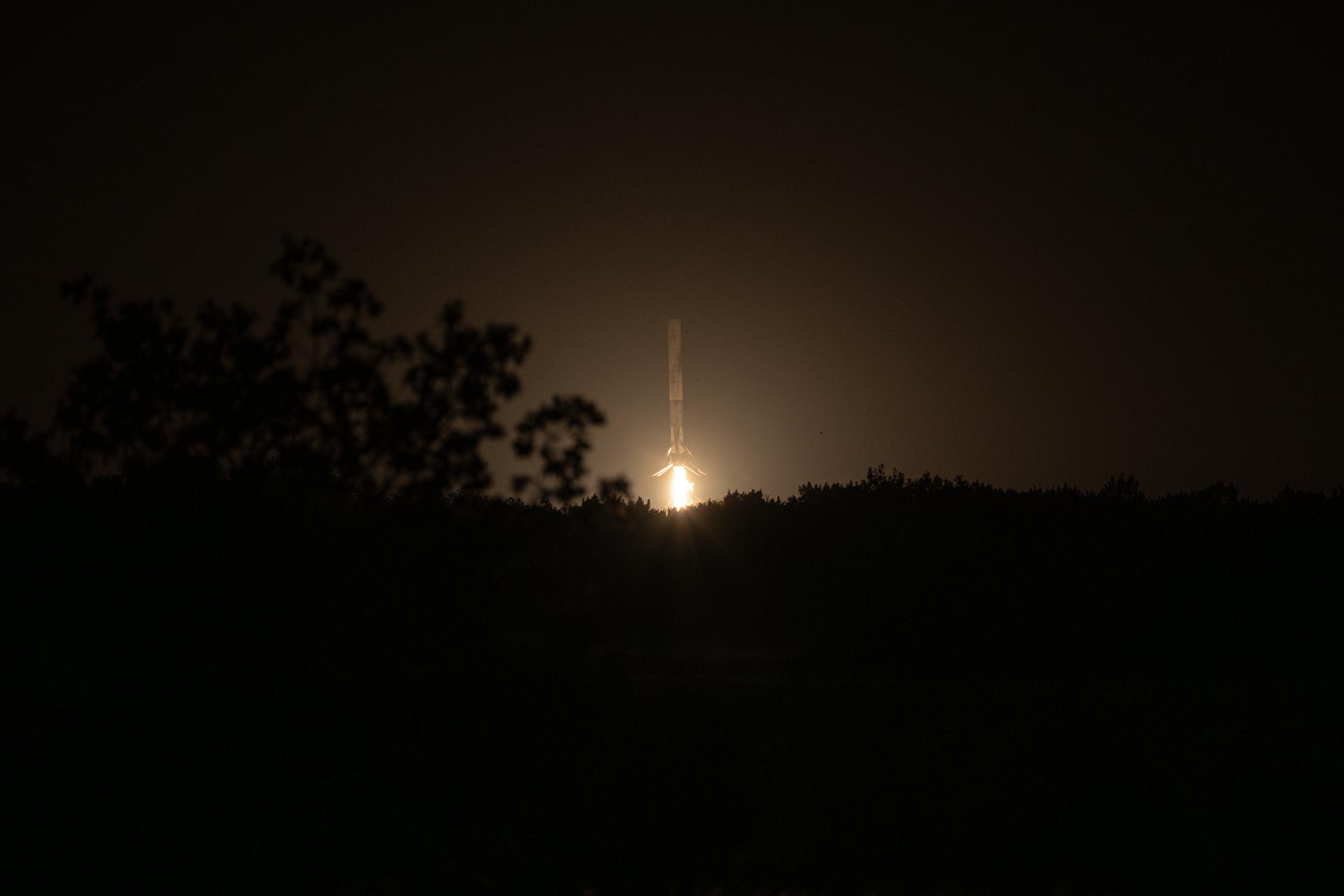
On the morning of June 15, 2026, a Falcon 9 lifted off from Space Launch Complex 4E at Vandenberg Space Force Base in California at 8:34 a.m. PDT, carrying 24 Starlink broadband satellites toward low Earth orbit. By the numbers it was an unremarkable flight: another batch of satellites for a constellation that already numbers in the thousands, lofted by a booster that had done this many times before. The mission, Starlink 17-54, will not headline anyone's history books.
And yet it was a first. This was the first Falcon 9 SpaceX flew as a publicly traded company — three days after the largest IPO in history, and the contrast between the ordinariness of the rocket and the extraordinariness of that milestone is the whole point.
The flight itself
Starlink 17-54 was a textbook West Coast Starlink run. The first-stage booster, designated B1093, was flying for the 14th time. After separation it returned to the Pacific and landed on the droneship Of Course I Still Love You, marking the 203rd landing on that particular vessel and the 624th successful booster recovery across SpaceX's entire program.
Those figures are worth sitting with for a moment. A single drone ship has now caught more than 200 returning rockets. The company as a whole has recovered boosters more than 600 times. Reuse at this scale was, not so long ago, the speculative promise that justified SpaceX's existence. On this flight it was simply the procedure — the part of the broadcast where nothing dramatic is supposed to happen, and didn't.
The week it happened in
What set the week apart had nothing to do with the rocket. On June 12, 2026 — three days before this launch — SpaceX shares began trading on the public market under the ticker SPCX. The offering priced at $135 per share, opened at $150, and closed its first session at $160.95 — a 19 percent jump that pushed the company's valuation to roughly $2.1 trillion.
The mechanics of the offering were as outsized as the valuation. SpaceX put up around 555.56 million Class A shares, targeting a raise of about $75 billion. Demand ran far ahead of supply: the order book was reportedly about four times oversubscribed. By the close, it stood as the largest IPO in stock market history.
Then, 72 hours later, SpaceX went back to doing the thing it does several times a week, as though nothing had happened. In a sense, that was the message.
What going public changes — and what it doesn't
It's tempting to treat an IPO as a turning point, the moment a company becomes something new. For an operational business like SpaceX, the more honest reading is that the listing certifies what already exists rather than creating something different.
Consider what the IPO did not alter. The Starlink 17-54 booster was built, flown, and recovered exactly as it would have been a week earlier. The cadence of West Coast Starlink launches, the droneship recovery infrastructure in the Pacific, the satellite production line feeding the constellation — none of that depends on a stock ticker. The 624 prior landings happened entirely before SPCX existed. A Falcon 9 does not fly differently because there are now public shareholders watching.
What the listing does change is the relationship between the company and the capital markets. A roughly $75 billion raise — reportedly about four times oversubscribed — is an enormous pool of money, and public markets bring public scrutiny: quarterly expectations, a share price that reacts to every launch and every anomaly, and a valuation that the market re-prices in real time. A 19 percent first-day pop and a $2.1 trillion valuation are not statements about a single Falcon 9. They are bets on the future of the launch cadence and the constellation that flights like Starlink 17-54 quietly extend, one batch of 24 satellites at a time.
That is the tension worth watching. The case investors are buying is built on operational consistency — the same boring reliability that made this flight unremarkable. The valuation, by contrast, is anything but boring. Reconciling those two things, launch after launch, is now part of the job in a way it wasn't before June 12.
Why It Matters
The first Falcon 9 of the public-company era was deliberately, almost defiantly, ordinary — and that ordinariness is the story. SpaceX's record-setting debut, the largest IPO ever recorded and a valuation north of $2.1 trillion, rests on the premise that flights like Starlink 17-54 will keep happening on schedule, with boosters that land on the 624th try as reliably as the first. The IPO didn't transform the rocket; it monetized the predictability of the rocket. For a company whose entire pitch has been turning spaceflight into routine, the most telling thing about its first launch as a public entity is that there was nothing telling about it at all. The interesting question now is whether public-market pressure — quarterly expectations, a price that moves on every success and failure — sits comfortably alongside an operation whose value comes precisely from being uneventful.
Sources
- SpaceX launches its first Falcon 9 rocket since Nasdaq debut — Spaceflight Now
- SpaceX IPO takeaways: SPCX closes at $161, jumping 19% after record debut — CNBC
- Starlink 17-54 mission details (Vandenberg SLC-4E, booster B1093, droneship landing) — Spaceflight Now
- Vandenberg Space Force Base — Space Launch Complex 4E launch operations (official) — U.S. Space Force
