
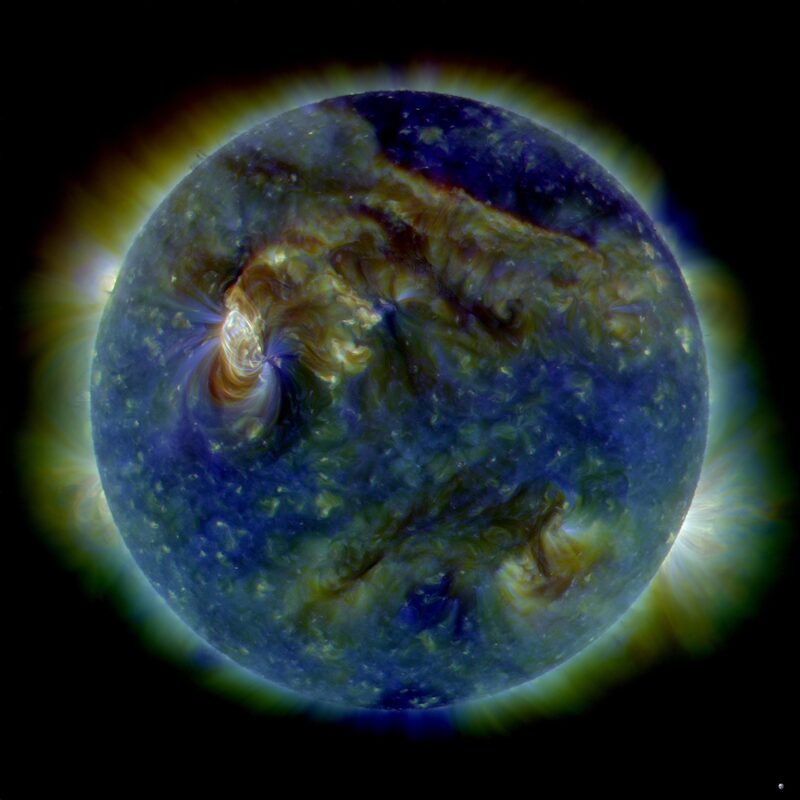
The Sun is not a stable, benign lamp. It is a magnetically active star that periodically ejects billion-ton clouds of magnetized plasma — coronal mass ejections, or CMEs — at speeds of several hundred to several thousand kilometers per second. When a CME arrives at Earth, it compresses Earth's magnetic field on the dayside and distorts it on the night side, driving electric currents through the planet's ionosphere and inducing voltages in any long conductor on the surface: power transmission lines, pipelines, submarine cables. If the arriving magnetic field is oriented southward (antiparallel to Earth's field) and the CME is large, the resulting geomagnetic storm can be severe enough to cause transformer failures in power grids, disrupt satellite operations, and render GPS unusable for hours to days.
The historical record is clear about the consequences of major events. In September 1859, the largest geomagnetic storm in recorded history — the Carrington Event — disrupted telegraph systems globally, caused sparks and fires in telegraph offices, and produced auroras visible from the tropics. The scale of the physical event is estimated from the aurorae, the magnetometer records of the period, and from cosmogenic isotopes (beryllium-10 and chlorine-36) preserved in ice cores, which record the particle flux of the accompanying solar energetic particle event. Modern analysis suggests the Carrington storm was a Dst (disturbance storm time index) of approximately -850 nT, compared to the largest modern measured storm of -589 nT (the March 1989 storm that caused the Hydro-Québec grid collapse, leaving six million people without power for nine hours).
The infrastructure vulnerability
The 1989 storm is the closest historical analogue to what a Carrington-class event would do to modern infrastructure. The difference is that the modern grid is far more tightly coupled, more reliant on long-distance high-voltage transmission, and more dependent on vulnerable electronics at every node than the 1989 grid was. A 2013 Lloyd's of London report estimated that a Carrington-class event striking the United States today would cause between $0.6 trillion and $2.6 trillion in damage, affecting 20 to 40 million people and lasting one to two years to restore full service — because the large extra-high-voltage transformers that are most vulnerable to geomagnetically induced currents are custom-built, not stockpiled, and take months to a year to manufacture and install individually.
Space weather forecasting has improved significantly since 1989. NOAA's Space Weather Prediction Center in Boulder, Colorado issues real-time alerts based on observations from the Deep Space Climate Observatory (DSCOVR), positioned at the L1 Lagrange point about 1.5 million kilometers sunward of Earth, where it detects incoming CMEs 15 to 45 minutes before arrival. That warning time is enough to protect some grid infrastructure through deliberate switching actions — but only if utilities have procedures in place and the forecast is acted on. The gap between what space weather science can forecast and what infrastructure operators are prepared to do about it remains the central vulnerability. A major preparedness initiative — involving grid operators, satellite operators, government agencies, and the insurance sector — is underway but incomplete.
Solar cycle 25, which began in December 2019 and is expected to peak in 2025, has been more active than NOAA's initial predictions. May 2024 saw the strongest geomagnetic storm since 2003 — a G5 event (the maximum on NOAA's five-level storm scale) that produced aurora visible from Florida, Texas, and California and disrupted some high-frequency radio communications and agricultural GPS systems. The storm was not a Carrington-class event, but it demonstrated that modern infrastructure is measurably vulnerable even to moderate extreme events: precision agriculture systems relying on differential GPS corrections lost accuracy for several hours; shortwave radio communications experienced widespread blackouts; some satellite operators conducted precautionary safe-mode procedures. No power transformers failed, but the event renewed attention to grid hardening.
The Sun's activity follows an approximately 11-year cycle between solar minimum and solar maximum, but individual cycles vary considerably in intensity, and the timing of extreme events within the cycle is not predictable beyond a few days' warning. The best current approach to infrastructure protection combines improved forecasting (longer lead times, better CME trajectory models), hardware hardening (transformer shielding, surge protection for grid electronics), and operational procedures (deliberate disconnection of vulnerable transmission segments during storm warnings). The insurance and reinsurance sectors have become significant drivers of investment in space weather resilience, as the actuarial risk of a catastrophic geomagnetic storm is large enough to matter to underwriters even at low annual probability.
Sources
- NOAA Space Weather Prediction Center — real-time space weather forecasts, storm scales, and historical event data
- Carrington Event — Wikipedia (1859 storm magnitude, telegraph disruption, and comparison to modern infrastructure risk)
- Geomagnetic storm — Wikipedia (Dst index, CME arrival effects, 1989 Quebec blackout, and DSCOVR warning system)
