
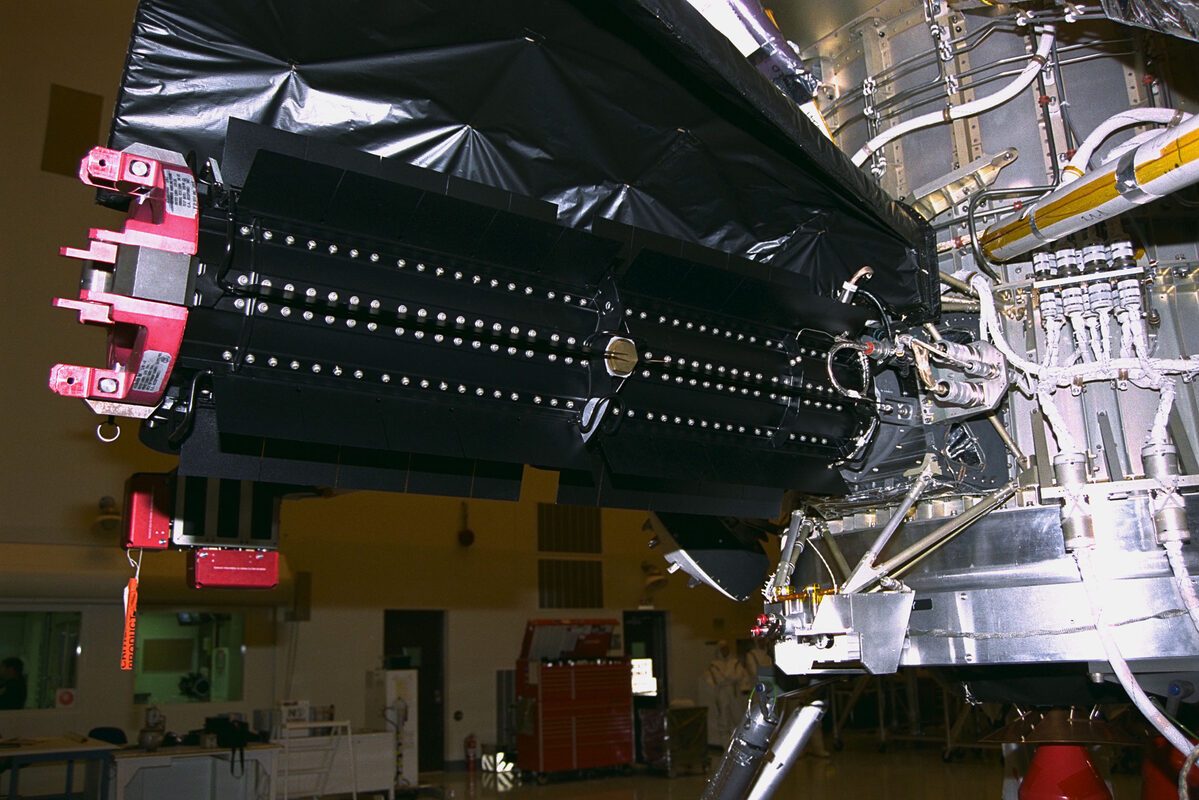
The Voyager probes, both New Horizons, Cassini, Galileo, and the Curiosity and Perseverance rovers all run on nuclear power. Not fission reactors — the same kind of controlled nuclear chain reaction that powers a submarine or a power plant — but radioisotope thermoelectric generators: devices that convert the heat of radioactive decay directly into electricity via thermocouples. The fuel is plutonium-238, a non-weapons-grade isotope that decays by emitting alpha particles, producing about half a watt of thermal power per gram. RTGs are compact, reliable, and produce power continuously regardless of solar distance, dust, or shadow. Their limitation is power density: a kilogram of plutonium-238 produces roughly 0.5 watts of electrical power through the thermocouple conversion. For a single spacecraft, this is adequate. For a lunar base, a Mars surface habitat, or a high-power scientific spacecraft, it is not.
The solution is fission. A nuclear fission reactor can produce kilowatts to megawatts of power from a compact package, scaling more efficiently with power level than RTGs. The challenge is the reactor design: it must be safe during launch (non-critical during Earth ascent, requiring mechanical interlocks), reliable in the target environment, and light enough to be practical. These constraints have been understood since the 1960s, when the U.S. operated the SNAP-10A reactor in space (the only American fission reactor ever operated in orbit, briefly, in 1965). The Soviet RORSAT program flew dozens of fission-powered radar satellites in the 1970s and 1980s, with several failures that scattered radioactive material. Interest in space fission reactors then declined until the need for surface power on the Moon and Mars renewed it.
Kilopower
The Kilopower project, a collaboration between NASA and the Department of Energy's Los Alamos National Laboratory, demonstrated a compact fission reactor prototype — the KRUSTY (Kilopower Reactor Using Stirling Technology) — at the Nevada National Security Site in 2018. The full-power test produced 1 kilowatt of electrical power from a uranium-235 core the size of a paper towel roll, using Stirling engines to convert heat to electricity. The test ran for 28 hours at full power and validated the reactor design and control systems. A scaled version producing 10 kilowatts is the target for the first operational Fission Surface Power system.
Ten kilowatts is enough power to sustain a four-astronaut habitat on the Moon or Mars indefinitely — running life support, communications, science instruments, and charging for extravehicular activity equipment. Multiple 10-kilowatt units could be deployed and networked to provide more power as a base grows. The lunar south pole, the target for Artemis surface operations, receives limited direct sunlight in some locations and no sunlight at all in permanently shadowed craters. Nuclear fission eliminates the sunlight dependency entirely.
Nuclear thermal propulsion
Beyond surface power, nuclear fission can also drive propulsion systems significantly more efficient than chemical rockets. Nuclear thermal propulsion (NTP) uses a reactor to heat a propellant (typically hydrogen) to high temperatures before expelling it through a nozzle. The specific impulse — a measure of propellant efficiency — of an NTP system is roughly twice that of the best chemical rockets. For a crewed Mars mission, NTP could cut transit time from six to nine months (chemical) to three to four months, reducing crew radiation exposure and the life support consumables required. The DRACO program (Demonstration Rocket for Agile Cislunar Operations) is developing an NTP system for a demonstration flight in the late 2020s. The 1960s NERVA program had already proven the concept; DRACO is catching up to where that program left off before it was cancelled in 1972 for lack of a Mars mission to use it.
Beyond Kilopower and DRACO, the long-term vision for nuclear power in space includes megawatt-class reactors that could drive electric propulsion at thrust levels impractical with chemical systems. Electric propulsion (ion drives and Hall thrusters) is already used on commercial satellites and deep-space probes; coupling it to a fission power source could enable missions to the outer solar system in years rather than decades, opening the gas giants and their moons to a new generation of exploration.
Sources
- NASA NSSDC — Pluto/Outer Planets Fact Sheet: radioisotope thermoelectric generator heritage from deep-space missions
- Kilopower — Wikipedia (KRUSTY test, Fission Surface Power program, and lunar/Mars applications)
- Nuclear thermal rocket — Wikipedia (NERVA, DRACO, specific impulse, and Mars mission applications)
