
In 1968, Raymond Davis Jr. lowered a tank containing 100,000 gallons of cleaning fluid into a gold mine in South Dakota and started counting neutrinos from the Sun. Over the next 25 years, he found roughly one-third of what theory said should be there. This was either a profound problem with our understanding of the Sun, a profound problem with our understanding of neutrinos, or an error in the experiment. It took three decades to learn it was none of the above — and that the answer was stranger than either possibility.
Solar neutrinos were a prediction of the same nuclear physics that explained why the Sun shines. If hydrogen fusion powers the solar interior, the proton-proton chain that converts hydrogen to helium produces a precisely calculable flux of electron neutrinos. John Bahcall spent his career calculating that flux in increasingly fine detail, refining solar models that incorporated opacity, element abundances, and the thermodynamics of the solar interior. His predictions were consistent and well-founded. Davis's experiment, calibrated against known neutrino sources, found only 30 to 40 percent of the expected rate. The gap became known as the solar neutrino problem.
The suspects
Three competing explanations occupied physicists for decades. The first was that the solar models were wrong — that the core temperature, composition, or energy-generation mechanism differed from what Bahcall calculated. This explanation was disfavored by helioseismology, the technique of measuring the Sun's internal structure through surface oscillations, which agreed with Bahcall's models at the one-percent level. The Sun was not the problem.
The second possibility was that Davis's detector was wrong — that the chlorine-based detection chemistry missed neutrinos at rates beyond the known systematic uncertainties. This became less tenable as alternative detectors (Kamiokande in Japan, using water and photomultiplier tubes rather than chlorine chemistry) confirmed a deficit, though one somewhat different in magnitude. Different detectors had different energy thresholds, and the deficit varied with energy in ways that carried information.
The third possibility was the one the data eventually forced: that neutrinos change flavor in transit. Electron neutrinos, produced in the solar core, could transform into muon or tau neutrinos by the time they reached Earth. If Davis's detector (and Kamiokande) was sensitive only to electron neutrinos, it would see a deficit even if the total neutrino flux was exactly what Bahcall predicted. For this to happen, neutrinos would have to have mass — a direct contradiction of the Standard Model of particle physics, which treated neutrinos as massless.
SNO and the proof
The Sudbury Neutrino Observatory, built 2,100 meters underground in a nickel mine in Ontario, was designed specifically to distinguish between these possibilities. It used 1,000 tonnes of heavy water — water in which the hydrogen atoms have been replaced with deuterium — as its detector medium. Heavy water could detect electron neutrinos specifically (via charged-current interactions) and all neutrino flavors equally (via neutral-current interactions). By running both measurements simultaneously, SNO could separately count the electron neutrinos and the total neutrino flux.
The results, published in 2001 and 2002, were unambiguous. The total flux of all neutrino flavors agreed with Bahcall's solar model to within the experimental uncertainties. The electron neutrino flux was about one-third of the total. The missing neutrinos had not disappeared; they had changed identity. Two-thirds of the solar electron neutrinos arriving at Earth had oscillated into muon or tau neutrinos, which Davis's detector could not see. The solar neutrino problem was solved — and the Standard Model's treatment of neutrinos as massless was definitively refuted.
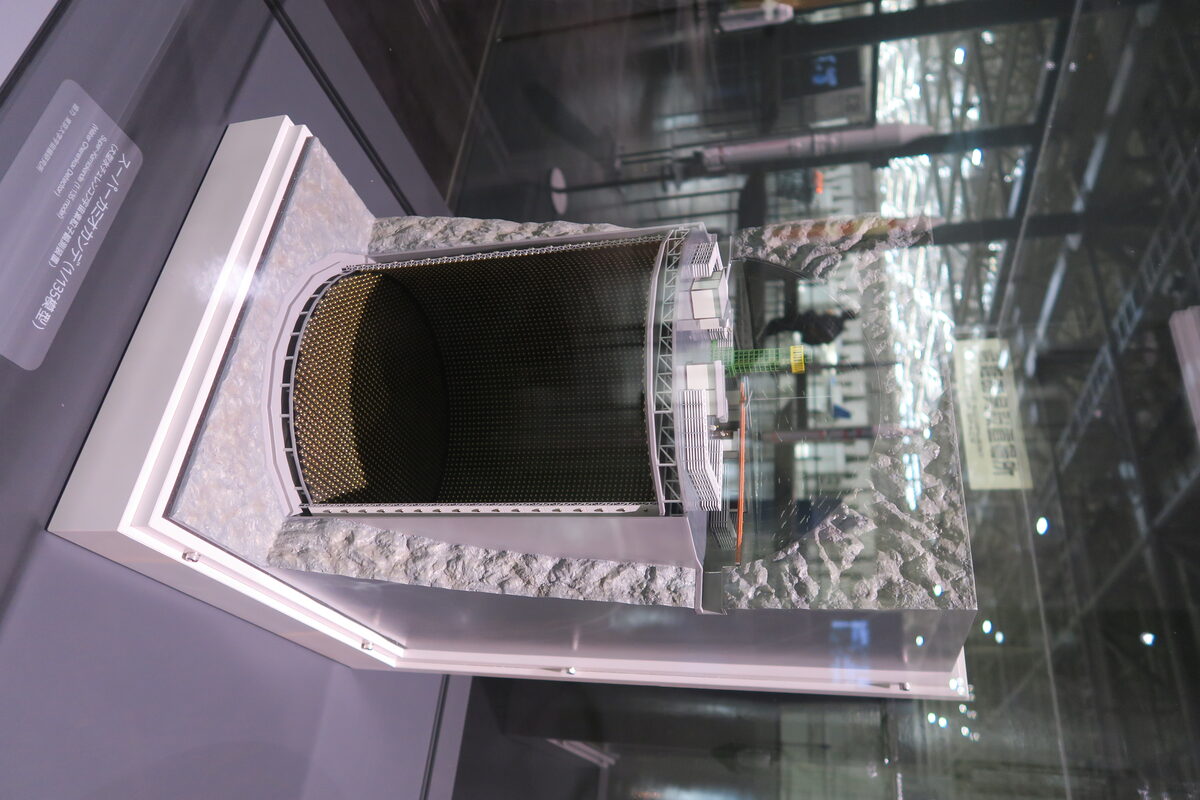
The 2015 Nobel Prize in Physics went to Arthur McDonald of SNO and Takaaki Kajita of Super-Kamiokande, the Japanese successor to Kamiokande that had independently established atmospheric neutrino oscillation (muon neutrinos transforming to tau neutrinos as they pass through the Earth). The two measurements together established that neutrino oscillation is a real phenomenon, that neutrinos have at least two distinct nonzero masses, and that the mixing angles between the three neutrino flavors are large — different from the small mixing angles of quarks, for reasons still not fully understood.
What it means going forward
Massive neutrinos create problems and opportunities in equal measure. They are not accommodated by the Standard Model without adding new physics — either right-handed neutrinos, a seesaw mechanism, or Majorana masses (in which a neutrino is its own antiparticle). The absolute mass scale is still unknown; oscillation experiments measure mass differences, not absolute values. Cosmological measurements constrain the sum of neutrino masses to be less than about 0.1 eV — but the ordering of the mass states (normal vs. inverted hierarchy) is only recently being resolved by experiments like NOvA and T2K, and the CP-violating phase that may help explain why the universe contains more matter than antimatter is being measured by the same instruments.
Davis's cleaning fluid, sitting in a mine in South Dakota, started something that physicists will be following for another generation. The Sun turned out to be fine. The neutrino was the anomaly — and the anomaly was a door.
Sources
- Nobel Prize in Physics 2015 — McDonald and Kajita for neutrino oscillation discovery
- Solar neutrino problem — Wikipedia (Homestake, SNO, Kamiokande, and the oscillation solution)
- Sudbury Neutrino Observatory — Wikipedia (heavy water detector design and the flavor-resolved measurement)
- Fermilab — Neutrino physics: what neutrinos are, oscillation, and ongoing experiments
