
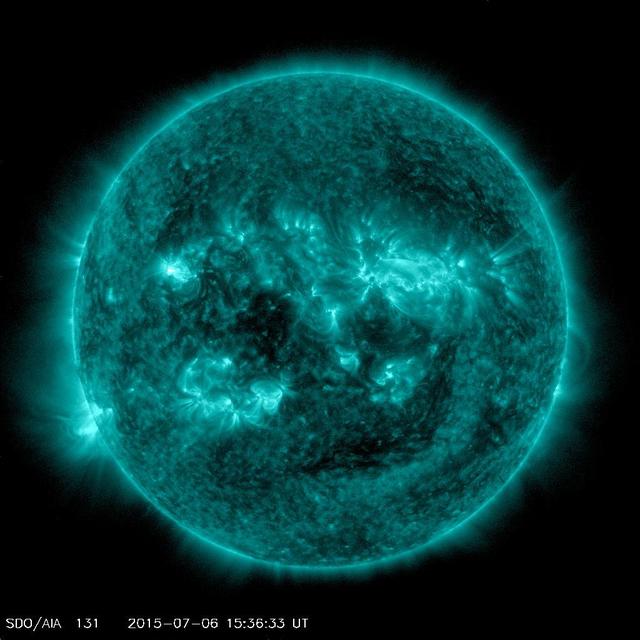
In May 2024, people in Texas, Florida, and northern Mexico stepped outside and watched the sky turn crimson and green. Auroras at those latitudes are not supposed to happen — or rather, they happen rarely enough that most people alive today had never seen one outside the subarctic. The culprit was a sequence of X-class solar flares and associated coronal mass ejections that drove the Kp geomagnetic index to 9, just shy of the theoretical maximum, producing the strongest geomagnetic storm since the Halloween storms of 2003. It was a demonstration, vivid and impossible to ignore, that Solar Cycle 25 is not behaving the way the experts said it would.
When NOAA's Solar Cycle 25 Prediction Panel released its consensus forecast in 2019, the message was essentially: don't worry about it. The panel projected a solar maximum of around 115 sunspots (smoothed), making it a below-average cycle, roughly comparable to the underwhelming Cycle 24 that preceded it. That forecast aged poorly. By late 2024, the smoothed sunspot number had climbed past 230 — roughly double the prediction — placing Cycle 25 among the most active cycles since systematic counting began in the eighteenth century. The Sun, it turns out, did not read the panel's report.
What the cycle actually is
The eleven-year solar cycle is not a clock so much as a breathing pattern. The Sun's magnetic field, generated by differential rotation in the convection zone, winds itself up over roughly a decade until the field becomes so tangled and stressed that it erupts through the photosphere in pairs of sunspots — dark, cooler regions where intense magnetic flux suppresses convective heat flow. As the cycle progresses toward maximum, the number and complexity of active regions increases, and with that comes an elevated probability of flares and coronal mass ejections, or CMEs, the billion-ton plasma clouds that can travel from the Sun to Earth in as little as seventeen hours.
The Maunder Minimum, a seventy-year span from roughly 1645 to 1715 during which sunspot counts dropped nearly to zero, coincided with a period of unusual cold in Europe and North America — the heart of what climatologists call the Little Ice Age. The connection between solar output and terrestrial climate remains contested, but what is not contested is that periods of elevated solar activity have measurable consequences for the near-Earth space environment. The current maximum is unambiguously in that elevated range.
Solar physicists track the cycle through several proxies beyond raw sunspot counts: the 10.7-centimeter radio flux (F10.7), which correlates well with ultraviolet output and ionospheric ionization; the rate of X-class and M-class flares; and the frequency of halo CMEs — those aimed more or less directly at Earth. By all of these metrics, Cycle 25 has been overperforming since at least 2022, a full two years before the panel's projected maximum window.
What it does to the infrastructure we depend on
The chain of effects from a major solar storm runs through several distinct physical mechanisms, and they hit different infrastructure in different ways. When a large CME arrives, it compresses the dayside magnetosphere and stretches the nightside into a long tail, driving electrical currents in the ionosphere. Those currents induce voltages in any long conductor on the ground — power transmission lines, natural gas pipelines, railway tracks. The March 1989 event that collapsed the Hydro-Québec grid in ninety seconds was not caused by a direct electromagnetic pulse from the flare; it was caused by geomagnetically induced currents (GICs) that overwhelmed the transformers. The province lost power for nine hours, and some high-voltage transformers took months to replace.
The vulnerability has not disappeared. It has grown. The North American grid has expanded significantly since 1989, and the long-haul transmission lines that tie regional grids together are precisely the conductors most susceptible to GIC saturation. NERC, the North American Electric Reliability Corporation, has issued GIC mitigation standards since 2014, and utilities have added GIC monitors and blocking devices, but the transformer fleet is aging and high-voltage transformers take up to two years to manufacture. A replay of the March 1989 event — let alone a Carrington-scale event, which is estimated to have been five to ten times more powerful — would stress that fleet in ways the grid is not fully prepared to absorb.
Satellites face a different set of problems. The ultraviolet and X-ray output from solar flares heats the upper atmosphere, causing it to expand. At orbital altitudes between 300 and 600 kilometers — where the International Space Station lives, where most Earth-observation satellites operate, and where the bulk of the Starlink constellation orbits — that expansion increases atmospheric drag. During Cycle 24's relatively quiet maximum, atmospheric density at 400 kilometers was low enough that operators could predict satellite positions years in advance. During the May 2024 storm, drag on low-Earth-orbit objects increased sharply enough that SpaceX reported elevated station-keeping fuel consumption across the Starlink constellation, and space situational awareness agencies temporarily lost track of hundreds of objects as their predicted orbits diverged from reality.
Ionospheric disruption hits GPS with particular precision. The L1 and L2 frequencies used by GPS pass through the ionosphere, which introduces a range error that receivers correct using models of electron density. During major storms, the ionosphere becomes turbulent and inhomogeneous in ways that break those models, producing positioning errors of meters to tens of meters in severe cases. Aviation relies on WAAS augmentation, which can be degraded or temporarily withdrawn during significant ionospheric events. The FAA issued advisories during the May 2024 storm, and pilots in some regions reported GPS unreliability for hours.
Monitoring and the hard problem of forecasting
The gap between detecting a CME and predicting its Earth impact with useful accuracy remains the central challenge in space weather forecasting. NOAA's Space Weather Prediction Center relies heavily on the DSCOVR satellite, stationed at the L1 Lagrange point about 1.5 million kilometers sunward of Earth, to detect the interplanetary magnetic field orientation of an incoming CME. This is crucial: a CME whose magnetic field points southward will reconnect efficiently with Earth's northward-pointing magnetosphere and drive a major storm. One pointing northward may pass with barely a tremor. DSCOVR typically provides fifteen to forty-five minutes of warning — enough time to alert grid operators, but not enough time to safely shut down transformers without disrupting power delivery.
NASA's Parker Solar Probe, launched in 2018 and now flying closer to the Sun than any spacecraft in history, is providing new data on how CMEs evolve in the inner heliosphere. ESA's Solar Orbiter, operating since 2020, is imaging the Sun's poles for the first time and improving models of how the solar wind structures. The hope is that these missions will eventually allow forecasters to predict CME impact characteristics from farther away — perhaps from observations near the Sun itself — extending warning times from minutes to hours. The science is advancing, but the operational systems have not caught up.
In the meantime, the solar maximum we are living through is the most consequential for technology-dependent civilization in at least two decades. The grid is more interconnected than it was in 1989. Satellites are far more numerous. GPS is embedded in logistics, aviation, agriculture, and financial transaction timestamping in ways it was not in 2003. The May 2024 storms produced aurora and inconvenience. The next Carrington-class event — which paleorecords suggest occurs every few centuries, and which could occur during any active cycle — would produce something considerably harder to write off as a light show.
The Sun is not malfunctioning. It is doing exactly what it has always done, on its own schedule, indifferent to the infrastructure that civilization has draped across the planet beneath it. The question that space weather scientists spend their careers on is not whether we will get a direct hit, but whether we will be ready when we do.
