
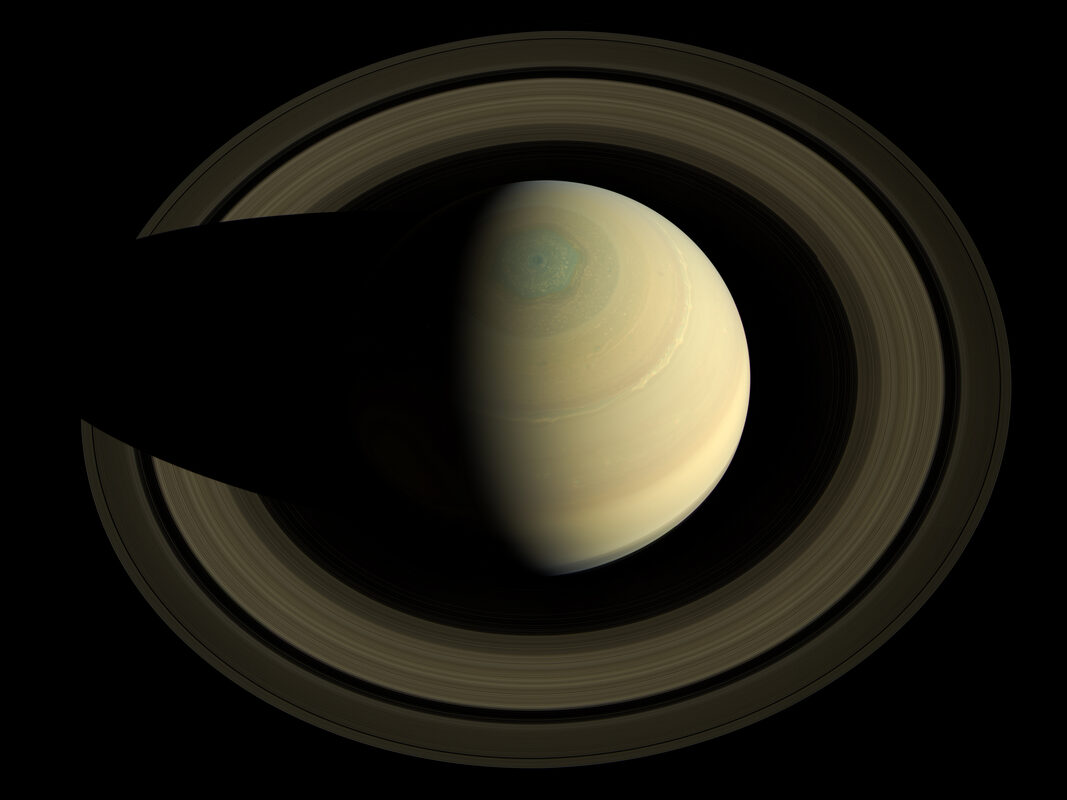
In 1848, French mathematician Édouard Roche calculated the minimum distance at which a fluid satellite can exist in a circular orbit around a larger body without being pulled apart by tidal forces. Below this distance — the Roche limit — the difference in the central body's gravitational attraction between the near and far sides of a satellite exceeds the satellite's own self-gravity, stretching and eventually disrupting it. Roche's calculation assumed a fluid, self-gravitating sphere, and the exact value depends on the densities and rigidities of both bodies. For typical materials orbiting a planet, the Roche limit is roughly 2.5 times the planet's radius. Saturn's main ring system extends from about 1.1 to 2.3 Saturn radii — comfortably within the Roche limit for water ice, the primary constituent of the rings.
The Roche limit explains why the ring regions of the giant planets are rings rather than moons. Material within the Roche limit cannot coalesce under its own gravity into large bodies because tidal forces disrupt any growing clump before it becomes massive enough to hold itself together. Outside the Roche limit, the same material accretes normally — which is why Saturn's inner moons (Pan, Atlas, Prometheus, Pandora) sit just outside the ring boundaries and shepherd the ring particles into their observed structures. The boundary between "ring" and "moon" is not arbitrary or historical; it is a physical threshold determined by the ratio of tidal to gravitational forces.
How Saturn's rings formed
The origin of Saturn's rings has been debated since the Voyager missions revealed their intricate structure. The primary question is age: are the rings ancient — remnants of the original solar system material that never accreted into moons, or debris from an early moon destroyed by an impactor — or are they young, having formed within the last 100 million years from a more recent event? Cassini's mass measurements of the rings (by measuring their gravitational effect on the spacecraft's trajectory) found a total ring mass of about half a percent of Earth's Moon — surprisingly small for a structure that ancient. The ring's pristine white color, dominated by nearly pure water ice with minimal darkening by interplanetary dust, also suggests youth: ring material accretes dust at a predictable rate, and the rings' brightness implies they have not been collecting dust for billions of years.
The "young ring" scenario gained support from Cassini's Grand Finale, its final orbits passing between the rings and Saturn's atmosphere in 2017. Measurements during those passes showed that ring material is raining onto Saturn's atmosphere at a rate of several thousand kilograms per second — "ring rain" driven by charged ring particles following Saturn's magnetic field lines. At this rate, the current rings would be gone within 100 to 300 million years. Combined with the low ring mass and the bright color, the evidence points to rings formed within the last 100 million years — during the age of dinosaurs on Earth, in cosmic terms, an eyeblink ago.
Tidal forces in other contexts
The Roche limit is not only about rings. The disruption of comet Shoemaker-Levy 9 in 1992, as it passed within Jupiter's Roche limit, split the comet into 21 fragments that subsequently impacted Jupiter in a spectacular sequence in 1994. Tidal forces from Earth are slowly decelerating the Moon's rotation, which is why the Moon always shows the same face toward Earth (tidal locking). At the extreme end, the tidal forces near black holes are so strong that objects are "spaghettified" — stretched lengthwise and compressed laterally — as they approach the event horizon. The phenomenon Édouard Roche calculated for planetary satellites in 1848 operates on scales from comet disruptions to galactic events, governed by the same mathematics throughout.
