
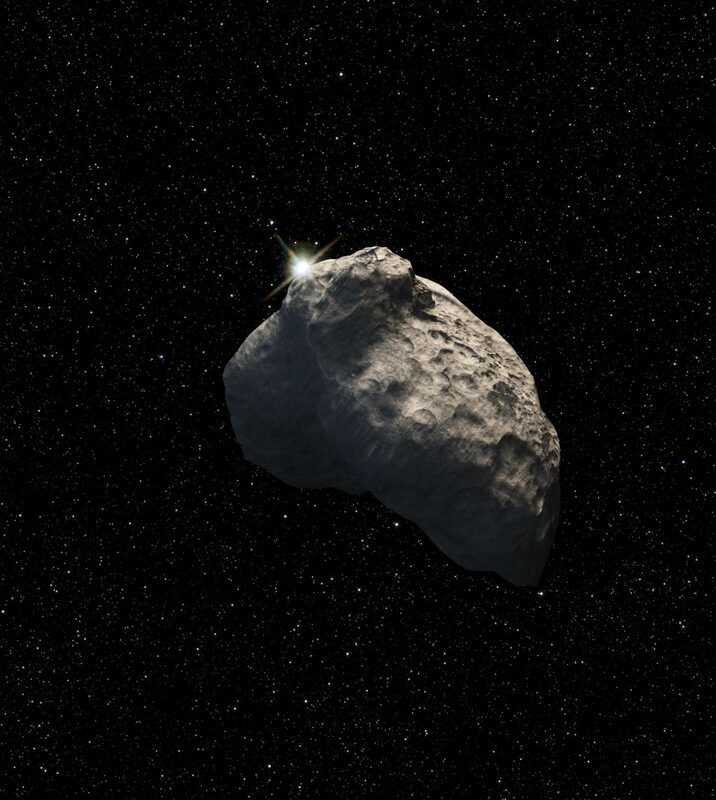
The outer solar system is mostly empty. Beyond Neptune, at distances from 30 to hundreds of astronomical units from the Sun, a sparse population of icy objects — the trans-Neptunian objects, or TNOs — orbit in trajectories shaped by Neptune's gravitational influence and the ancient geometry of the solar system's formation. Most of those orbits are predictable from known physics. But a subset of the most distant ones, those with perihelia beyond 150 AU, have a peculiarity: their orbital planes and orientations are clustered in a way that seems unlikely to occur by chance. In 2016, Konstantin Batygin and Mike Brown at Caltech published a statistical argument that the clustering is a signature of a gravitational influence — a distant, massive planet that nobody has found yet.
The proposed object, which they called Planet Nine, would need to be roughly 5 to 10 times the mass of Earth, orbiting between 400 and 800 AU from the Sun in a highly elliptical orbit inclined about 20 degrees from the ecliptic plane. At such a distance, it would be far fainter than any planet ever detected and could easily have been missed by previous sky surveys. Its orbital period would be somewhere between 10,000 and 20,000 years. In each orbit, it comes close enough to the distant TNOs to gravitationally shepherd them — over billions of years, clustering their orbital orientations into the pattern now observed.
The statistical case
The original Batygin-Brown paper reported a probability of roughly 0.007 percent that the clustering of six extreme TNOs occurred by chance — about 3.8 sigma, a significant but not definitive statistical signal. The argument has been updated multiple times as new objects were discovered, and the analysis remains contested. Skeptics point out that most extreme TNOs are discovered in a small fraction of the sky — the parts imaged by the surveys that found them — which means the apparent clustering could be a selection effect rather than a physical one. If surveys avoid certain directions (toward the galactic plane, for example, where crowded star fields make faint object detection difficult), the population we know about is an incomplete and potentially biased sample of the full population.
Careful analyses by other groups have found different estimates of the statistical significance, ranging from barely above random to several sigma. The Outer Solar System Origins Survey (OSSOS), which discovered many new extreme TNOs with well-characterized survey biases, argued in 2017 that the clustering was not statistically significant once the survey geometry was accounted for. Batygin and Brown responded that OSSOS was not sensitive to the most relevant objects. The debate has not resolved.
The search
Multiple teams are actively searching for Planet Nine with large-aperture survey telescopes. The Subaru Telescope's Hyper Suprime-Cam has covered large areas of the sky at depths sufficient to detect a 5-Earth-mass object out to roughly 700 AU. No candidate has been found. The Vera Rubin Observatory, which began its full survey operations in 2025, is expected to be the most powerful tool in the search: it covers the southern sky repeatedly with a 3.2-gigapixel camera, reaching depths that would detect reflected light from a Neptune-sized object at 1,000 AU and a super-Earth at several hundred AU. If Planet Nine exists and is anywhere near the predicted location, Rubin is likely to find it within a few years of survey operation.
Alternative explanations for the orbital clustering have been proposed. A disk of small objects, collectively massive enough to exert a detectable gravitational influence, could produce similar effects without requiring a single large planet. Early stellar encounters during the Sun's time in its birth cluster might have perturbed outer solar system orbits into the observed pattern. And if the clustering is partly a selection effect, no additional explanation is required at all. The competing hypotheses make different predictions about the population of undiscovered TNOs — predictions that Rubin's survey will test systematically over the next decade.
The solar system has surprised us before. The discovery of Uranus, Neptune, and Pluto each required explanations for orbital anomalies that existing models could not account for. Planet Nine may follow the same pattern, or it may dissolve as the data improve. The answer is probably in the survey data already being collected.
