
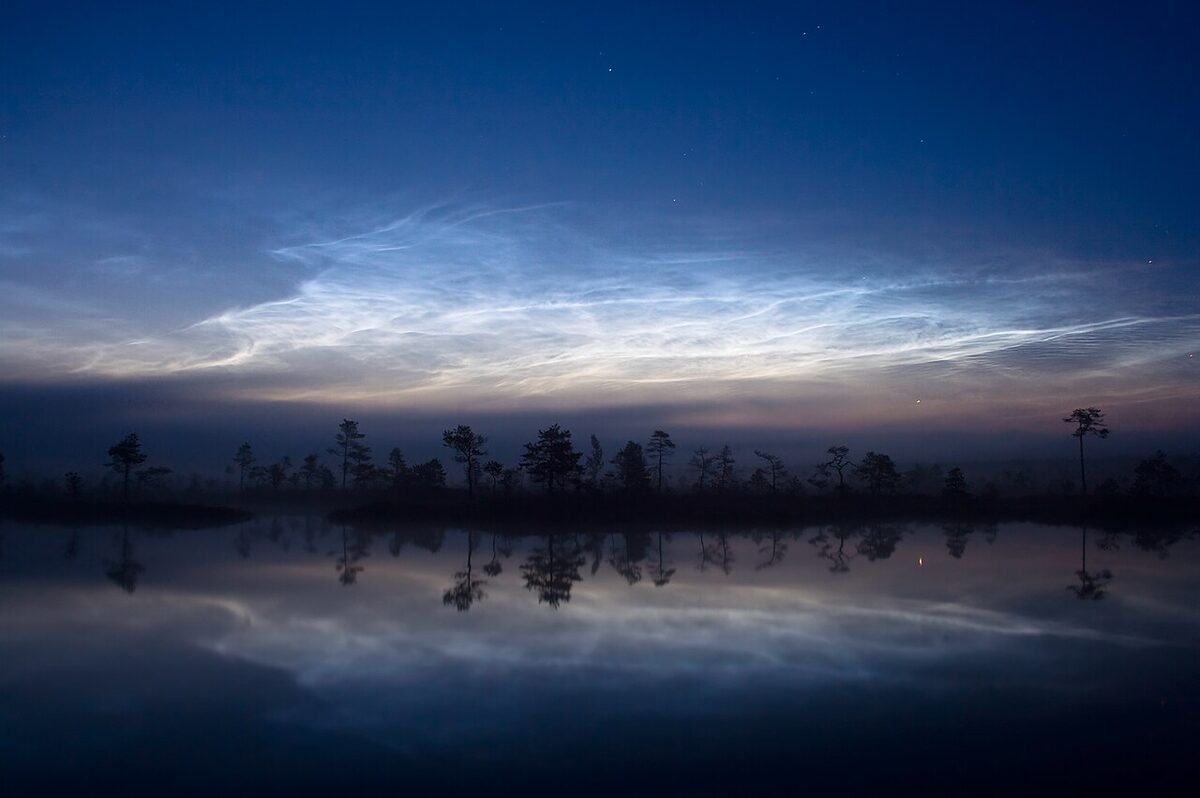
Most clouds are lit by day and vanish into darkness at night. There is one striking exception, and its season is just beginning. Noctilucent clouds — the name means "night-shining" — appear only in deep twilight, glowing an unearthly electric blue against a darkening sky long after the Sun has set. They are the highest clouds on Earth, and for skywatchers at northern latitudes, the short summer window of June and July is the time to look for them.
Clouds at the edge of space
What makes noctilucent clouds extraordinary is their altitude. Ordinary weather clouds top out around 10 to 12 kilometres up. Noctilucent clouds form near 80 kilometres — in the mesosphere, the coldest layer of the atmosphere, so high that they are effectively at the boundary of space. Up there the air is achingly thin and, in summer, paradoxically the coldest place on the planet, cold enough that the tiny amount of water vapour present can freeze onto specks of dust, much of it the debris of meteors burning up. The result is a veil of ice crystals at the very top of the atmosphere.
Their glow is a trick of geometry. Because the clouds are so high, they remain bathed in sunlight even after the Sun has dropped well below the horizon for observers on the ground — the sunlight reaches up and over the curve of the Earth to illuminate them from below while the lower sky is already dark. That is why they shine only in twilight: too early and the sky is too bright to see them; too late and even the high clouds fall into Earth's shadow. The sweet spot is roughly an hour or two after sunset, or before sunrise, low toward the northern horizon.
They also have a curious history. Noctilucent clouds were not described until the 1880s — the first widely noted sightings came in the years after the 1883 eruption of Krakatoa threw vast amounts of material into the high atmosphere — and whether they genuinely did not exist before then or simply went unrecorded remains an open question. Either way, they sit at the intersection of meteorology and astronomy: seeded by the dust of vaporized meteors, lit only by the geometry of a Sun that has already set. For photographers they are a rewarding target, since a tripod and a few seconds of exposure capture their delicate structure and colour far better than the eye alone.
How and where to see them
Catching noctilucent clouds takes a little geography and a little patience. They are best seen from latitudes roughly between 50 and 70 degrees — across Canada, the northern United States, the United Kingdom, and northern Europe — during the weeks around the summer solstice, when the geometry of sunlight and the seasonal cold of the high atmosphere align. Find a spot with a clear, unobstructed view to the north and low light pollution, and watch the twilight band after the Sun has set. The clouds look different from ordinary ones: pale, electric-blue or silvery, often rippled into delicate wavy or web-like patterns, and noticeably brighter and bluer than the dull grey of weather clouds catching the last light.
There is a scientific intrigue to them beyond their beauty. Noctilucent clouds were first reported only in the 1880s, and they appear to have grown more frequent and more widespread since — a trend many researchers link to changes in the upper atmosphere, including rising levels of methane, which supplies water vapour high up as it breaks down. In that sense the clouds may be a faint visible signal of how human activity is altering even the edge of space. For a casual observer, though, no background is required. They are simply one of the more otherworldly sights the sky offers from an ordinary backyard — and for the next several weeks, they are in season.
