
June 2026 is one of those months that rewards anyone willing to step outside at the right hour. The sky's two brightest planets just finished a spectacular embrace, Mercury is about to make its best evening appearance of the season, the Moon will pass directly in front of Venus mid-month, and the longest day of the year arrives on the 21st. Here is the rest of the month, night by night, drawn from NASA's June skywatching outlook and the almanac calendars.
The Evening Show in the West
If you caught Venus and Jupiter on June 8 and 9, you saw the month's headline act: a conjunction that brought the sky's two brightest planets within about a degree and a half of each other — close enough that a pinky finger held at arm's length could just fit between them. They have separated since, but the western twilight remains the place to look all month. Venus climbs a little higher each evening while Jupiter slides the other way, sinking toward the sunset glare on its way to passing behind the Sun in July. Binoculars aimed at Jupiter on any clear evening this week will still pick up its four Galilean moons before it goes.
Mercury makes it a trio. From June 11 through 15 the innermost planet joins Venus and Jupiter low in the west — a compact parade of three planets in the fading twilight. Mercury reaches greatest eastern elongation on June 15, standing 24 degrees from the Sun, its best evening showing of this apparition. Catch it in the half hour after the sky starts to darken; by late June it drops back into the glare. On June 16, a thin crescent Moon slides into the scene and forms a line with all three planets — the month's best photo opportunity, and gone within an hour of full darkness.
June 17: The Moon Occults Venus
The rarest event of the month comes on June 17, when the crescent Moon passes directly in front of Venus. Observers across parts of the United States, Canada, Brazil, and Venezuela are positioned to see the occultation; for many locations it happens during daylight, which makes it a genuine challenge — and a genuine hazard. Venus is bright enough to follow in a daytime sky with binoculars or a small telescope, but never sweep optics anywhere near the Sun without proper solar filtering. If the timing or geometry doesn't favor your location, the pairing is still strikingly close before and after the occultation itself.
Solstice on the 21st
The June solstice lands on Sunday, June 21 at 1:24 a.m. Pacific time (8:24 UTC) — the moment the Sun reaches its northernmost point and astronomical summer begins in the Northern Hemisphere. It is the longest day of 2026, which for skywatchers cuts both ways: maximum daylight, minimum observing window. The compensation is noctilucent cloud season, now at its peak. These electric-blue ripples form on meteor dust about 80 kilometers up — far above weather — and catch sunlight long after sunset. From latitudes between roughly 45 and 80 degrees north, look toward the northwest 60 to 90 minutes after sundown on clear nights through the solstice weeks.
The Morning Side
Early risers get their own planets. Saturn rides highest in the eastern sky before dawn, hanging below the Great Square of Pegasus; the Moon paid it a visit on June 10. Mars spends early June buried in morning twilight but climbs steadily through the second half of the month, passing near the Pleiades star cluster — a fine binocular pairing in the brightening sky. The Moon slid past Mars on June 12.
Meteor watchers have two minor showers to note. The Daytime Arietids peaked June 10 — strong by radio counts, but only a stray few visible in the last hour before dawn. The June Bootids run June 22 to 27 and usually deliver a meteor or two per hour at best, with one asterisk: this shower has a history of unannounced outbursts, including a hundred-plus-per-hour surprise in 1998. Outbursts are unpredictable — the Bootids have ignored expectations before.
The Strawberry Moon Closes the Month
June's full Moon — the Strawberry Moon, named by the Algonquin for the short strawberry-harvest season, not its color — arrives June 29 at 7:57 p.m. Eastern. It is the first full Moon of northern summer, and it rides the lowest track across the sky of any full Moon this year, glowing in Sagittarius near the red supergiant Antares. A low full Moon means more atmosphere to shine through, which often lends it a warm amber cast near the horizon — the closest the Strawberry Moon comes to living up to its name. Two nights earlier, on June 27, the nearly full Moon passes close to Antares itself, and from some locations occults it.
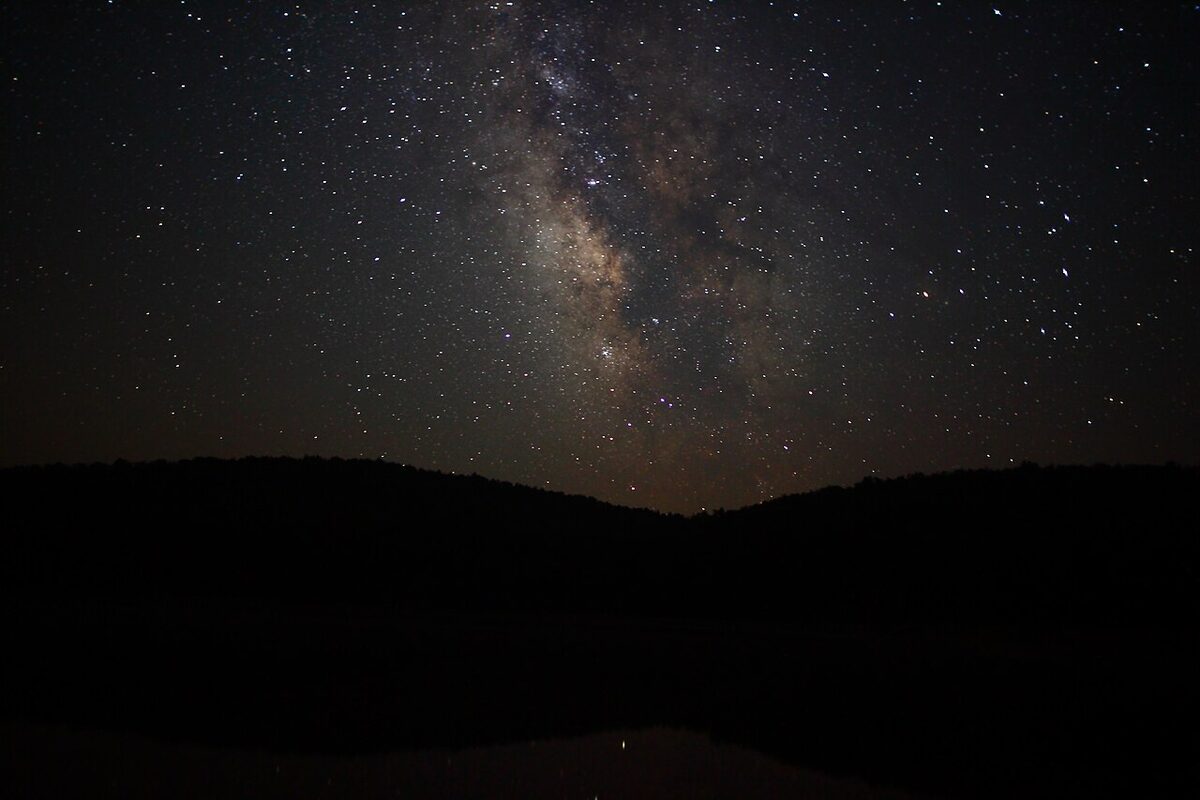
For deep-sky observers, the real news is the return of the summer Milky Way. By 10:30 p.m. the Summer Triangle — Vega, Altair, Deneb — stands well up in the east, signposting the Ring Nebula, the Dumbbell, and the North America Nebula, while the galaxy's bright core rises in the south through the small hours.
Why It Matters
None of this requires a telescope, a dark-sky site, or anything beyond a clear western horizon and ten spare minutes after sunset. June's planet gathering is the kind of naked-eye event that turns casual glances into a habit — three worlds and the Moon arranged in a line you can explain to a kid in one sentence. The occultation on the 17th is rarer still: the Moon physically covering another planet while you watch. Skywatching in June is an exercise in catching things before they go — Jupiter before the glare takes it, Mercury before it drops, the noctilucent clouds before the season turns. Check a pass-prediction tool like NASA's Spot the Station for bonus satellite flyovers, set an alarm for the 16th, and take the ten minutes.
