
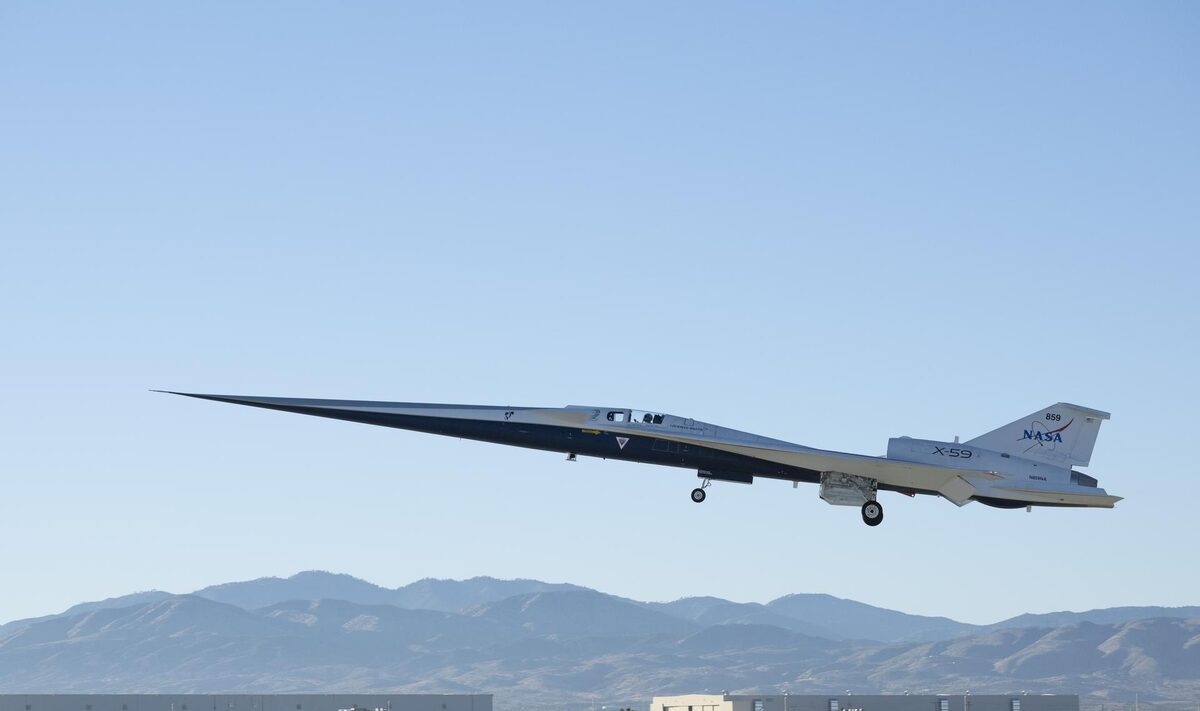
For more than a year, NASA's X-59 has flown with NASA pilots, out of a NASA facility, on a NASA mission, and it still did not legally belong to NASA. That ended on November 18. According to a post on the agency's Quesst mission blog published November 23, NASA officially took ownership of the experimental quiet-supersonic aircraft from contractor Lockheed Martin Skunk Works that day.
The handover is paperwork, but it marks a real point in the program. Lockheed Martin had retained official ownership while working toward completion of an aircraft acceptance review with NASA, which NASA calls a key step in contract closeout. The X-59 is now NASA's aircraft. Lockheed Martin remains involved and will provide supplemental support on an as-needed basis, NASA says.
From Palmdale to a working test aircraft
The X-59 first flew on October 28, 2025. It departed Lockheed Martin Skunk Works' facility in Palmdale, California, and flew to NASA's Armstrong Flight Research Center in Edwards, California, which has since served as its home base. Lockheed Martin's announcement of that first flight, which quoted OJ Sanchez, was titled "X-59 Soars: A New Era in Supersonic Flight Begins." Company releases often say things like that. The more useful measure is what the aircraft has done since.
By late October 2026, the X-59 had completed more than 40 additional flights, Air Data News reported. The aircraft has flown above 56,000 feet and reached Mach 1.53. It has also demonstrated Mach 1.4 at 55,000 feet, the conditions planned for its primary mission. Those numbers matter because they show the airframe can actually reach the supersonic regime where its shaped-boom design is supposed to pay off.
The jet has also begun flying beyond the California desert. Air Data News reported that the X-59, registered as N859NA, left Edwards Air Force Base on October 28 on its first major trip away from its California test area, stopping in El Paso and then Fort Worth, Texas, on the way to NASA's Kennedy Space Center in Florida, where it was expected to appear at the MAX POWER event on November 7 and 8. A long ferry flight with intermediate stops is not a technical milestone. It does suggest an aircraft that can operate away from its home base, which a community overflight campaign will require.
What the X-59 is actually for
The X-59 is not a prototype airliner and was never meant to become one. It is a measurement tool. According to NASA's overview of the Quesst mission, the program has two goals. The first is to design and build an aircraft that reduces the loudness of a sonic boom to a gentle thump for people on the ground. The second is to fly that aircraft over several U.S. communities to gather data on public responses to the sound and deliver that data to national and international regulators.
NASA splits the mission into three phases: building the aircraft and flying it to expand its envelope, acoustic validation over the test range at Armstrong and Edwards Air Force Base, and community response testing. NASA's mission page says that at the successful conclusion of the first-phase flights, NASA will officially take delivery of the aircraft from Lockheed Martin. That is the step the November 18 transfer represents. The X-59 is now NASA's aircraft to use in the remaining testing and, eventually, in the overflights.
The work involves several NASA centers. NASA says the mission's systems project office spans all four of its aeronautical research field centers: Langley in Virginia, Glenn in Cleveland, and Ames and Armstrong in California. That reflects how much of the effort is about acoustics, atmospheric propagation and human-response research, not just flying a new airplane.
Cathy Bahm, Low Boom Flight Demonstrator project manager, commented on the transfer in the agency's announcement, saying it shows how much closer NASA is to providing the data to hopefully make commercial supersonic flight over land a reality. NASA also noted that its newly announced X-70 now joins the X-59 in the agency's X-plane portfolio.
Why It Matters
The hard part of quiet supersonic flight is not only aerodynamic. It is also regulatory and social. Aircraft designers can shape a fuselage to spread out and soften a shock wave. But no rulebook can be rewritten on engineering data alone if nobody knows how people on the ground will react to the result. Quesst exists to answer that second question. NASA explicitly frames the community survey data as information for regulators establishing data-driven acceptable noise thresholds for supersonic flight over land.
That makes the order of events important. An aircraft with more than 40 flights behind it, demonstrated performance at Mach 1.4 and 55,000 feet, and NASA ownership is an aircraft moving toward the program's main job. The announcement itself says the X-59 continues flight testing under NASA ownership, and NASA's mission page lays out acoustic validation and then community overflights as the remaining phases.
What NASA has not said publicly in these sources is just as notable. The ownership announcement gives no date for the start of community overflights and does not name which communities will be overflown. The phase structure is clear. The schedule for the phase that matters most to regulators is not.
For now, the facts are modest. The jet flies, it has gone supersonic, it has begun traveling beyond its California test area, and it now belongs to NASA. Whether the "thump" works as intended can only be learned from the people who will hear it, and that part of the experiment has not started yet.
