
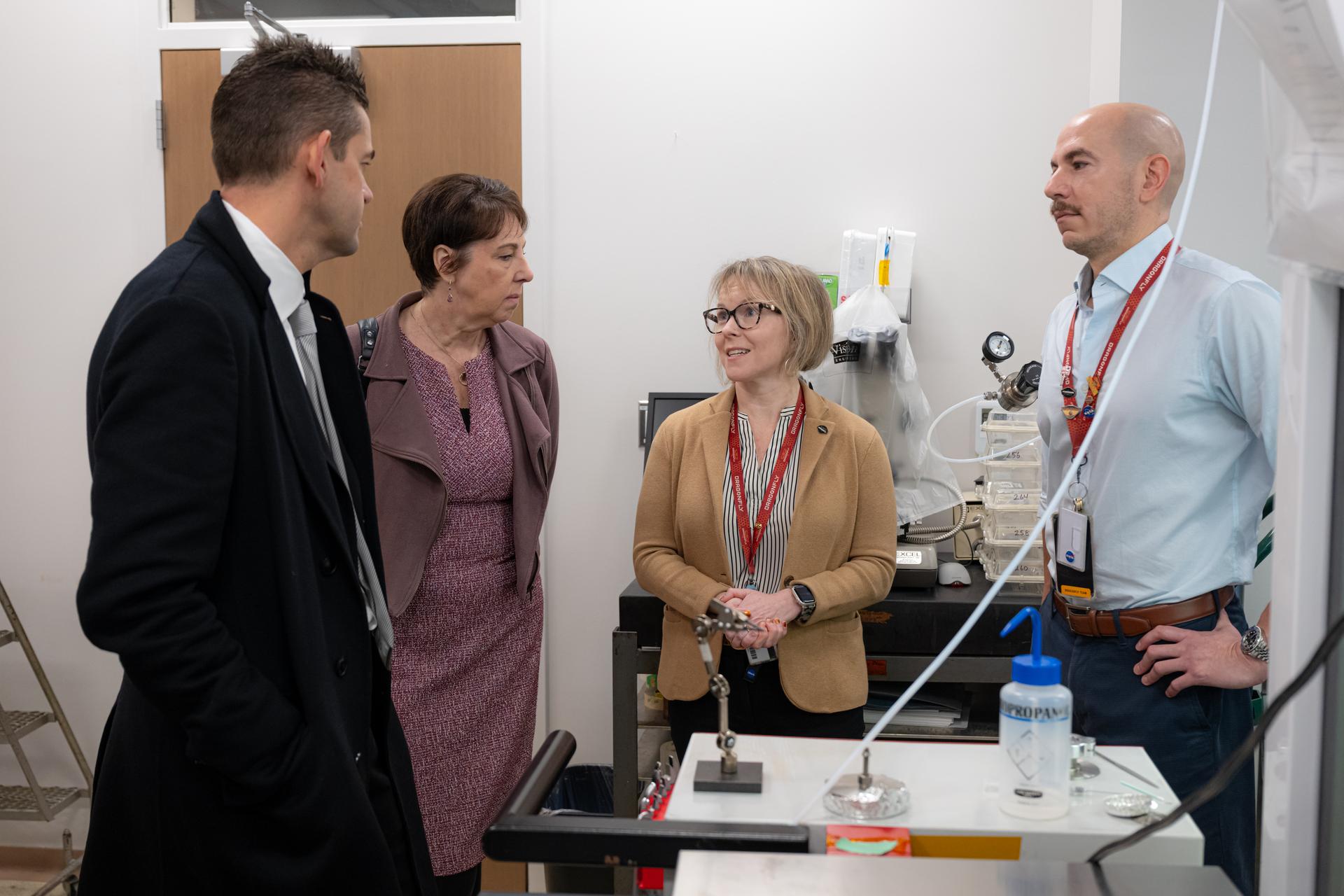
A rotorcraft that will fly across Saturn's largest moon needs a way to see where it is going, where it is landing and what it is sitting on. As of mid-November, Dragonfly has that. NASA reported on Nov. 24 that all seven cameras of the DragonCam suite, built by Malin Space Science Systems (MSSS), had been installed in their insulated housings, tested and integrated into the rotorcraft at the Johns Hopkins Applied Physics Laboratory (APL) in Laurel, Maryland.
The cameras are part of a broader wave of hardware now reaching APL as the spacecraft fills out. Two separate navigation cameras, also built by MSSS, went onto the vehicle earlier, this summer. NASA published a photo of technicians Chad Cook and Seth Harvey installing the high-resolution microscopic imager, part of the DragonCam suite, on Nov. 6. On Nov. 9, shortly after the suite was installed, the team captured a panorama of the APL cleanroom from the forward and side wide-angle cameras, an early sign that the suite works as a system and not just as a set of parts on a shelf.
Seven cameras, four jobs
DragonCam isn't a single instrument pointed in one direction. It is a set of cameras placed around the rotorcraft, each covering a different part of the job of exploring a world nobody has ever seen up close at human scale. Broken down by role:
- Looking ahead. A forward-facing wide-angle camera (WAC) with a 90-degree field of view is paired with a medium-angle camera (MAC) whose view overlaps the WAC's at higher resolution. Together they give Dragonfly a stereoscopic view of the terrain in front of it, which lets the team judge depth and shape as well as appearance.
- Looking around. Two side-mounted WACs, together with the forward cameras, capture panoramic views of the Titan landscape, building up the wide context scientists need to understand a landing site's geology.
- Looking down. Two downward-facing WACs show the surface beneath the lander, helping the mission team decide whether a landing spot is safe for deploying the DrACO drill (Drill for Acquisition of Complex Organics) and the seismometer. Before either instrument touches Titan, someone needs to know exactly what it will touch.
- Looking very closely. The microscopic imager aims at DrACO's drill site to pick out detail in the millimeter-sized sand grains around the sampling location.
That adds up to seven. The two navigation cameras installed this summer are in addition to the science cameras and are not part of DragonCam.
Lighting up the Titan night
Titan's nights last a long time: NASA says the long night spans nearly eight Earth days. A camera that could only work in daylight would sit idle for long stretches.
To work around that, APL built a configurable LED array that spans the spectrum from the infrared to the ultraviolet. According to NASA, it provides information about the color of surface materials at the sampling site and helps scientists make inferences about their composition, and it lets the cameras see Titan as human eyes would. The ultraviolet end of that range has a more specific scientific job: during the long Titan night, these observations also may allow DragonCam to identify organic molecules that fluoresce under ultraviolet light. Dragonfly's mission is built around carbon-rich material on Titan, so a cheap optical test that flags interesting material before the drill is committed could be a valuable tool.
The hardware also has to survive the environment. Titan's ambient temperature reaches about minus 290 degrees Fahrenheit. Each camera looks out at Titan through a window in a foam enclosure that insulates the cameras and the rotorcraft's interior from that cryogenic environment, rather than being exposed directly to the cold.
Inside the microscope
The microscopic imager is the most specialized of the seven, and its design has been described in detail in a January 2026 preprint by Clark, Ravine, Caplinger and colleagues at MSSS, posted to arXiv.
Unlike a microscope on a robotic arm, this one is body-fixed: it is bolted to the Dragonfly vehicle and doesn't move to its target. Instead, it images the surface from a distance of about one meter (98.6 centimeters nominally), at a nominal 52-degree angle, and reaches a pixel scale better than 60 microns per pixel, fine enough to resolve individual sand grains.
Getting a sharp image under those constraints takes some optical engineering:
- Focal length: about 77.5 mm, given the sensor's 4.8-micron pixel pitch.
- Optics: an all-refractive design with nine elements, a six-element stationary group and a three-element moving group.
- Tilted focal plane: because the camera's boresight is tilted 52 degrees off the vertical, the optical configuration uses a compensating tilted focal plane based on the Scheimpflug imaging principle, the same idea familiar from tilt-shift photography, so the slanted patch of ground stays in focus.
- Focus mechanism: to accommodate range variations due to vehicle pose and surface topography, a focus mechanism gives the camera a depth of field of about 130 mm.
The paper adds that the camera sits in a cavity in the foam insulation covering the spacecraft and looks through a single-pane window. It is designed to survive temperatures as low as minus 130 degrees Celsius without power, and it will be heated to a nominal minus 30 degrees Celsius before imaging so that its mechanism actuates properly. The result is a fixed camera that can still adapt to wherever the rotorcraft happens to settle, which matters for a vehicle that will land at many different spots.
Why It Matters
Dragonfly's whole premise, as laid out on APL's mission page, is mobility: a rotorcraft lander that travels between and samples diverse sites on Saturn's largest moon. That only pays off if the vehicle can understand each new place quickly. DragonCam covers that whole chain: stereoscopic forward views to read the terrain, panoramas for geological context, downward cameras to help judge whether the surface is safe for the drill and seismometer, and a microscope to examine the grains around the sampling site.
Carolyn Ernst, the DragonCam instrument scientist at APL, said in NASA's announcement that the images will help relate the samples collected at multiple sites to Titan's broader landscape and to the story of its geology. Principal investigator Elizabeth Turtle called seeing the cameras become part of the lander an exciting milestone, and MSSS's Michael Ravine said that having them on the spacecraft makes it much easier to picture how they will work on Titan.
The UV-capable lighting adds something more speculative and potentially more important. If organic molecules on Titan's surface fluoresce under ultraviolet light as NASA says they might, the cameras could offer an early hint about the material at a site. For a mission whose goals include investigating the progression of prebiotic chemistry, that kind of context could be useful in deciding where and how to look more closely.
On the engineering side, finishing the camera integration is a milestone in its own right. Having all seven DragonCam units installed, tested and already returning a panorama means the vehicle's imaging system now exists as flight hardware rather than a set of specifications. NASA notes that science instruments are only starting to arrive at APL, and plenty of integration and testing work remains, but Dragonfly can now, quite literally, see.
