
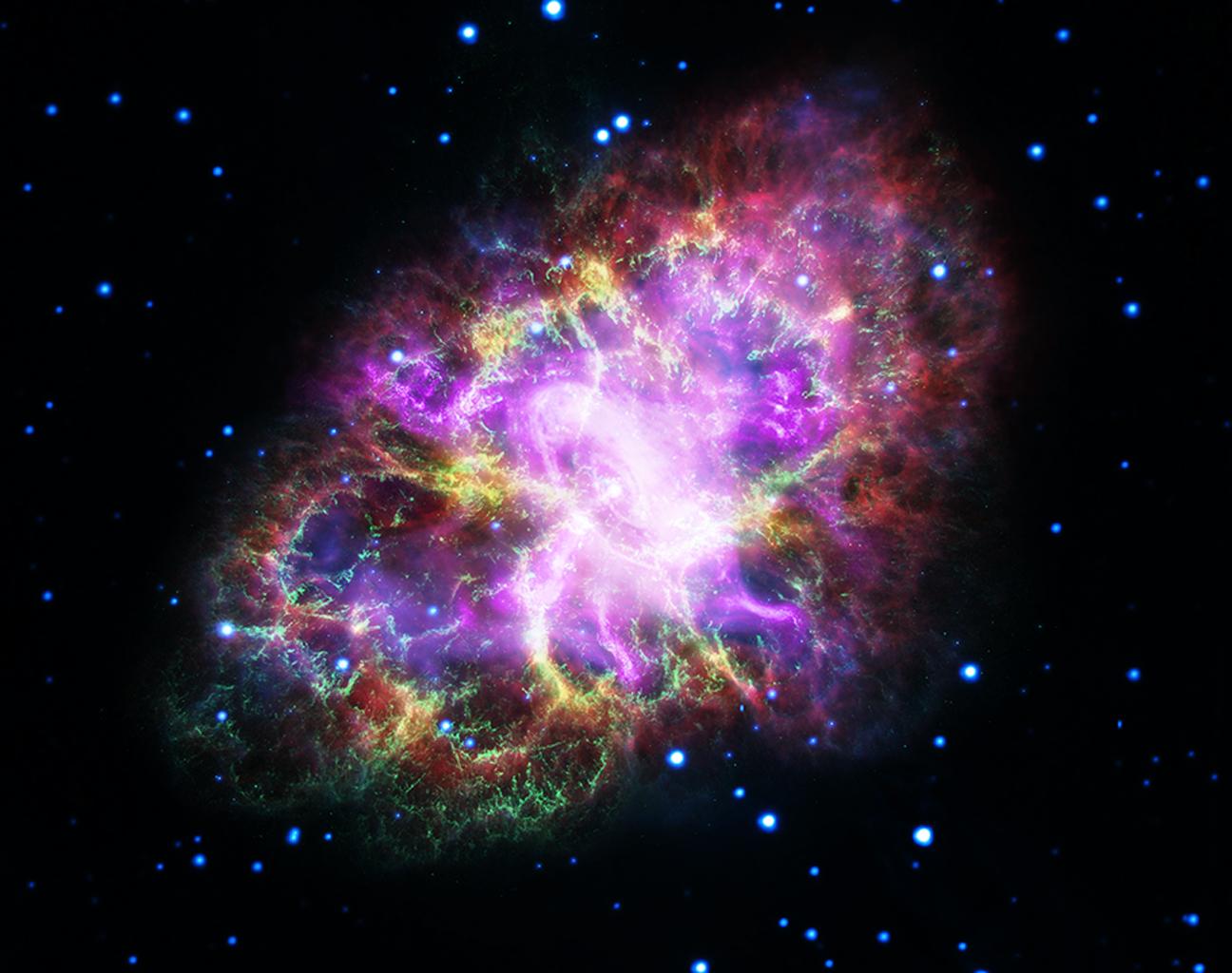
An X-ray telescope that has spent years riding to the innermost planet has produced its first test image, and the target was nowhere near Mercury. The Mercury Imaging X-ray Spectrometer (MIXS) aboard the European-Japanese BepiColombo mission looked at the Crab Nebula. The image, released by a University of Leicester team as a proof-of-concept test, comes just days after the spacecraft entered orbit around Mercury in an arrival that did not go entirely to plan.
According to Universe Today, MIXS is the first X-ray instrument flown on an interplanetary spacecraft. It is also the UK Space Agency's instrument contribution to the mission, and the test image was released by a University of Leicester team. The Crab Nebula observation was assembled from 55 slews over 39 hours on September 11 and 12, 2026. That was shortly after BepiColombo jettisoned its transfer module on September 3, which finally gave MIXS a view of deep space.
An Arrival With a Hiccup
BepiColombo reached orbit around Mercury on November 21, 2026, at an altitude of roughly 635 km, EarthSky reports. The insertion did not go cleanly. The orbit-insertion burn stopped early, after completing about three-quarters of the planned manoeuvre, and the spacecraft entered safe mode. ESA's Josef Aschbacher said the cause was traced to a software issue in attitude guidance and thruster control.
Even with the shortened burn, the spacecraft was captured. The next major step is the separation of the orbiters, planned for December 9. Science operations are expected to begin in April 2027. MIXS has not begun its main work yet. The Crab Nebula image is a proof of concept for the hardware.
Why Point a Mercury Instrument at a Nebula?
Universe Today describes the Crab Nebula, about 6,500 light-years away in Taurus, as a prominent X-ray source and a fine target for calibration and testing. During the cruise to Mercury, the transfer module blocked the instrument's view, so only the detectors' behavior could be monitored. Only after the module separated did MIXS see deep space for the first time, which made the Crab a chance to test the instrument before arrival.
Mostly, the image is a proof of concept. An instrument that can collect and focus X-rays from a source light-years away should be well placed to measure the much closer X-ray glow of a planetary surface.
How the Optics Work
X-rays are difficult to focus. MIXS operations scientist Adam Fox told Universe Today that X-rays can only be reflected to a focus at very shallow angles, so conventional X-ray telescopes need focal lengths of about 10 metres and nested mirrors with a mass of hundreds of kilograms. MIXS uses micro-pore optics instead, with millions of pores 20 microns wide. Per Fox, that allows an X-ray telescope 1 m long that weighs only 11 kg, small and light enough to fly to Mercury.
What MIXS Will Do at Mercury
The main science goal is chemistry. ESA's MIXS science page describes the method as X-ray fluorescence (XRF) in the 0.5 to 7.5 keV energy range. That range covers rock-forming elements from magnesium to iron. Each element gives off X-rays at its own characteristic energies. Measuring those energies across Mercury's surface shows which elements are present, and in what amounts.
ESA lists three main aims:
- Produce global maps of the abundance of rock-forming elements, with accuracy between 5 and 50 percent.
- Carry out higher-resolution mapping of selected regions.
- Confirm X-ray emission from Mercury's auroral zones, where interactions with the planet's magnetic environment are expected to produce X-rays.
The Max Planck Institute for Solar System Research likewise describes MIXS as measuring X-rays from both Mercury's surface and its magnetosphere. The institute notes that the fluorescence signal reveals the surface's composition and, through it, its geological history.
There is a catch. Fluorescence depends on how much X-ray light the Sun is sending at any given moment, so a brighter or dimmer surface signal could reflect a change in the Sun rather than a change in the rocks. That is why MIXS works with a partner instrument, the Solar Intensity X-ray and particle Spectrometer (SIXS). According to ESA, SIXS provides the reference solar flux, so the team can tell which variations in Mercury's X-ray glow come from the surface and which come from the Sun.
Why It Matters
Mercury's surface chemistry is a record of how the planet formed and how its crust developed. Global element maps would let scientists compare regions, link composition to geological features, and test ideas about Mercury's history against measured data. MIXS is built to make those maps. If it performs at Mercury as it did on the Crab Nebula, it will produce some of the mission's most important datasets.
The instrument also matters as a technology demonstration. As the first X-ray instrument on an interplanetary spacecraft, MIXS shows that micro-pore X-ray optics can work far from Earth. The September test was carried out well before orbit insertion, so it says nothing about how MIXS will fare in Mercury orbit, but it is an encouraging first check.
Several milestones remain before the Mercury science begins: orbiter separation on December 9, the work of reaching final orbits, and the start of science operations in April 2027. For now, MIXS has shown it works on a well-known target. Its first maps of Mercury's surface chemistry are still months away.
