
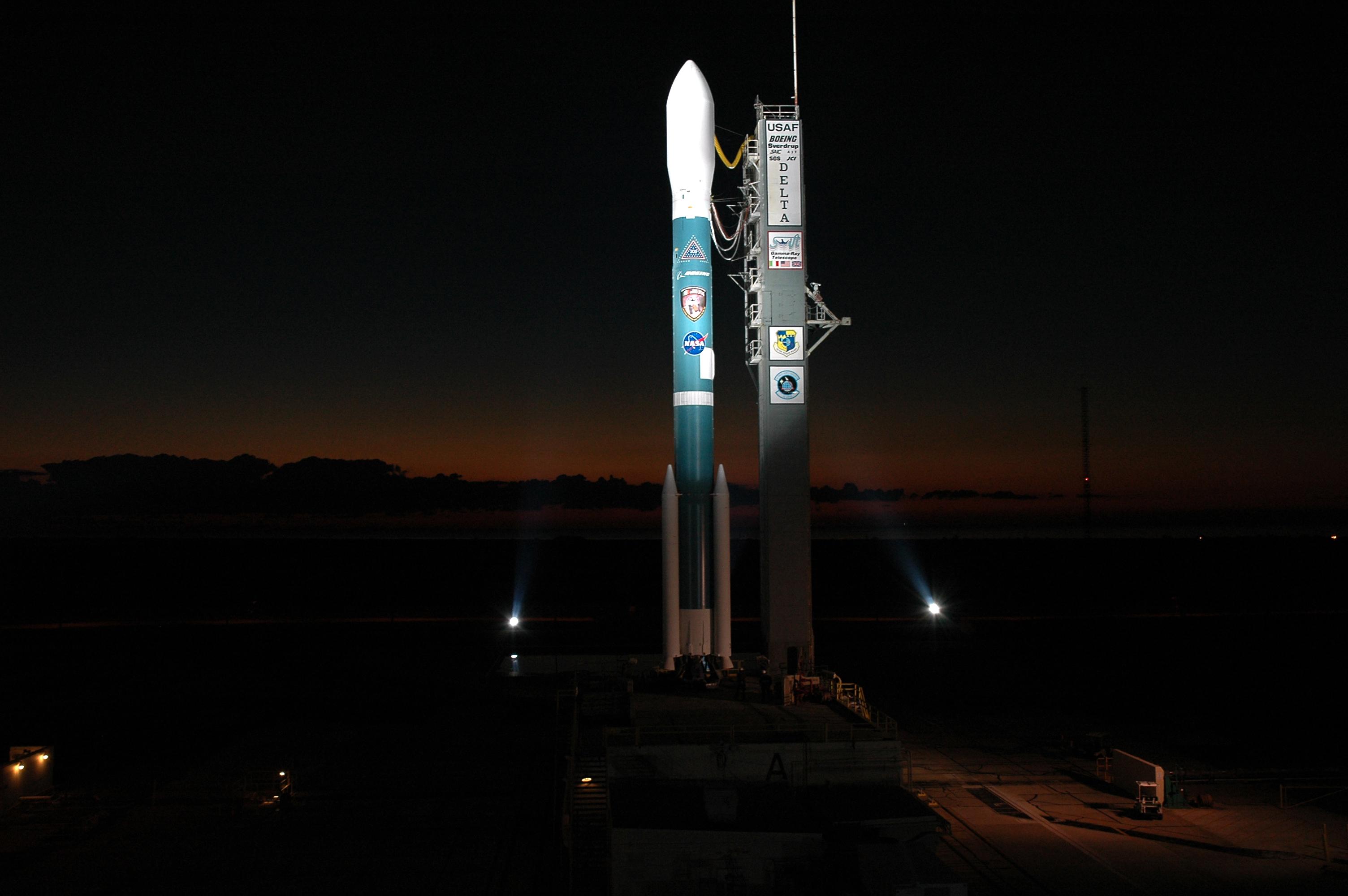
NASA and the startup Katalyst Space Technologies announced Wednesday that their LINK servicing spacecraft will not perform the orbit-boosting maneuver it was built for. The mission's target, the Neil Gehrels Swift Observatory, will not get the altitude bump that was supposed to buy the aging gamma-ray burst hunter more years of science. The reason: LINK itself is in trouble, hobbled by an attitude-control failure that has left it unable to safely capture and push a spacecraft many times its size.
It's a role reversal nobody wanted. LINK launched on July 3 aboard a Northrop Grumman Pegasus XL rocket with a single, urgent job: rendezvous with Swift, which has been observing the universe's most violent explosions since 2004, and nudge it into a higher, more stable orbit before atmospheric drag pulls it into an uncontrolled reentry. Swift's orbit had been decaying for years in low Earth orbit, and the servicing mission was conceived as a fix — not just for one telescope, but as an early test of using commercial spacecraft to keep aging NASA assets alive rather than replacing them.
Instead, LINK has spent the weeks since launch fighting for its own stability.
What Went Wrong
According to reporting from Via Satellite and Space.com, LINK began experiencing attitude-control problems that caused the spacecraft to spin and communicate only sporadically with ground controllers. A preliminary investigation traced the trouble to LINK's reaction wheels — the spinning flywheels spacecraft use to orient themselves without burning propellant — finding that two of the craft's three wheels were inoperable. Investigators also found signs of degraded cold-gas thruster performance, compounding the problem. With only one functioning reaction wheel and thrusters not performing as designed, LINK lacks the precise, sustained pointing control that capturing and boosting another spacecraft would demand.
NASA's Wednesday update, posted to the agency's Swift mission blog, confirmed that LINK "will not capture or boost an agency satellite to a higher altitude to extend its science mission as planned" because of the ongoing attitude-control issue. The agency did not frame this as the end of the mission, however. LINK will still attempt rendezvous and proximity operations — flying close to Swift, matching its orbit, and maneuvering nearby — to demonstrate capabilities NASA says will inform future in-space servicing missions, even without the capture-and-boost finale.
A Mission Built on a Tight Clock
The compressed nature of this project may help explain both its ambition and its risk. Katalyst was awarded its $30 million contract for the mission less than a year before LINK's July 3 launch, giving the company well under twelve months to design, build, test, and integrate a spacecraft capable of rendezvousing with and physically boosting an operational space telescope. Compressing that entire process into under a year is an aggressive schedule for a mission of this complexity.
Satellite servicing — the general concept of sending a spacecraft to refuel, repair, or reposition another spacecraft already in orbit — is still a young and largely unproven capability. A handful of missions have demonstrated pieces of it, but capturing and repositioning an operational science observatory built decades before servicing was contemplated is a different order of difficulty. Swift, launched in 2004 at a cost of about $250 million, was never designed to be grabbed by another vehicle.
Why It Matters
Swift's situation hasn't changed for the better: its orbit has continued to decay, and the original purpose of this mission — averting an uncontrolled reentry while extending the observatory's scientific life — has not been achieved. NASA has not announced a replacement plan for boosting Swift's orbit, and the agency's update focused on what LINK can still accomplish rather than what happens to Swift next.
That leaves the broader test unresolved. In-space servicing is widely viewed across the space industry as essential to a future where expensive assets — telescopes, space stations, communications satellites — aren't simply abandoned once they run low on fuel or drift into decaying orbits. NASA leaning on a commercial startup, on an unusually fast contract timeline, to attempt this on a real operating science mission was itself a bet on that future. LINK's reaction-wheel failure is a reminder that the attitude-control systems needed to safely approach and maneuver around another spacecraft are exactly the systems most likely to strain under real-world conditions, not just in simulation.
Even a scaled-back rendezvous and proximity operations demonstration still has value: NASA and Katalyst will get real data on how a partially disabled servicer behaves near an operational spacecraft, which is itself useful information for building more robust systems next time. But the marquee goal — showing that a young company could reach orbit, catch a telescope, and give it a new lease on life, all within a year of contract signing — will not happen this time. Swift's clock keeps running regardless.
