
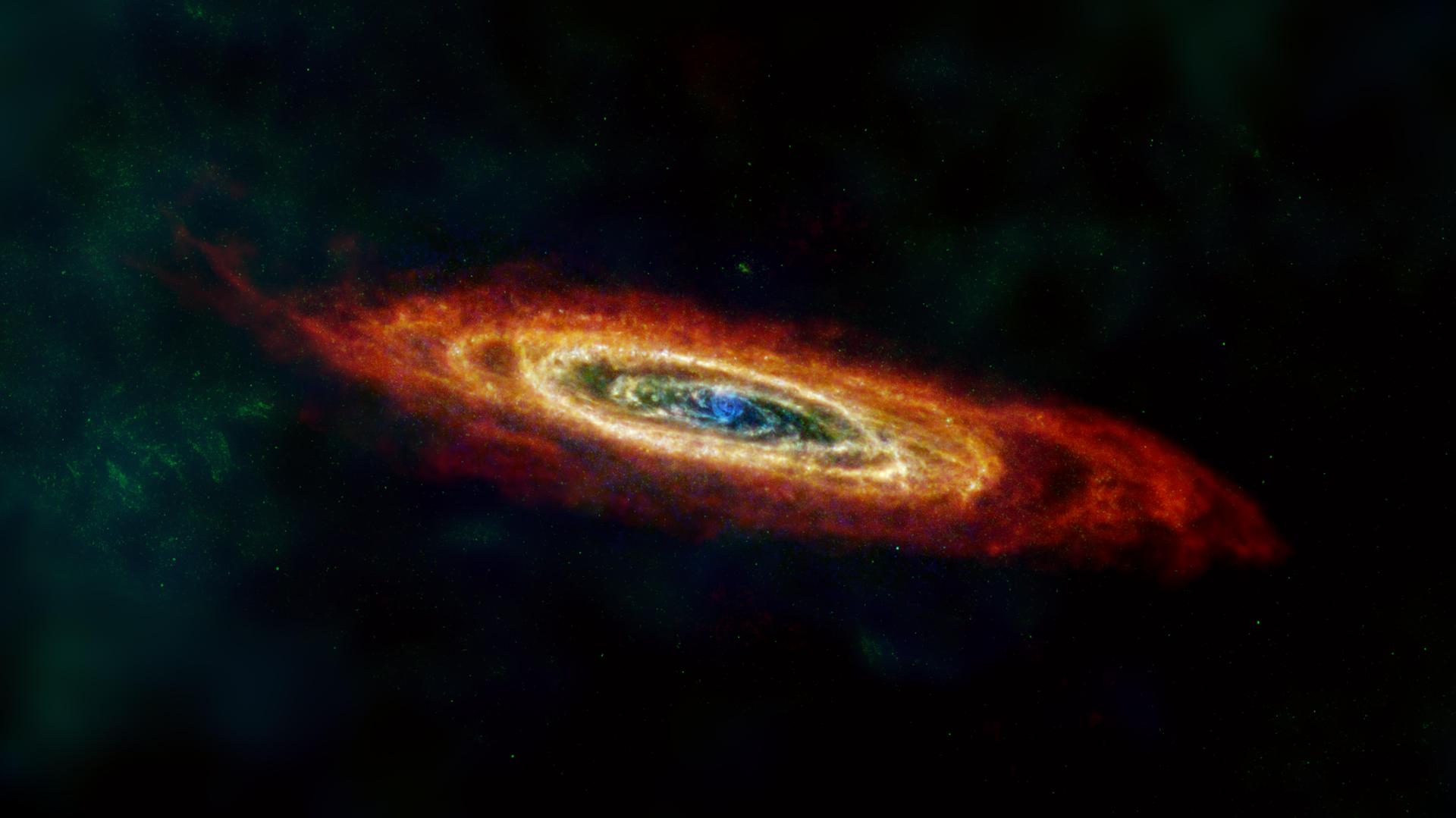
NASA announced on Sept. 24, 2026, that a far-infrared observatory called PRIMA had been selected to advance into its next stage of development as the first mission in the agency's new Probe Explorers class — a tier of astrophysics missions deliberately built cheaper and faster than flagships like the James Webb Space Telescope, but bigger and more capable than the small Explorer-class satellites NASA has flown for decades. The mission's cost is capped at $1.2 billion, excluding launch, and it is targeting liftoff in 2033 for a five-year primary mission.
PRIMA stands for PRobe far-Infrared Mission for Astrophysics. It's a mouthful of a name for a fairly compact instrument: a 5.9-foot (1.8-meter) telescope, cooled to cryogenic temperatures so its own heat doesn't drown out the faint infrared light it's built to detect. That cooling is the whole point. Far-infrared wavelengths carry signatures of cold dust, forming planets, growing black holes, and the chemical buildup of the universe over cosmic time — but a warm telescope glows in infrared itself, swamping the signal. PRIMA sidesteps that by chilling its optics to hundreds of degrees below zero, which IPAC says makes it orders of magnitude more sensitive than previous far-infrared missions.
What PRIMA Will Actually Do
According to Spaceflight Now and IPAC's own reporting on the announcement, the observatory will carry two science instruments alongside its telescope: an imaging polarimeter called PRIMAger and a high-resolution spectrometer called FIRESS. Spaceflight Now, which covered the announcement the same day, reports that the science goals span three connected questions — how planets and stars form, how supermassive black holes grow alongside their host galaxies, and how water on Earth came to be. Those are not small questions, and far-infrared light is one of the few ways to get at all three with a single instrument, because it traces the cold gas and dust that optical and near-infrared telescopes largely miss.
The mission is managed by NASA's Jet Propulsion Laboratory, with Goddard Space Flight Center and Marshall Space Flight Center also involved. It's not a NASA-only effort, either: the agency's release lists international partners including France's CNES, Italy's ASI, Germany's DLR, the Canadian Space Agency, South Korea's KASI/KASA, Japan's JAXA, and the UK Space Agency — a roster that reflects how far-infrared astronomy has become a genuinely global pursuit, with hardware and expertise distributed across multiple space agencies rather than concentrated in one.
Why a New Mission Class at All?
The Probe Explorers class exists to fill a gap. NASA's flagship missions — Hubble, Webb, and the newly launched Roman Space Telescope — cost billions of dollars and take well over a decade to build. Smaller Explorer missions are cheap and fast but limited in scope. PRIMA is meant to sit between those extremes: ambitious enough to do flagship-caliber science on a focused topic, but capped tightly enough on cost and schedule to actually launch on a predictable timeline. Shawn Domagal-Goldman, director of NASA's Astrophysics Division, framed it in generational terms in the agency's release, noting that Webb and Roman set a "cadence of launching premiere-class missions" and that PRIMA is meant to "kick off the next decade" in that same spirit — just at a different scale and price point.
The mission wasn't picked on a whim. NASA's release notes it was recommended by the National Academies' 2020 Decadal Survey, the once-a-decade exercise in which the astronomy community ranks its priorities and hands NASA a roadmap. A far-infrared observatory placed highly enough in that survey to eventually become the first Probe-class selection, which says something about how much appetite there is in the field for exactly this kind of instrument after a long gap since NASA's last dedicated far-infrared mission.
The Caltech and IPAC Connection
Caltech and its IPAC science center — the Infrared Processing & Analysis Center — will play a substantial role in developing PRIMA, according to a report from IPAC's own news page. IPAC already lists PRIMA under "In Development" on its mission roster, alongside NEO Surveyor and UVEX, putting it in company with other next-generation NASA astrophysics efforts that share IPAC's data-processing infrastructure. Caltech President Ray Jayawardhana, quoted by Spaceflight Now, called the selection "a giant leap for far-infrared astronomy" — notable phrasing given how long the far-infrared community has been waiting for a dedicated successor to earlier cold-telescope missions.
Spaceflight Now also reports that PRIMA was selected to move into Phase B development on the day of the announcement — the design phase where a concept mission starts turning into detailed engineering plans, ahead of the harder cost and schedule commitments that come later. That's a meaningful marker: Phase B is where missions either solidify or run into the technical problems that cause delays and cost overruns, so the next several years will be a real test of whether the Probe Explorers class can deliver on its promise of flagship science at a fraction of flagship cost.
Why It Matters
Far-infrared astronomy has been underserved for years. IPAC notes that PRIMA follows the European Space Agency's Herschel observatory, along with NASA's Spitzer Space Telescope and the newer SPHEREx mission, as the next in a line of infrared missions — but nothing has yet matched a dedicated far-infrared observatory's reach. That's left a real gap in astronomers' ability to study cold dust, the earliest stages of star and planet formation, and the growth of black holes obscured by gas and dust that optical telescopes simply can't see through. PRIMA is built to close that gap.
It also matters as a structural bet. If a $1.2 billion mission like PRIMA, moving from selection to a targeted 2033 launch in about seven years, launches on time and on budget, it validates the entire Probe Explorers concept — a middle tier NASA can lean on for future decadal-survey priorities without committing to another Webb-scale, multi-decade flagship every time. Given how sharply flagship costs have climbed and how long they take to reach orbit, a mission class that can deliver focused, high-impact science on a tighter budget and timeline is something the astrophysics community has wanted for a long time. PRIMA is now the test case.
