
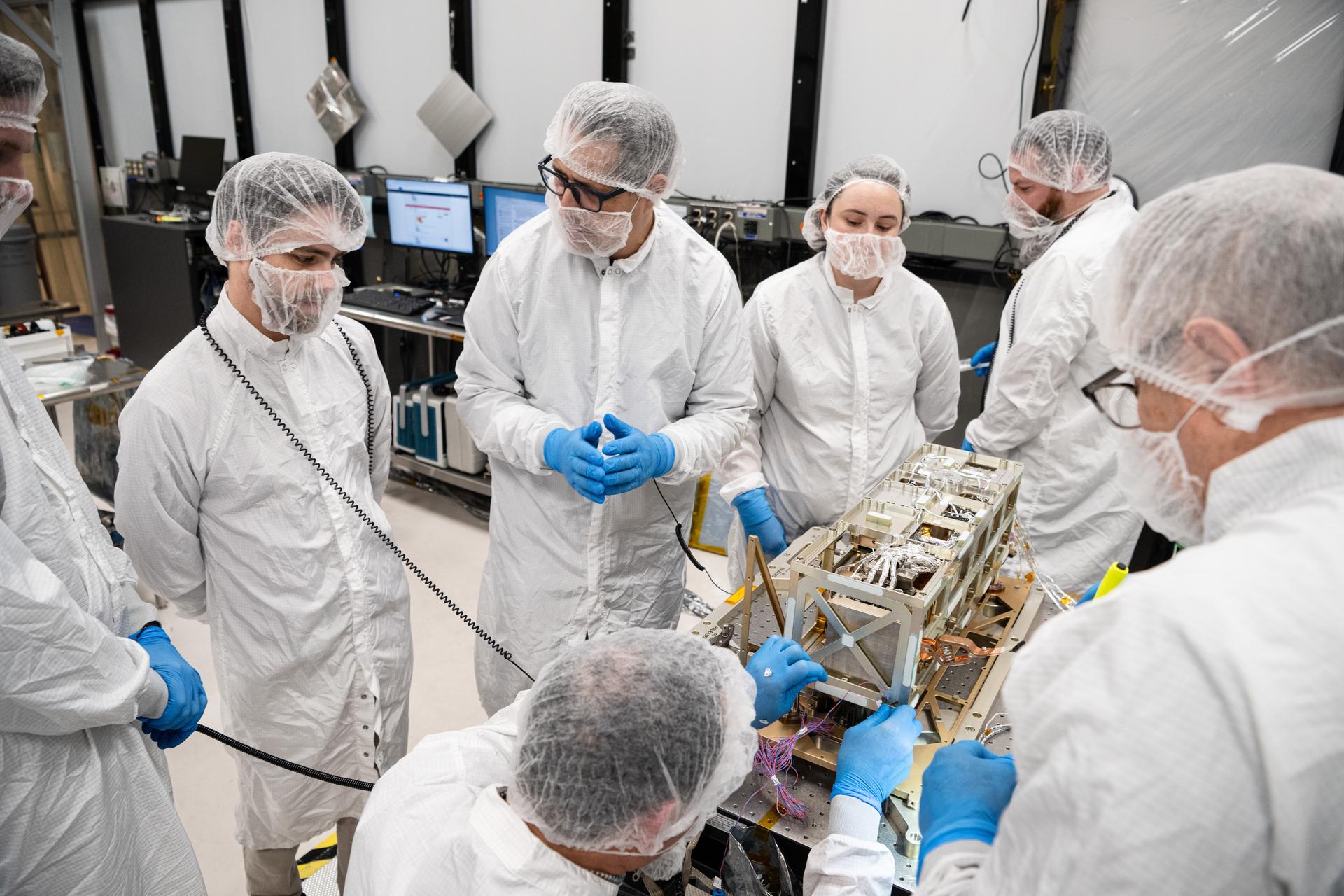
The last time anyone had a working seismometer on the Moon, Jimmy Carter was in the White House. NASA switched off the Apollo Passive Seismic Experiment network in 1977, ending eight years of continuous moonquake monitoring that began with Apollo 11. Now the agency says it has finished building the instrument meant to pick that work back up: the Lunar Environment Monitoring Station, or LEMS, a device roughly the size of a carry-on suitcase that astronauts on a future Artemis mission will plant near the lunar South Pole.
NASA announced on August 11, 2026 that engineers at Goddard Space Flight Center, working with the University of Maryland, Baltimore County and partner universities, have completed hardware development and testing on LEMS after five months of test campaigns. Weighing about 11 pounds under the Moon's weaker gravity, the station is built to run largely unattended for months — potentially years — logging moonquakes and meteorite impacts long after the astronauts who deployed it have gone home.
What's actually in the box
LEMS is deceptively simple for what it has to survive. At its core are two seismometers supplied by the University of Arizona's Lunar and Planetary Laboratory, which redesigned the sensors in partnership with Silicon Audio Inc. specifically for the mission. A flexible, lightweight solar array charges onboard batteries during lunar daylight, storing enough power to keep the station's electronics alive through the roughly two-week lunar night — a stretch during which temperatures at the pole can plunge to minus 400 degrees Fahrenheit.
Rather than streaming data continuously, LEMS phones home about once a month, relaying its seismic logs to Earth through NASA's Deep Space Network. Morehead State University built the telecommunications system that handles that link, while Washington University in St. Louis is responsible for processing and distributing the data once it arrives. That division of labor — one team on sensors, another on comms, another on downstream science — reflects how sprawling the LEMS project has become since it started as a concept in 2018.
From a 2018 concept to an Artemis payload
LEMS is led by planetary scientist Mehdi Benna at UMBC's Center for Space Sciences Technology, and its path to the launch pad has been a long one. The idea originated under NASA's Development and Advancement of Lunar Instrumentation program, a line of funding meant to mature hardware concepts before they're mission-ready. NASA formally selected LEMS on April 10, 2024 as one of three inaugural science payloads for Artemis III, which was slated at the time to put the first astronauts back on the lunar surface since Apollo 17. NASA's August 2026 completion announcement, however, no longer ties LEMS to a specific mission number — the agency says the finished instrument will sit in a clean room at Goddard until it is assigned to an Artemis flight for deployment.
Once deployed, LEMS is designed to operate independently for anywhere from three months to two years, depending on how its hardware holds up to the thermal cycling of lunar day and night. Benna has described the stakes in sweeping terms, calling Artemis III "the Apollo 11 of our generation" — a framing that puts a lot of weight on a device barely bigger than a piece of airline luggage.
Why It Matters
Seismometers are one of the few instruments that can see inside a planetary body without drilling into it. Every moonquake or meteorite strike sends vibrations rippling through the Moon's crust, mantle, and core, and the way those waves bend, speed up, or slow down reveals what they're passing through. That's exactly how the original Apollo network — despite recording only a modest catalog of events over its lifetime — first gave scientists a working model of the Moon's internal structure and helped pin down how it formed.
Almost 50 years later, that model is still built on a limited, aging dataset gathered from equatorial Apollo landing sites. LEMS will be the first dedicated lunar seismic instrument since then, and notably the first ever stationed near the South Pole, a region NASA has prioritized because of its permanently shadowed craters and suspected water ice. A seismometer running there for months or years could refine estimates of the Moon's interior in ways the equatorial Apollo data simply can't, while also building a real-time picture of how often small impactors strike the polar region — information that matters directly for the safety of any long-duration lunar surface operations NASA hopes to run in the years after astronauts first land there.
There's also a practical case for the instrument's design itself. Everything on LEMS has to be light enough for an astronaut to carry and deploy by hand, rugged enough to survive a temperature swing of hundreds of degrees every lunar day-night cycle, and autonomous enough to keep collecting data with only a monthly check-in via the Deep Space Network. If that combination works in the field, it becomes a template for other astronaut-deployed science hardware on later Artemis missions, where every pound of payload and every minute of crew time on the surface is scarce.
What comes next
Completing hardware testing is a milestone, not a launch. LEMS still has to be assigned to a specific Artemis flight and integrated with that mission's landing systems before it ever reaches the Moon, and its actual science return depends entirely on that mission's timeline holding and the crew successfully deploying it near the South Pole as planned. NASA's Joel Kearns, of the agency's Science Mission Directorate, called finishing LEMS "a major step in a new era of lunar surface science" — a claim that will be tested the moment the instrument starts recording its first moonquake, whenever that turns out to be.
Sources
- NASA Completes Astronaut-Deployed Science Instrument for Lunar Surface
- NASA Selects UMBC-led Lunar Instrument For Implementation On Artemis III Moon Landing Mission
- NASA Goddard to Build Quake Detector for Artemis III Moon Landing
- Seismometers Re-designed by U of A Will Measure Moonquakes During a Future Artemis Mission
