
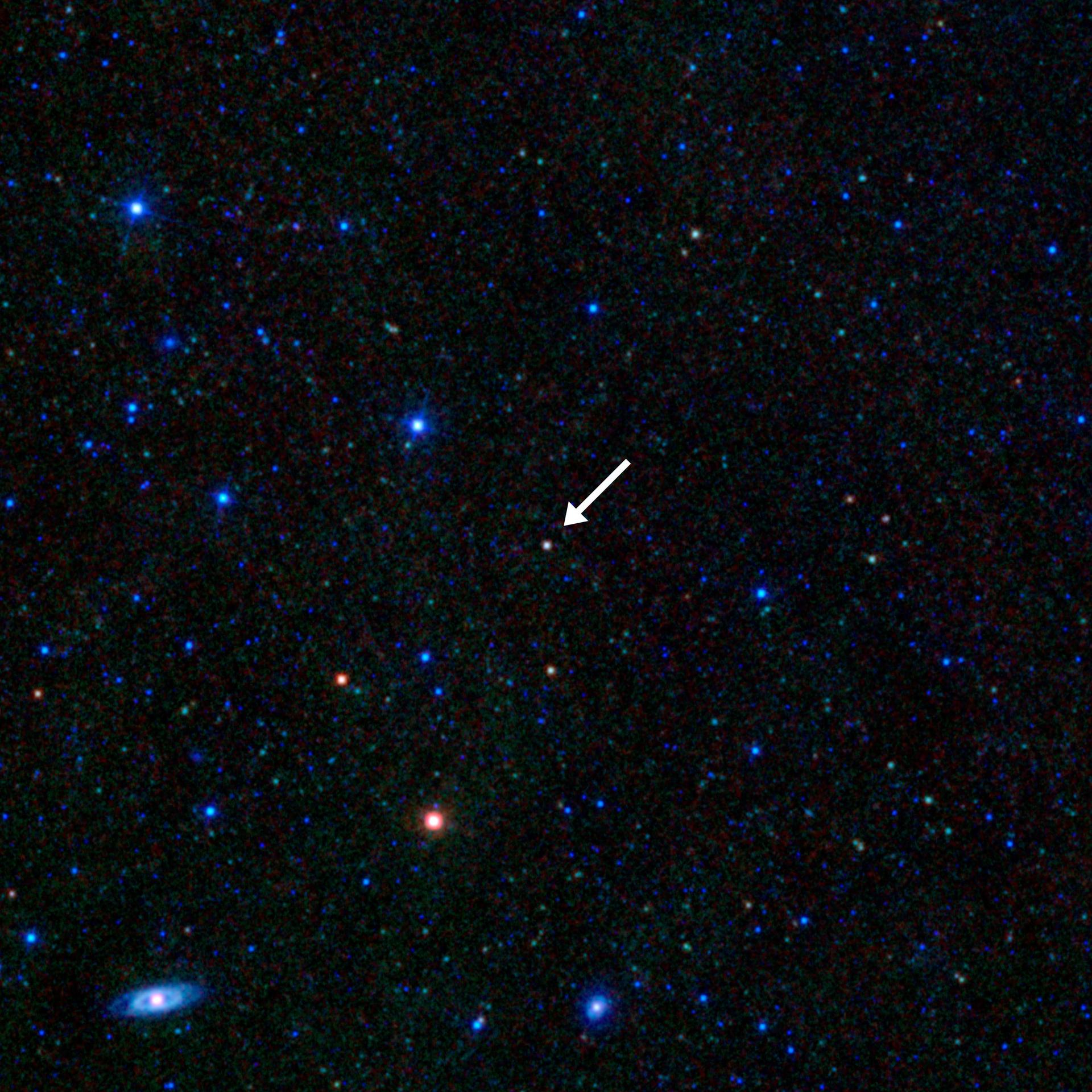
For decades, a source cataloged as IRAS 18293-0941 sat quietly in astronomical databases, filed away and largely forgotten. It took an international team led by Josep Martí of the University of Jaén to look again and realize what they were staring at: the first "microblazar" ever identified in the Milky Way, a stellar-mass black hole whose relativistic jet happens to be pointed almost directly at Earth.
The team announced the discovery on Sept. 22, 2026, and the underlying study — "A Galactic microblazar as a potential accelerator of ultra-high-energy particles" — has been accepted for publication in Astronomy & Astrophysics, following a preprint posted to arXiv on Sept. 1. The 13-author paper, which also lists Pedro L. Luque-Escamilla and Benito Marcote among its authors, identifies IRAS 18293-0941 as a strong candidate for a class of object astronomers have theorized about but never actually caught in our own galaxy.
What a "Microblazar" Actually Is
Blazars are among the most extreme objects in the universe: supermassive black holes at the centers of distant galaxies, actively feeding on surrounding gas and dust, that launch jets of particles at close to the speed of light. What makes a blazar a blazar — rather than just another jetted black hole — is orientation. The jet happens to point nearly straight at Earth, and because the emitting material is moving toward us at relativistic speeds, the radiation gets dramatically boosted and beamed in our direction, a phenomenon called relativistic beaming.
A microblazar is the same idea scaled down. Instead of a supermassive black hole billions of times the mass of the sun, it's a stellar-mass black hole — likely only a handful of solar masses — locked in orbit with a companion star. In a release from the Netherlands Research School for Astronomy, republished by Phys.org (read via a Wayback Machine snapshot after the live page returned an error), IRAS 18293-0941 fits that description: a black hole system producing a collimated, one-sided radio jet, with the visible jet moving toward Earth while its mirror-image counterjet, moving away, is essentially invisible to us.
Buried in Dust, Hiding in Plain Sight
Part of why this system went unnoticed for so long is where it sits. Martí, the study's lead author, described the source's predicament bluntly: it "sits behind so much dust that it is essentially invisible in ordinary optical images," according to EarthSky, which first reported the human details of the discovery in a Sept. 27 piece by Kelly Kizer Whitt. The object had been logged in earlier catalogs and then effectively dropped from active study — a footnote until someone went back and reexamined the radio data.
What the team found: IRAS 18293-0941 lies roughly 12,000 light-years from Earth, according to EarthSky. The system consists of a black hole roughly 10 times the mass of the sun, per Phys.org, and a companion star; the two complete an orbit around each other every 11.38 days. From that tight binary, twin jets erupt in opposite directions, one aimed almost directly along our line of sight, traveling at roughly three-quarters the speed of light.
A Possible Link to One of the Galaxy's Most Energetic Sources
The discovery would be notable on its own as a rare, well-oriented example of a Galactic jet system. But the paper's more striking claim is about where that jet's energy might end up. Phys.org's account describes the jet traveling roughly 100 light-years before slamming into a molecular cloud — and it's at that collision point that things get interesting.
The research team models a likely physical connection between IRAS 18293-0941 and LHAASO J1831-1007u, a source of ultra-high-energy particle emission cataloged by the Large High Altitude Air Shower Observatory. If the jet is indeed acting as the engine behind that ultra-high-energy source, the impact zone where the jet meets the molecular cloud could be accelerating particles up to petaelectronvolt energies — roughly 100 times the energy reached by the Large Hadron Collider, Earth's most powerful particle accelerator, according to Phys.org. That would make this modest, dust-shrouded binary one of the most powerful natural particle accelerators identified anywhere in the Milky Way.
Why It Matters
Blazars have long been studied as extragalactic phenomena — distant, supermassive, and safely far removed from any direct entanglement with our own galaxy's structure. Finding a microblazar inside the Milky Way, with a jet pointed at us, gives astronomers something blazar research has never had before: a nearby, resolvable laboratory for studying relativistic jet physics up close, rather than squinting at beamed light from galaxies hundreds of millions of light-years away.
It also reframes how astronomers think about the Milky Way's population of stellar-mass black holes. If IRAS 18293-0941 is a legitimate microblazar linked to an ultra-high-energy particle source, it suggests that Galactic X-ray binaries — of which many are known — could be an underappreciated category of cosmic-ray accelerator, hiding in plain sight behind interstellar dust the way this one did. The fact that this source was cataloged decades ago and essentially ignored raises an obvious question: how many more microblazars are sitting in old survey data, waiting for someone to look again with the right instruments and the right question in mind?
There's also a practical angle for particle astrophysics. The origins of ultra-high-energy cosmic rays and gamma rays detected reaching Earth remain one of astrophysics' persistent open problems. A confirmed, nearby, directly observable accelerator — one whose black hole, companion star, orbital period, and jet geometry can all be measured — would give researchers a concrete system to test models against, rather than relying solely on indirect signatures from far more distant and poorly resolved sources.
What Comes Next
The study has cleared peer review and is accepted for publication in Astronomy & Astrophysics, which should bring closer scrutiny from the broader community. Follow-up observations — deeper radio imaging to confirm the jet's structure and speed, and multi-wavelength work to pin down the connection to LHAASO J1831-1007u — will determine whether IRAS 18293-0941 holds up as the genuine article: the Milky Way's first confirmed microblazar, and possibly one of its most energetic hidden engines.
Sources
- A Galactic microblazar as a potential accelerator of ultra-high-energy particles — arXiv preprint
- Milky Way's first microblazar may produce fastest particles in the galaxy — Phys.org (via Wayback Machine snapshot)
- A black hole jet is aimed at us ... and it's in our galaxy — EarthSky
