
For years, gravitational microlensing has been the quiet cousin of exoplanet detection methods. It doesn't produce the tidy phase-folded light curves of the transit method or the elegant wobble plots of radial velocity. Instead, it relies on a chance alignment: a foreground star and its planets drift directly in front of a distant background star, and for a few days to a few weeks, their combined gravity bends and magnifies that background star's light into a signature nobody can reproduce twice. Once the alignment passes, the system is gone — no second look, no follow-up transit, just the light curve you managed to catch.
That fragility is exactly why a new discovery, posted to arXiv on September 11 by Cheongho Han and 67 coauthors, is drawing attention. The event, cataloged as KMT-2026-BLG-0083, wasn't caught by one telescope but three separate survey teams working independently — the Korea Microlensing Telescope Network (KMTNet), the OGLE survey, and the newer PRIME infrared survey — with a fourth project, DREAMS, chipping in follow-up monitoring. That kind of redundant, multi-observatory coverage is what let the team pin down not one planet around the lensing star, but two.
What the light curve revealed
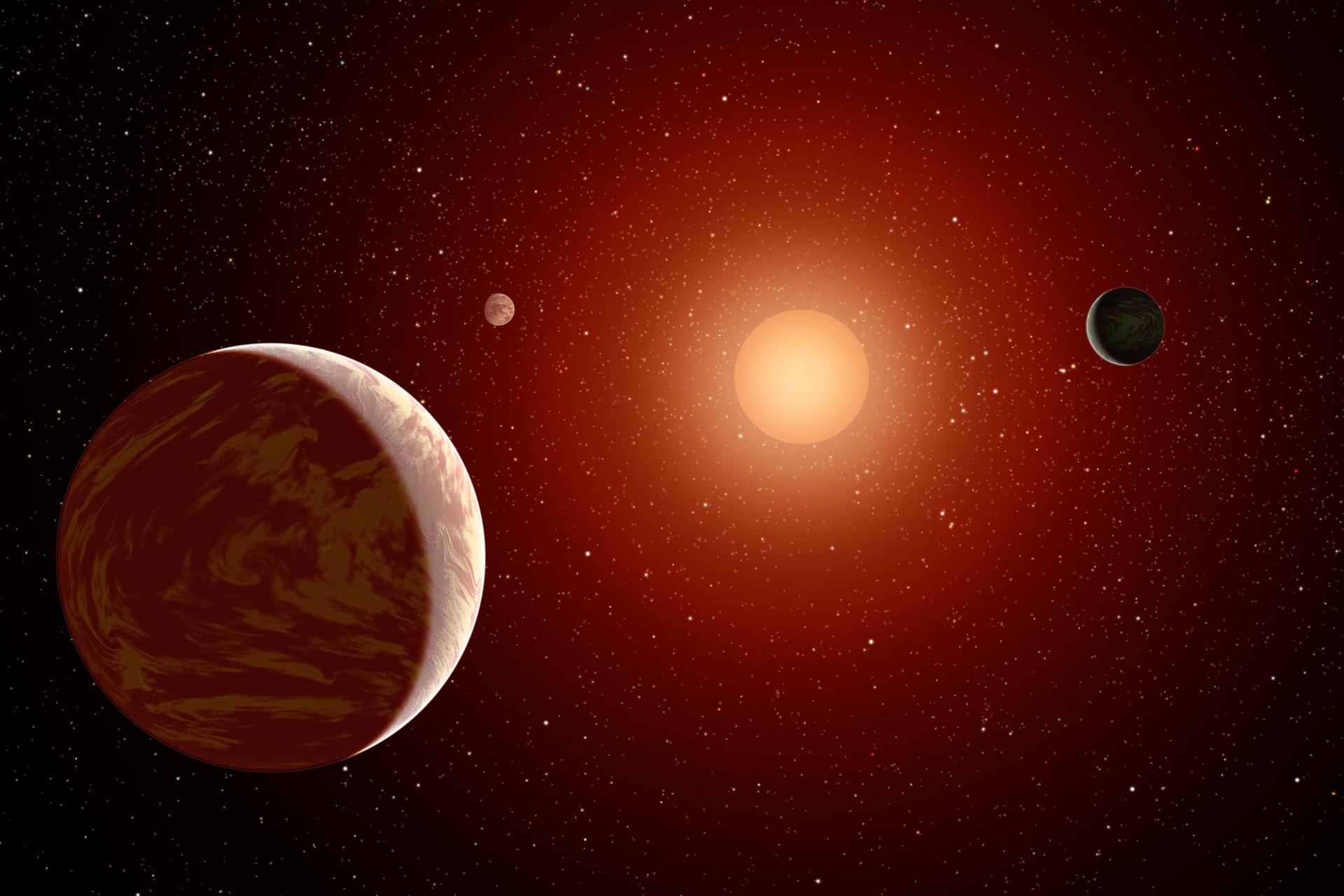
The host star is an M dwarf with roughly 0.48 times the mass of the Sun — a fairly ordinary red dwarf by galactic standards, the most common type of star in the Milky Way. Orbiting it, according to the paper, are two planets in the Jupiter mass class: one at 1.54 Jupiter masses sitting at a projected separation of 1.7 AU, and a heftier one at 2.65 Jupiter masses out at 10.6 AU.
The inner planet's position is the detail worth sitting with. At 1.7 AU from a star half the Sun's mass, it lands close to that star's "snow line" — the distance from a star beyond which it's cold enough for water and other volatiles to condense into ice during planet formation, a boundary the paper explicitly identifies this planet as sitting near. The snow line is where planet-formation models predict giant planets are most efficiently built, because the extra solid material (ice, not just gas and rock) gives a growing planetary core a head start on accreting a massive gas envelope before the protoplanetary disk dissipates. The outer planet, by contrast, sits well beyond that boundary — a wide-orbit configuration that the standard core-accretion story struggles to explain, and that some planet-formation theorists instead attribute to disk instability or later migration.
Having both in the same system, around a star as low-mass as this one, is unusual. Jupiter-mass planets are already a stretch for M dwarfs to form and hold onto — these stars have less protoplanetary disk material to work with than a Sun-like star does. Two of them, at very different orbital distances, makes KMT-2026-BLG-0083L only the seventh multi-planet system that microlensing has confirmed since the technique started finding planets.
How three surveys caught the same needle
The independent detection by KMTNet, OGLE, and PRIME is itself a demonstration of how far microlensing infrastructure has come. KMTNet runs three identical 1.6-meter wide-field telescopes spaced around the globe — at Cerro Tololo in Chile, the South African Astronomical Observatory, and Siding Spring in Australia — specifically so that as the Earth rotates, at least one of them always has the galactic bulge (where most lensing events are found) in view. That round-the-clock coverage is essential for catching short, unrepeatable signals like planetary anomalies buried in a lensing light curve.
PRIME adds a different tool to the same hunt: a 1.8-meter near-infrared telescope at Sutherland Observatory in South Africa, built with a 1.45-square-degree field of view and four large infrared detectors. It's a joint project of the University of Osaka, NASA, the University of Maryland, and SAAO, and it doubles as Japan's contribution to preparing for NASA's Roman Space Telescope, which will run its own large-scale microlensing survey later this decade. PRIME's first observing campaign, running from February 2024 through June 2025, flagged 486 candidate microlensing events — a measure of the survey's throughput in its opening season. KMT-2026-BLG-0083 came later, one of the events PRIME caught independently of KMTNet's own detection.
OGLE was the third independent detection of the event. Having all three surveys catch the same signal, with DREAMS adding targeted follow-up, gave the team enough independent data points to model the lens system's mass ratios and separations with confidence, rather than relying on a single, noisier light curve.
Why It Matters
Multi-planet systems are the sharpest tool astronomers have for testing theories of how planets form, because they show what a single protoplanetary disk was capable of producing in one go. A lone gas giant around a red dwarf could be an oddball; two giants at very different distances from the same low-mass star is a data point that planet-formation models have to actually account for — and right now, models built mostly around Sun-like stars struggle to explain how M dwarfs, with their comparatively meager disks, build even one Jupiter-class planet, let alone two.
Microlensing also has a structural advantage over transit and radial-velocity surveys: it's sensitive to planets in wide orbits — a few AU out — that other methods mostly miss, because those methods work best on planets orbiting close to their stars. That's precisely the territory where KMT-2026-BLG-0083L's outer planet sits. As the tally of microlensing-detected multi-planet systems slowly grows past half a dozen, each new one adds a rare, otherwise invisible category of data point: giant planets in the outer reaches of systems built around the galaxy's most common — and most poorly understood, in terms of planet formation — type of star. With NASA's Roman Space Telescope set to run a dedicated microlensing survey later this decade, discoveries like this one are a preview of a dataset that should turn this rare category into a much larger sample.
