
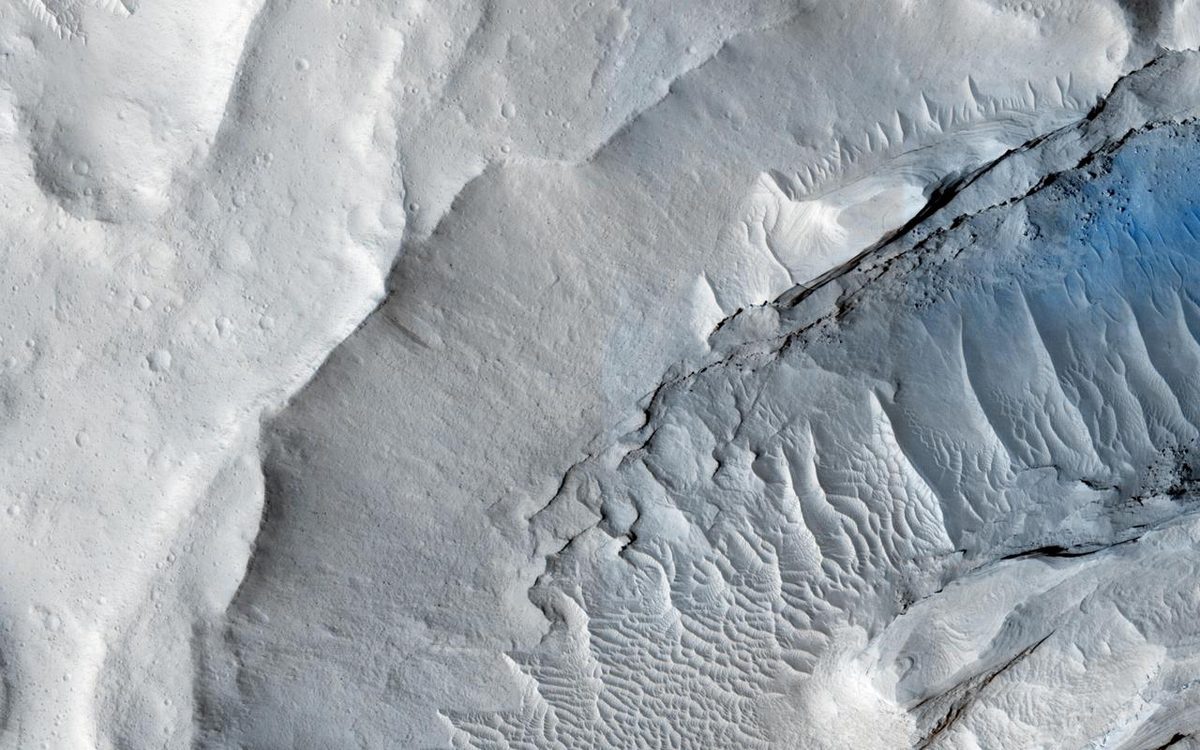
The northern third of Mars sits several kilometers lower than the rest of the planet. That topographic depression — the largest in the solar system — has puzzled planetary scientists since Mariner 9 mapped the hemispheric dichotomy in 1971. One answer that keeps accumulating evidence: it was, for a geologically meaningful stretch of time, the floor of an ocean. Not a thin seasonal film or a transient meltwater pulse, but a body of water deep enough to sustain a global hydrological cycle, alter atmospheric chemistry, and potentially support microbial life. The question that has consumed a generation of Mars scientists is not really whether it happened, but how long it lasted and how it ended — two questions whose answers turn out to matter enormously for whether life had time to establish itself before the water vanished.
The hypothesis goes back formally to a 1987 paper by Victor Baker and colleagues, though the observational scaffold supporting it has grown steadily ever since. The evidence is circumstantial but strikingly convergent. The northern lowlands — formally Vastitas Borealis — display what appear to be ancient shorelines at consistent elevations, delta deposits where rivers debouched into standing water, and a surface that radar instruments aboard Mars Reconnaissance Orbiter read as having the dielectric signature of ice-rich sediment laid down in a wet environment. SHARAD, the shallow radar sounder on MRO, has mapped subsurface layering consistent with a basin that was filled, dried, possibly refilled, and then frozen over billions of years of declining obliquity and solar luminosity.
Reading the shorelines
The shoreline debate has never been clean. Early analyses using MOLA topographic data showed that proposed ancient coastlines deviate by kilometers in elevation across their length — a problem, because a liquid surface should be equipotential. Critics argued the deviation was too large to be explained by post-ocean modification. But subsequent work has complicated that objection. Mars's lithosphere has been deformed over time by volcanic loading in the Tharsis region, which sits at the planet's equator and represents the most massive volcanic construct in the solar system. The weight of Tharsis has literally tilted the planet's crust, and accounting for that deformation brings the putative shorelines into much better agreement with a level ancient ocean surface. A 2016 study in Geophysical Research Letters found that when Tharsis-induced true polar wander is removed from the topographic record, proposed Arabia shoreline elevations match to within a few hundred meters — well within the expected range of post-depositional erosion and infill.
More recently, attention has shifted from the shorelines themselves to what was deposited near them. Fan deltas require sustained river discharge over thousands to millions of years to build up their characteristic layered architecture. The deltas feeding ancient Aeolis Dorsa, studied in detail using CTX and HiRISE imagery from MRO, show stratigraphy that researchers have interpreted as recording sea-level change — transgressive and regressive sequences of the sort familiar from Earth's coastal geology. That is a more specific and harder-to-fake signal than the simple presence of a depression. Sea-level change implies a dynamic ocean subject to climate forcing, not just a one-time catastrophic flood.
What the rovers have added
Curiosity's seven-kilometer traverse across the floor of Gale Crater, which itself sits near the ancient highlands-lowlands boundary, has revealed something important about the regional water budget. The crater hosted a lake for an extended period — isotope ratios in ancient mudstones record conditions compatible with habitability for hundreds of thousands to tens of millions of years. That timeline, reconstructed from sedimentary accumulation rates and cosmogenic isotope exposure ages, tells scientists that the Hesperian epoch (roughly 3 to 3.5 billion years ago) involved intermittent but prolonged surface water, not just brief catastrophic outflows.
Perseverance's work in Jezero Crater adds another data point. Jezero preserves a textbook river delta system on its western rim — a fan-shaped deposit that formed when a river carrying sediment met a standing body of water inside the crater. Orbital spectroscopy identified phyllosilicate minerals (clay minerals that form in the presence of water) in the delta before the rover even landed, and surface analysis has confirmed the presence of carbonates and organic-compatible mineral assemblages. The crater's fill history, now being decoded from drill cores that will eventually be returned to Earth via the Mars Sample Return campaign, appears to span multiple wet episodes. A crater lake that turned on and off across hundreds of thousands of years is consistent with a planetary climate that cycled between wetter and drier states rather than simply freezing solid once and staying that way.
What ties these local records to the global ocean hypothesis is volume accounting. The quantity of water implied by Curiosity's mudstones, Jezero's delta, and the hundreds of valley networks mapped across the ancient southern highlands is staggering when integrated across the planet. Hydrogen isotope ratios in Mars's current atmosphere — measured by the MAVEN orbiter and refined by Curiosity's onboard mass spectrometer — record a D/H ratio about five times higher than Earth's. Deuterium is heavier than protium and escapes more slowly to space, so a high D/H ratio means Mars has lost a large fraction of its original water to atmospheric escape over the past four billion years. Backtracking that escape rate gives an estimate of the original water inventory equivalent to a global layer between 100 and 1,500 meters deep — the wide range reflecting uncertainties in the escape flux over geological time. The upper end of that range would fill the northern lowlands to several kilometers depth.
The timing problem — and what it means for life
Where the science remains genuinely contested is chronology. Crater-counting ages for Mars surfaces carry systematic uncertainties that translate into error bars of hundreds of millions of years. The best current synthesis places the hypothesized ocean primarily in the Noachian-Hesperian transition, roughly 3.5 to 4 billion years ago, with the possibility of a later, colder, ice-covered remnant persisting into the Hesperian. A 2021 paper in Nature Geoscience argued for two distinct ocean phases: an early deep warm ocean in the Noachian and a later, shallower, largely frozen ocean in the Hesperian, separated by a transitional period of glaciation. If correct, that architecture gives life two separate windows, with the second, icier ocean potentially providing a refugium where liquid water could persist beneath a protective ice lid — an analog to Europa or Enceladus — even as the surface became increasingly hostile.
The question of when the ocean disappeared is inseparable from the question of why Mars lost its magnetic field. Paleomagnetic data from the Mars Global Surveyor magnetometer showed that the ancient southern highlands preserve strong remnant magnetism, while the northern lowlands are magnetically quiet. The leading interpretation is that Mars had a dynamo-driven global field early in its history — possibly strong enough to partially shield the atmosphere from solar wind stripping — and that the dynamo shut down around 4 billion years ago. Without that magnetic shield, the solar wind could gradually erode the upper atmosphere, sputtering away hydrogen and progressively thinning the atmosphere that kept surface liquid water stable. The ocean didn't drain into the ground all at once; it likely evaporated and froze incrementally over hundreds of millions of years as atmospheric pressure fell and temperatures declined.
Understanding that decline in granular terms is now one of Mars science's central research programs. The ice currently locked in the polar caps and permafrost represents a frozen record of the late stages of that transition. RIMFAX, the ground-penetrating radar on Perseverance, is beginning to read the shallow subsurface stratigraphy at Jezero in the same way that Antarctic ice cores read Earth's climate history. The Mars Sample Return mission, if it proceeds, will let geochemists apply the full toolkit of terrestrial isotope geochemistry to the rocks Perseverance is caching — potentially pinning the chronology of Mars's wet period to absolute ages with uncertainties of tens rather than hundreds of millions of years. That precision would finally let scientists say, with real confidence, how long the ocean lasted, and whether that was long enough for life to do anything interesting before the water ran out.
