
Mars has never looked symmetrical. Its northern hemisphere is a low, smooth basin; its southern hemisphere is a battered, elevated highland studded with ancient craters. Planetary scientists have puzzled over this north-south split — the "crustal dichotomy" — for decades, without a clean answer for why one half of the planet's shell should differ so dramatically from the other. A new study published in Nature on August 27, 2026, adds a twist that nobody was expecting: the two halves may not just look different on the surface. They may be running at different temperatures deep inside.
The research, led by Alexander Berne — who completed the work as a Ph.D. student at Caltech and is now a postdoc at the University of Arizona — reports that the Martian interior beneath the southern hemisphere is roughly 200 to 400 degrees Celsius hotter than the interior beneath the north. The anomaly is large enough, the team says, that at least part of that southern material could be partially molten.
How do you take Mars's temperature from Earth?
You can't stick a thermometer into a planet 140 million miles away, so Berne's team used something more indirect and, in its way, more elegant: gravity. As Mars orbits the Sun, the Sun's gravity tugs on the planet's mass, very slightly deforming its shape — the same tidal flexing that raises ocean tides on Earth, just on a rocky world instead of a liquid one. How much a given patch of Mars flexes, and how that flex shows up in the planet's gravity field over time, depends on how stiff or soft the material underneath it is. Hotter, softer, or partially molten rock deforms differently than cooler, rigid rock.
Berne's group calls this technique "tidal tomography," and it works only if you have gravity measurements precise enough, and collected over a long enough stretch of time, to pick out those subtle regional differences. That's what made the study possible now rather than twenty years ago: the team drew on decades of accumulated gravity data from three NASA Mars orbiters — Mars Global Surveyor, Mars Odyssey, and the Mars Reconnaissance Orbiter — effectively turning three separate spacecraft missions, launched years apart for different primary purposes, into one long-running gravitational survey instrument.
Feeding that combined dataset into models of how Mars's interior should flex produced the same answer from multiple angles: something under the south pole region is warmer, and softer, than the equivalent depth in the north.
What's actually causing it?
Here the paper is honest about not having a single settled answer. Coverage of the findings from ScienceDaily notes that the team and outside researchers have floated several competing explanations, none of which cancel each other out:
- Leftover impact heat. One hypothesis raised by the researchers is that a giant, ancient impact released heat associated with the northern hemisphere — a signature that, on a planet without plate tectonics to recycle its crust, may never have fully dissipated by the present day.
- Asymmetric mantle convection. The heat could be actively generated — a pattern of convection in the southern mantle that behaves differently than whatever is happening (or not happening) in the north.
- An insulating crust. The thicker, older southern crust could simply be trapping heat from below more effectively than the thinner northern crust lets it escape, acting like a blanket rather than a heater.
Distinguishing between "there's a blanket up here" and "there's a furnace down there" is exactly the kind of question that needs more than one gravity dataset to resolve, and it's likely to be the next phase of this line of research.
Why It Matters
A lopsided interior would help explain several Mars mysteries that have resisted tidy explanations. Mars's crust carries strong remnant magnetism concentrated in the southern hemisphere — evidence that the planet once had a global magnetic field, generated by a churning liquid core, that shut off billions of years ago. A hemisphere that ran hotter for longer could have sustained the dynamo process, or recorded it differently, in ways that left an asymmetric magnetic fingerprint in the rock.
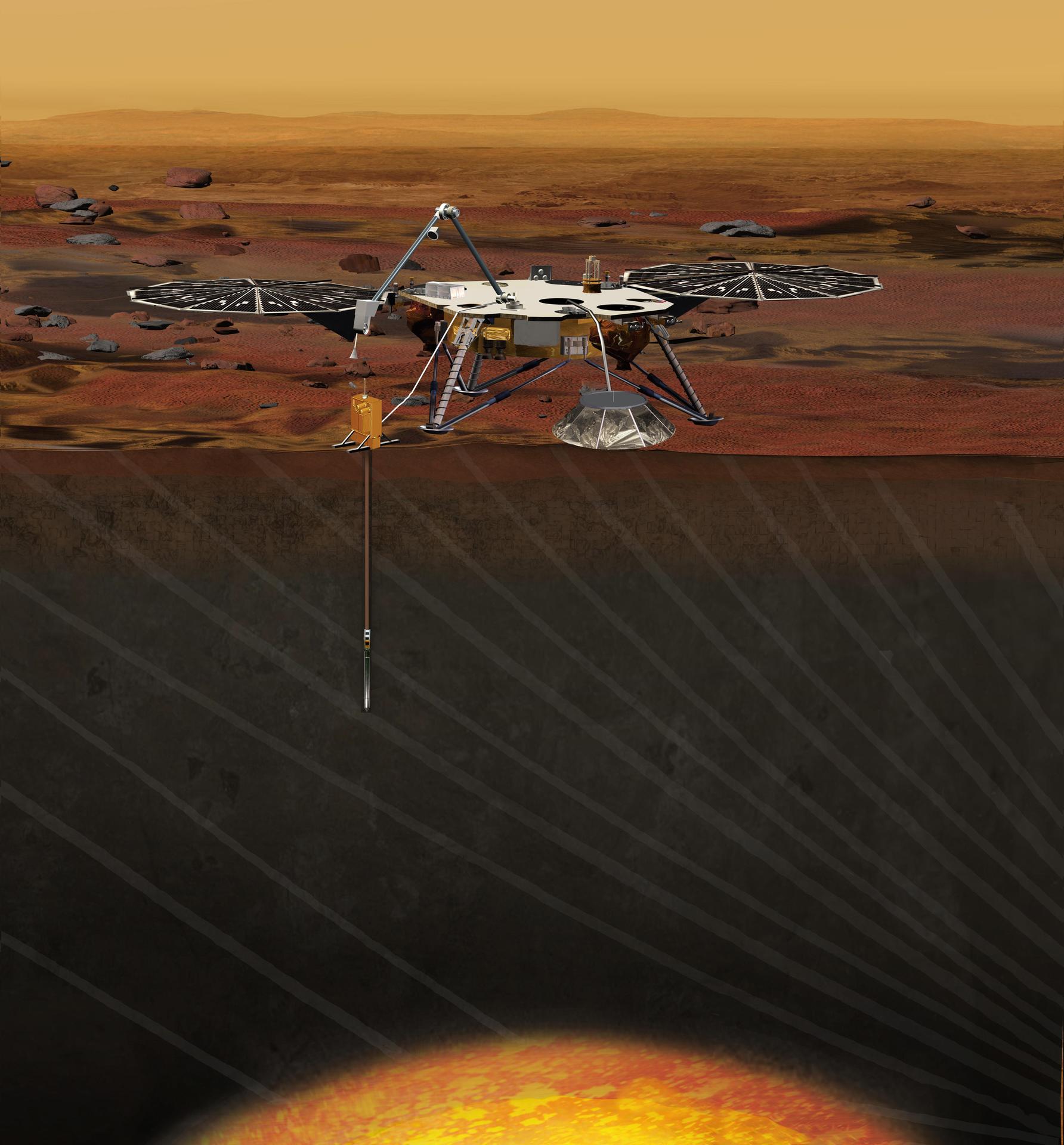
The finding also bears on how seismologists read the marsquakes recorded by NASA's InSight lander before that mission ended. InSight had already found that seismic waves lose energy — dissipate — faster crossing the southern hemisphere than the northern one, a puzzle at the time. A warmer, possibly partly molten southern interior offers a physical explanation: hotter, softer material saps more energy from a passing quake wave, which lines up with what InSight actually recorded.
And because heat drives everything from volcanic outgassing to the stability of subsurface water, a persistently hotter south could feed into models of Mars's early hydrology — including the formation of basins that may once have held water. Understanding where the ancient heat was concentrated is a piece of understanding where the ancient water could have persisted, and for how long.
None of this rewrites the story of Mars overnight. But it does mean that a planet often described as geologically "dead" — no plate tectonics, no active magnetic field, no obvious volcanism today — still has an active, asymmetric thermal engine humming away under its crust. Reading it out from twenty-plus years of accumulated gravity data, rather than from a single dramatic new instrument, is also a reminder of how much old spacecraft data still has left to give when someone asks it a new question.
