
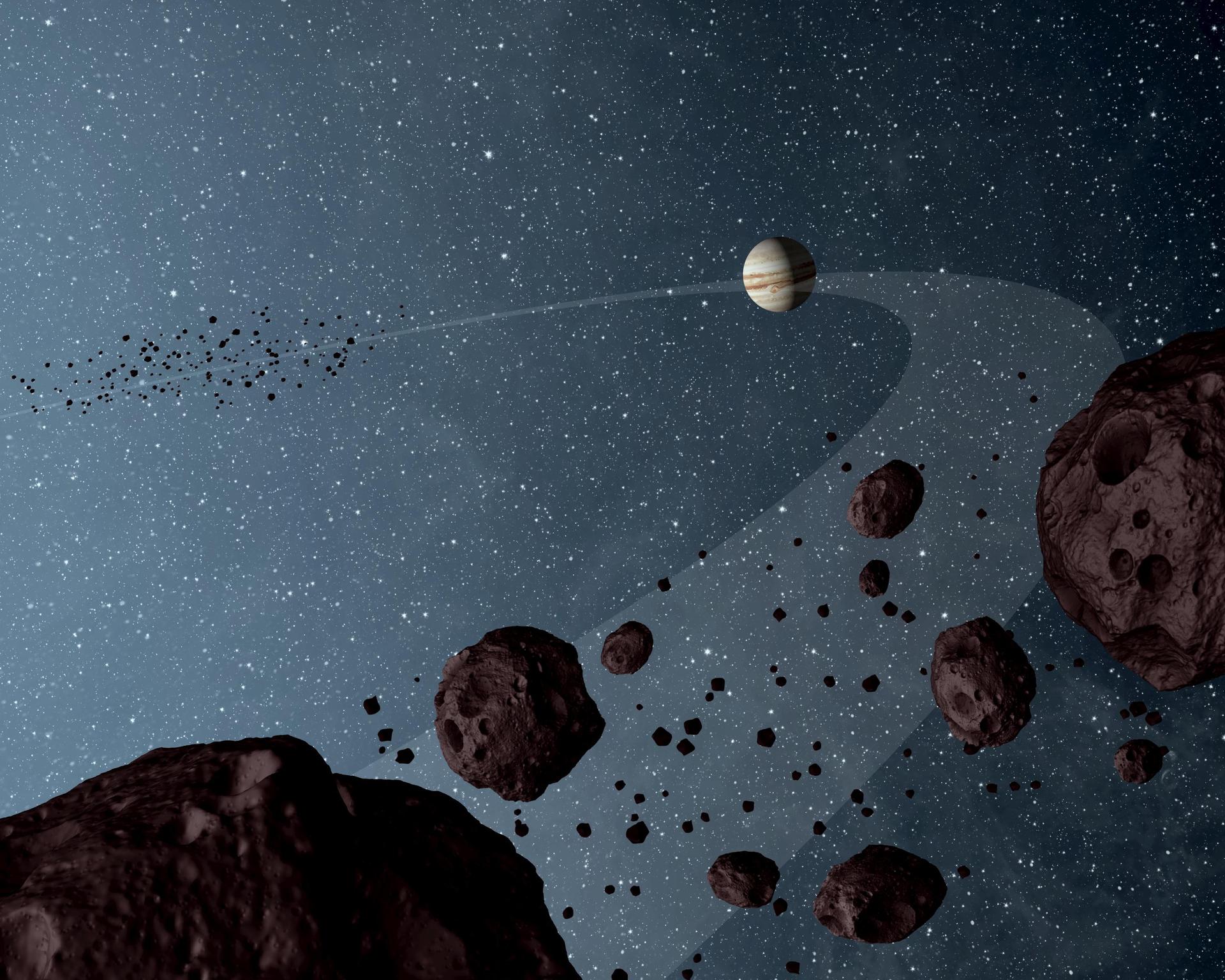
From hundreds of millions of miles away, NASA's Lucy spacecraft has started sizing up the asteroids it was built to visit. In a blog post published August 6, the mission team revealed that Lucy spent late March and early April of this year pointing its highest-resolution camera, L'LORRI, at Eurybates, Polymele, Leucus and Orus — the four Jupiter Trojan asteroids it will fly past between August 2027 and November 2028. The images came down from the spacecraft and were processed by July, and while none of them will win any beauty contests at this distance, that was never the point.
The point is exposure settings.
When Lucy sweeps past each of these bodies at closest approaches of just 300 to 600 miles, moving at speeds of up to 16,000 mph, there will be no second takes. Every camera setting has to be dialed in ahead of time, and the single hardest variable to pin down from the ground is lighting. Telescopes on Earth see the Trojans essentially the way we see a full Moon: nearly fully illuminated, with the Sun almost directly behind the observer. Lucy, approaching from within the asteroids' own neighborhood, sees them at oblique angles — partially lit, with real shadows — the way the actual flybys will look. That geometry simply cannot be reproduced from Earth, which is why the team is using the spacecraft itself as its own calibration rig. As the NASA post (authored by Katherine Kretke and Lonnie Shekhtman) explains, the goal is to tune the cameras so that surface details in the encounter images come out neither too dark nor washed out.
A Second Look, With Higher Stakes
This isn't Lucy's first long-distance portrait session with these four targets. Back on March 25–27, 2023, L'LORRI captured its first-ever views of the same quartet from about 330 million miles (530 million kilometers) away, staring at Eurybates for 6.5 hours, Polymele for 2.5 hours, Leucus for 2 hours and Orus for a full 10 hours. Those early observations were used to study how the Trojans reflect light at higher angles than anything visible from Earth — exactly the calibration problem the 2026 campaign is now refining, with the encounters no longer a distant abstraction but barely a year out.
The stakes have also grown in a literal sense: two of the four flyby targets are now known to host small moons. The Planetary Society's mission timeline lays out the sequence — Eurybates and its satellite Queta in August 2027, Polymele and its moon in September 2027, Leucus in April 2028, and Orus in November 2028. Each pass is a chance to catch two objects in one shot, and a reason to get the photometry right the first time.
The Mission So Far
Lucy launched in October 2021 on a 12-year tour that will ultimately take it past eight Trojan asteroids — the two swarms of primordial bodies that share Jupiter's orbit, leading and trailing the giant planet. No spacecraft has ever visited the Trojans before.
The mission hasn't been idle on the way out. Lucy has already flown past two main-belt asteroids as warm-up acts: Dinkinesh, where it discovered that the tiny asteroid's moon is itself a contact binary, and Donaldjohanson. Those encounters exercised the spacecraft's tracking and imaging systems on real targets — but the Trojans are the main event, and the 2027–2028 stretch is the densest run of science in the whole itinerary. After Orus, Lucy's tour continues to the trailing Trojan camp, where it will visit Patroclus and its companion Menoetius in March 2033.
L'LORRI, the long-range reconnaissance imager doing the current test work, is the sharpest of Lucy's three main remote-sensing instruments. It flies alongside L'Ralph, an imager and spectrometer that will map the target asteroids and the chemical makeup of their rocks and ices, and L'TES, a spectrometer that characterizes the asteroids' thermal properties — the trio that will map surfaces, compositions and temperatures during each encounter.
Why It Matters
The Trojans are widely treated as time capsules from the era of planet formation, and Lucy is humanity's first and, for now, only ticket to see them up close. But close flybys are unforgiving: at 16,000 mph and a few hundred miles of separation, an encounter's imaging window is brief, and a badly chosen exposure can turn a once-in-history dataset into a set of over- or under-exposed frames. By rehearsing on the real targets, under the real lighting geometry, more than a year in advance, the team converts one of the flybys' biggest unknowns into a solved problem — quietly, cheaply, with the hardware already in flight. The spring 2026 images themselves may be little more than dots, but they're the difference between hoping the 2027 pictures come out and knowing they will.
It's also a reminder of how deep-space missions actually work. The dramatic moments — launch, closest approach — are brief punctuation in years of unglamorous preparation. Lucy's cameras photographing distant points of light this spring is that preparation made visible: the dress rehearsal before the first act of the Trojan tour opens at Eurybates in August 2027.
Sources
- NASA's Lucy Begins Camera Tests Ahead of 2027 Trojan Flybys — NASA Science blog (Aug 6, 2026)
- Lucy, exploring Jupiter's Trojan asteroids — The Planetary Society
- NASA's Lucy spacecraft captures glowing view of Trojan asteroids from 530 million kms — Republic World
- NASA's Lucy Tests Its Cameras Ahead of 2027 Trojan Asteroid Flybys — Daily Galaxy
