
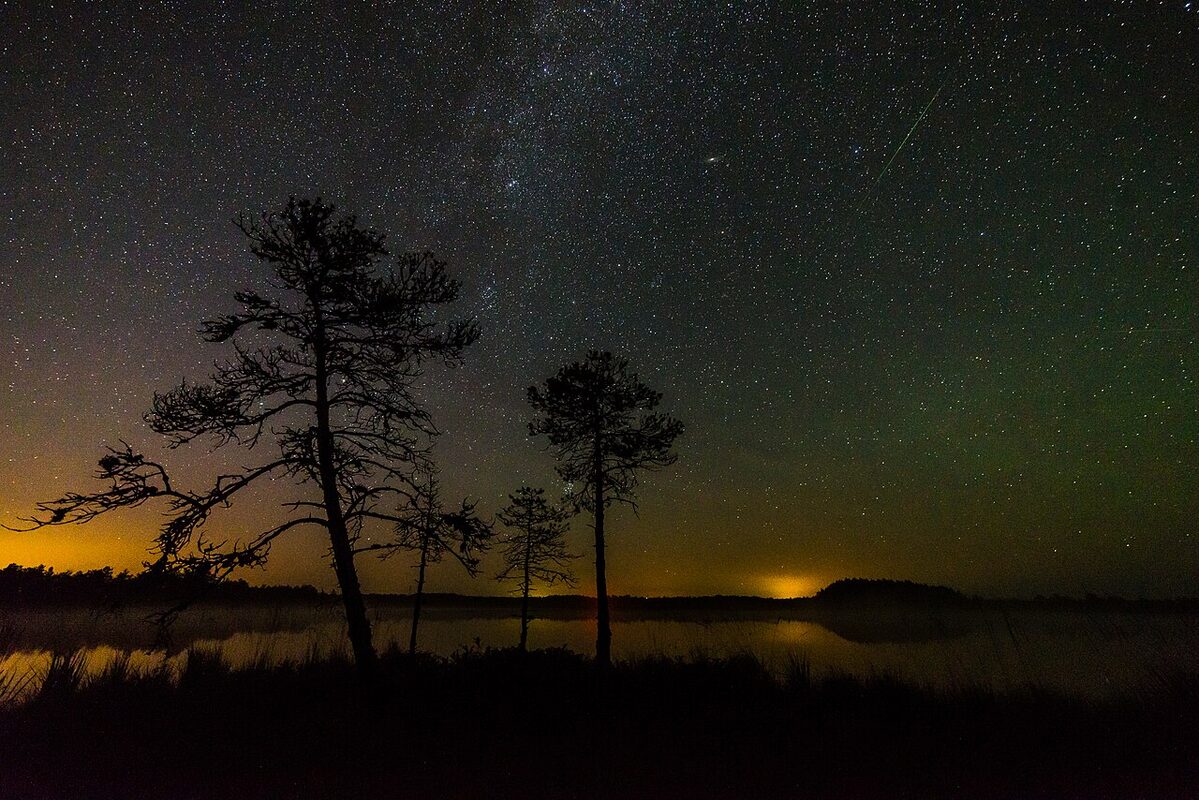
June rewards both ends of the night. The evening sky offers a clutch of planets low in the west; the small hours bring meteors, a pre-dawn planet or two, and the densest, most luminous stretch of the Milky Way arcing overhead. None of it needs a telescope, and most of it survives a modest amount of light pollution. Here is what to actually plan around.
A Venus–Jupiter conjunction, June 8–9
The month's headline event is a close pairing of the two brightest planets. On the evenings of 8 and 9 June, Venus and Jupiter close to within about 1.5 degrees of each other — roughly three full-moon widths — low in the west after sunset. Both are brilliant enough to punch through twilight; a pair of binoculars will frame them together in a single field. Mercury joins the scene nearby, completing a compact evening lineup of three planets, though it sits fainter and lower and wants a clear, unobstructed horizon to catch.
Saturn and a crescent Moon, pre-dawn June 10
Early risers get the consolation prize. Before sunrise on 10 June, a waning crescent Moon drifts close to Saturn in the eastern sky. The pair clear the horizon after midnight and stay up until dawn, the Moon's slim arc making an easy guide to the ringed planet's steadier, golden light.
The June Boötids, peaking June 27 — the wild card
Most years the June Boötids are a non-event, delivering only a few slow meteors an hour. But this is a shower with a history of surprises: its parent comet's debris is unevenly distributed, and on rare occasions Earth plows through a dense filament and the rate jumps to a hundred or more in an hour. The peak falls around 27 June. The odds favor a quiet night — but the Boötids are precisely the kind of shower where it is worth being outside, because when they go off, they go off without much warning.
Mars meets the Pleiades, June 27–30
In the closing days of the month, look east before dawn for a color contrast worth the early alarm: ruddy Mars sliding close to the blue-white Pleiades star cluster. The pairing of a warm planet against that cool knot of young stars is one of the more photogenic conjunctions of the season.
The Strawberry Moon, June 29
June's full Moon — traditionally the "Strawberry Moon" — arrives on the evening of 29 June. A full Moon is lovely to the naked eye but washes out fainter targets, so treat the nights around it as a time for lunar and planetary viewing rather than deep-sky hunting.
The Milky Way's core, all month
The quiet star of June is the galaxy itself. Through the month, the bright central bulge of the Milky Way climbs into the southern sky after dark — the thickest, most detailed part of the band, dense with star clouds and dark dust lanes. It is invisible from a city and unmistakable from a dark site, which makes it the best reason all month to drive somewhere genuinely unlit. Give your eyes a full twenty to thirty minutes to adapt, keep bright phone screens out of view, and let the faint structure resolve.
A note on the Daytime Arietids
One shower you will mostly have to take on faith: the Daytime Arietids, among the strongest of the year, peaked around 7 June with a theoretical rate near thirty an hour. The catch is in the name — its radiant sits close to the Sun, so the meteors stream down in daylight and are nearly impossible to watch. The only practical window is the short interval just before dawn, when the radiant briefly clears the horizon ahead of sunrise and a patient observer might catch a few long, low "earthgrazers" skimming the upper atmosphere. It is a reminder that the meteor calendar is governed by geometry, not convenience.
How to actually watch a conjunction
For the planetary pairings, technique beats equipment. Find an open western horizon for the dusk events and an eastern one for the pre-dawn pairings; buildings and trees swallow low objects fast. Start looking earlier than you think — bright planets emerge in twilight before the sky is fully dark — and reach for binoculars rather than a telescope, since a wide field frames two planets together where a telescope's narrow view cannot. No optics at all is fine, too; these are naked-eye events that simply look richer with a little help.
