
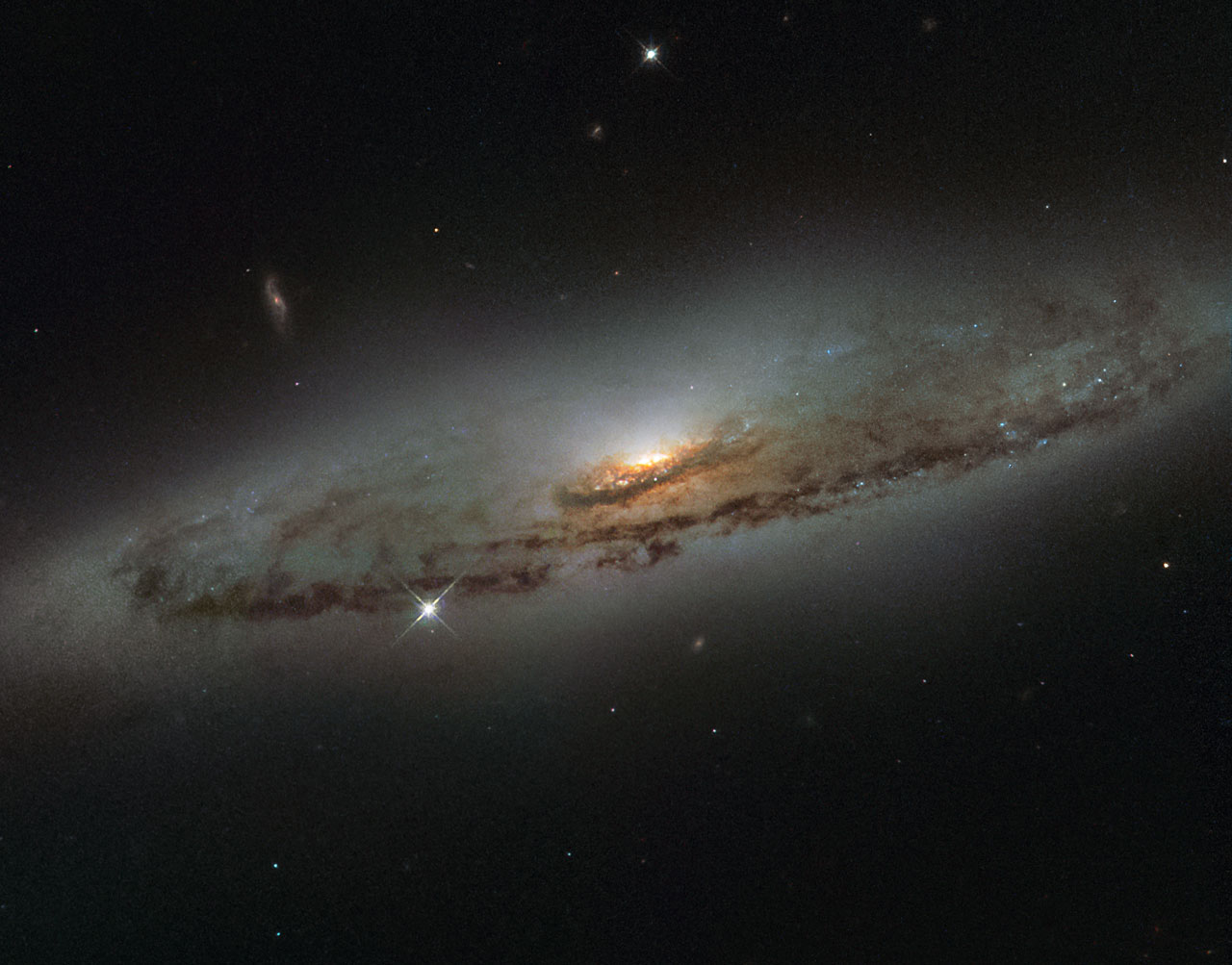
Many spiral galaxies are tidy about geometry. There is a flat disc, a bulge of older stars sitting in its middle like a yolk, and a pattern of arms winding around the disc. NGC 4698 does not follow that script. A new image from the Hubble Space Telescope, released on September 18, 2026, shows a spiral whose central bulge is stretched out at a right angle to its own disc, and whose innermost stars and gas rotate perpendicular to the rest of the galaxy.
NASA and ESA have both published the image. The galaxy is about 55 million light-years away in the constellation Virgo, where it is one of over a thousand galaxies in the Virgo Cluster, the nearest large galaxy cluster to us, according to NASA.
What the image shows
At first glance the outer parts of NGC 4698 look like a conventional spiral. But NASA notes that the spiral arms are prominent only in the outer disc, where they form a ring-like structure and shy away from the glowing centre. The middle of the galaxy is not a smooth continuation of the pattern outside it.
The centre is dominated by an elongated bulge of older, cooler stars. Those tightly packed stars orbit a supermassive black hole of millions of solar masses, and NASA says scientists have found signs that the black hole is actively growing. The odd part is the orientation. The bulge is elongated at a right angle to the disc, and ESA's description says the elongation is faintly visible above and below the dusty disc. In other words, part of the galaxy's structure is sticking out of the plane in which the rest of it sits.
NASA describes NGC 4698 as one of only a few known spirals whose bulge extends out from the disc at a right angle. That is a statement about how rare the configuration is among known galaxies, and it is why this one draws attention despite being an otherwise typical-looking spiral.
Two kinds of misalignment
The mismatch is not only about shape. The stars and gas nearest the centre also rotate perpendicular to the rest of the disc. So the galaxy has a structural misalignment (the bulge's long axis) and a kinematic one (the spin of the inner material). Both point the same way: something in the core is oriented differently from the main disc.
The 2012 study we discuss below describes the inner material as a nuclear disc of gas and stars rotating perpendicularly to the galaxy's main disc, and its title calls the arrangement a "polar nuclear disc." That is a small disc in the galaxy's heart whose rotation axis is tilted by about a right angle relative to the large-scale disc.
What could have done this?
The explanation NASA offers is that the cause is likely external. Gas funnelled in from an outside source could form a disc of gas and stars in the galaxy's centre, at an angle relative to the rest of the disc. Gas that arrives from somewhere else has no obligation to share the spin of the disc it lands in, so it can settle into a disc of its own on a different axis.
NASA adds that some observations suggest a past minor merger, and cites a short hydrogen "tail" streaming from one side of the galaxy as evidence. The wording matters here: this is a likely explanation supported by some observations, not a settled account of NGC 4698's history.
The photometric backing from 2012
None of this began with the new image. A 2012 paper by Corsini and colleagues, posted to arXiv as 1204.2265 and titled "Polar bulges and polar nuclear discs: the case of NGC 4698," had already investigated the structure. Its abstract describes a nuclear disc of gas and stars rotating perpendicularly to the main disc, and a bulge and main disc that appear elongated orthogonally to each other.
The team used photometric decomposition of optical and near-infrared images, essentially modelling how the galaxy's light is divided among its components. That analysis showed the bulge is actually elongated perpendicular to the main disc. It also found the bulge is equally likely to be triaxial or axisymmetric, so the data as analysed did not settle that question.
The findings support a scenario in which the nuclear disc is the end result of a pre-existing triaxial bulge acquiring external gas. The authors say the subsequent star formation either occurred homogeneously across the nuclear disc or proceeded through an inside-out process that ended more than 5 Gyr ago. That is context, not a 2026 result. But it lines up with the explanation in NASA's release: outside gas arriving in an already-shaped bulge, and a tilted disc forming at the centre.
Where the image comes from
The image credit reads ESA/Hubble & NASA, D. Thilker, the MAUVE-HST Team. ESA's page cites Hubble observing programme #18103, with Thilker as principal investigator, focusing on galaxies in the Virgo Cluster. NASA describes the data as coming from an observing program that zooms in on details of these relatively nearby galaxies, such as individual star clusters and nebulae, while also studying how a galaxy's journey through a cluster affects its evolution and ability to form new stars. ESA lists the image under a CC BY 4.0 licence, or alternatively the ESA Standard Licence.
The choice of target fits that program. NGC 4698 is one of over a thousand galaxies in the Virgo Cluster, so it sits in exactly the kind of crowded environment the program is meant to study.
Why It Matters
NGC 4698 is a small test of an idea that runs through galaxy evolution: a galaxy's present shape is a record of what has happened to it, including things that may have arrived from outside. NASA's account is that the culprit for this galaxy's out-of-sync centre likely lies outside it, with gas funnelled in from an external source forming a tilted disc in the core.
The galaxy also illustrates why detailed imaging within a cluster is useful. The Virgo Cluster is the nearest large cluster of galaxies, and NASA says the observing program uses such data to learn how a galaxy's passage through a cluster affects its evolution and star formation. The photometric work from 2012 and the new Hubble view are complementary: one measures the geometry, the other shows it in detail.
There are open questions left. NASA's language is hedged ("likely," "some observations suggest"), and the 2012 analysis could not say whether the bulge is triaxial or axisymmetric. The black hole's apparent growth is also noted without a stated link to the tilted disc. What the sources support is a striking and rare configuration, a likely outside-in origin, and a well-placed target for further study.
