
In 1999, the Hubble Space Telescope recorded the spectrum of a white dwarf called HS 0209+0832. The data held roughly 100 chemical features that nobody could identify. They sat in the archive for more than two decades as an unsolved case.
A paper published in Nature Astronomy on Monday, October 5, 2026, proposes an answer, and it is an odd one. According to the authors, the lines come from niobium and other elements heavier than iron. The mix of elements fits a planet that formed not when the star was young, but from material the star threw off as it was dying. The team calls the object a candidate second-generation planet.
Reopening the file
The study was led by Jamie Williams, a doctoral candidate at the University of Warwick. According to NASA's announcement, Williams went back to the archival Hubble observations with an updated chemical database. Niobium matched many of the features that had resisted identification. The release describes the result as "a high abundance of the element niobium."
Niobium was not the only surprise. The paper's abstract says the atmosphere of HS 0209+0832 is strongly enriched in trans-iron elements, including zinc, copper and niobium, while it is depleted in silicon and iron. The abstract also notes helium in the star's photosphere. The authors single out one key signature: a high enrichment of s-process elements, a family of heavy elements tied to a star's late life.
That ratio is what matters. Planetary debris falling onto a white dwarf is often rocky, with silicon and iron prominent. Here they are scarce, while heavy, exotic elements are abundant. The abstract says the accreted material is unlike any Solar System object.
Where niobium comes from
A white dwarf is the remnant core of a low-mass star that has burned through its nuclear fuel and lost its outer envelope of gas and dust. Nicholas Stone of the University of Wisconsin-Madison, quoted in NASA's release, notes that niobium and other elements heavier than iron are not formed in stellar cores by thermonuclear fusion. They can only be synthesized in the exotic conditions that briefly emerge inside dying stars.
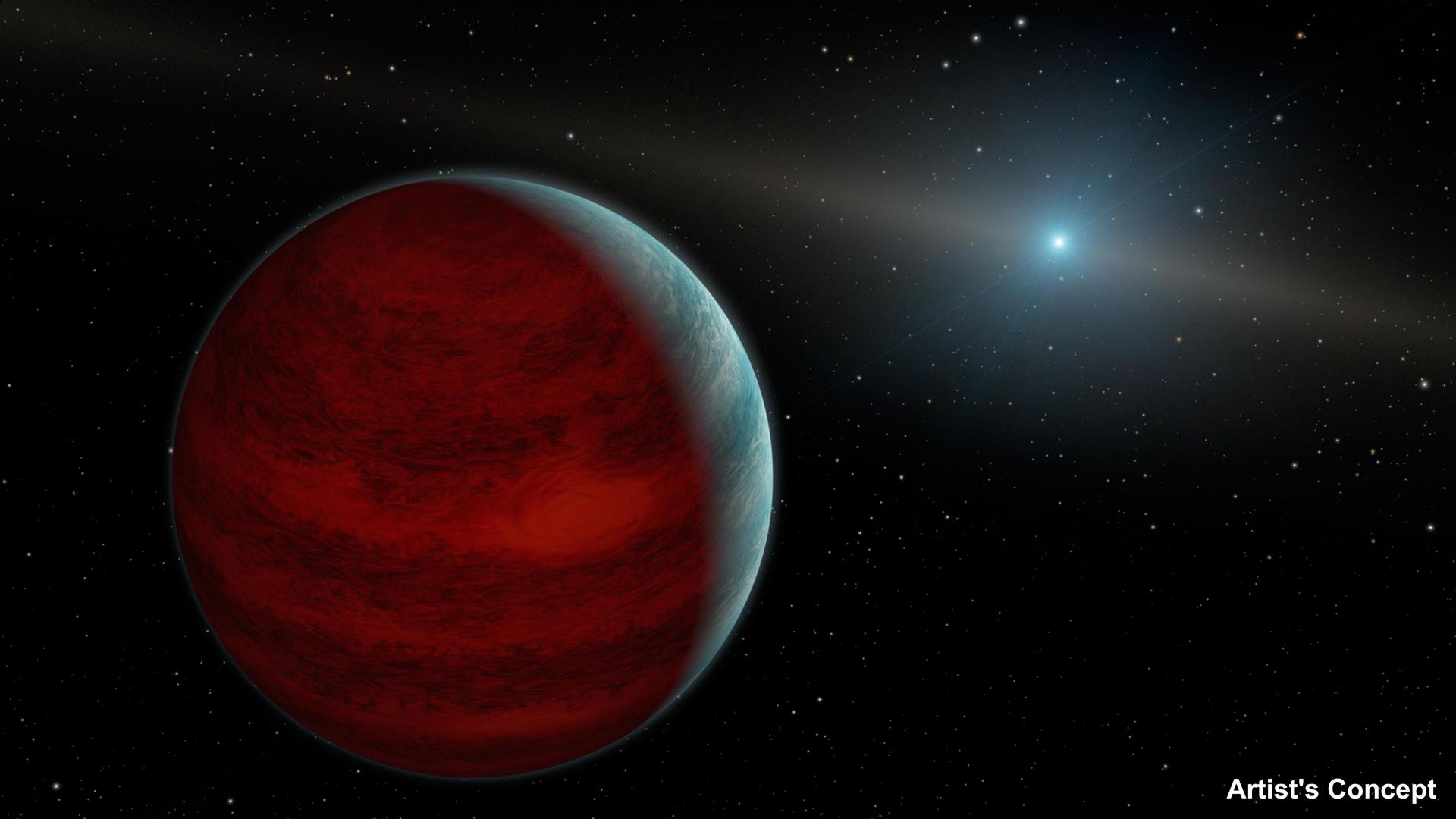
The team's explanation, set out in the ESA/Hubble release, goes like this. Once the star ejected this chemically enriched material, some of it coalesced into a gas giant planet, and the rest dispersed long ago. The Nature Astronomy abstract states the composition is consistent with a candidate second-generation planet formed from stellar material ejected during the giant phase. The paper's title also describes the candidate as accreting onto the white dwarf, which is why its unusual chemistry shows up in the star's spectrum.
A first-generation planet, like Earth, forms from material left over from a star's birth. A second-generation planet, in NASA's words, forms around the stellar remnant from its cast-off material. Its chemistry is inherited from the star's death, not from the cloud the star was born in.
How unusual is this?
The answer depends on how narrowly the question is framed. According to ESA/Hubble, a handful of planets have been identified orbiting white dwarfs. But this is the first candidate with the hallmarks of a planet that formed from material related to a star's death rather than its birth.
Space.com adds context. Scientists had long suspected that reborn planets could orbit more massive stellar remnants called neutron stars, but this is the first time one has been found around a white dwarf. "Finding one around a white dwarf was completely unexpected," Williams said in a statement sent to the outlet.
The careful wording in every source deserves attention. This is a candidate. The case rests on chemistry and on brightness data: NASA reports that TESS watched the white dwarf for four months and detected periodic brightness variations indicating a planet orbiting at about 3.7 million miles (6 million kilometers), much closer than Mercury orbits the Sun. The elements in the white dwarf's atmosphere match what a planet built from giant-phase ejecta should contain, and they do not match ordinary rocky debris. That is strong circumstantial evidence, and the researchers present it as a suspected planet, not a confirmed one.
Why It Matters
Planet formation is usually treated as a single event that happens early in a star's life. If HS 0209+0832 holds up, that picture is incomplete. Williams says the work points to the systems we know being only the first chapter of a potentially much longer tale. A star's death could provide a second chance to build planets, from material that differs chemically from what was there at birth.
This matters closer to home too. Space.com notes that the Sun will leave a white dwarf in about 6 billion years. White dwarfs are the expected end state for low-mass stars, so knowing what can form, or reform, around them is part of understanding how planetary systems age.
There is also a lesson about method. The key observations were not new. They were taken in 1999 and waited in the archive until Williams returned to them with an updated chemical database. The breakthrough came from rereading old data with better tools, not from a new telescope.
The open questions are clear. Williams says there is still a lot of work to do on how second-generation planets form, how common or rare they are, and how they evolve around a "dead" star, and he plans to use Hubble to explore these questions over the next several years. For now, HS 0209+0832 is a single candidate. It is also the first of its kind around a white dwarf.
Sources
- Suspected Second-generation Planet Solves NASA Hubble Cold Case (NASA Science)
- Suspected second-generation planet solves Hubble cold case (ESA/Hubble heic2613)
- Discovery of a second-generation planet candidate accreting onto a white dwarf (Nature Astronomy)
- 'Completely unexpected' Phoenix planet was born from the ashes of a dying star (Space.com)
