
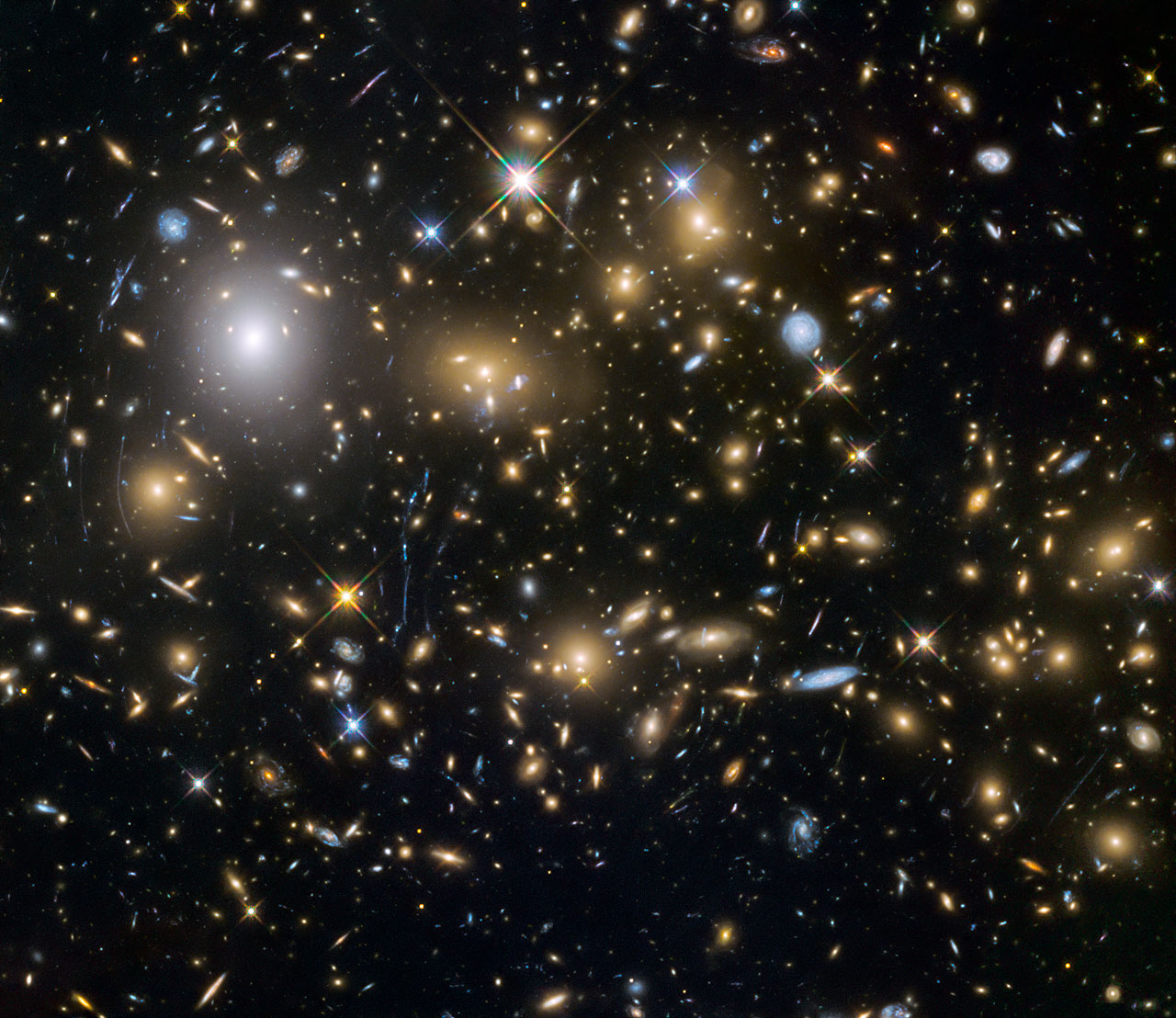
Most milestones are marked by doing nothing in particular. Hubble marked its 200,000th trip around Earth by waiting for an explosion that has already happened to show up again.
On Sept. 19, the Hubble Space Telescope completed its 200,000th orbit while pointed at the galaxy cluster MACS J0417, according to NASA. The target is a supernova nicknamed Athena, which the James Webb Space Telescope discovered in 2025. The cluster's gravity bends Athena's light along more than one path, and astronomers expect a new image of the same supernova to appear between now and early March 2027. Hubble is watching so it can catch that image when it arrives.
A supernova on a delay
MACS J0417 lies about 4.65 billion light-years away in the constellation Eridanus, Universe Today reports. Like other massive clusters, it acts as a gravitational lens. Light from objects far behind the cluster gets bent and magnified, and it can reach us along several different routes.
According to NASA, light from one explosion can reach Earth along multiple paths, so the same stellar explosion can appear more than once, separated by months or even years depending on the path it took. Webb caught one version of Athena in 2025. NASA says Athena is predicted to reappear between now and early March 2027.
That is why the timing matters. According to NASA, measuring when the reappearances show up does two things at once. It constrains how mass is distributed in the cluster, and it helps refine our understanding of the expansion rate of the universe, the Hubble constant.
Universe Today says Hubble will keep monitoring the cluster until about March 2027.
Two hundred thousand laps
The orbit count is a reminder of how long this observatory has been running. Hubble launched in April 1990 aboard the space shuttle Discovery and was designed for a 15-year life, Space.com notes. It has now operated for more than 36 years.
It circles Earth at an altitude of about 300 miles. Each lap takes roughly 95 minutes, which works out to about 15 orbits a day. NASA says Hubble has traveled more than 5 billion miles in total and made more than 1.7 million observations.
Space.com lists some of the earlier milestones:
- 2008: 100,000th orbit
- 2011: millionth science observation
- 2024: switch to operating on a single gyroscope
- 2025: a 2.5-billion-pixel mosaic of the Andromeda galaxy
Hubble is still doing long monitoring campaigns like the Athena watch, which require coming back to the same patch of sky again and again over many months.
Still oversubscribed
Hubble's age hasn't reduced demand for it. NASA says astronomers ask for about seven times as much observing time as the telescope has available each year. At that ratio, roughly six out of every seven requested hours cannot be granted.
The Athena campaign also shows how Hubble now works alongside newer telescopes. Webb found the supernova, and Hubble is following up. More help is coming: Universe Today reports that NASA's Roman Space Telescope is expected to begin science operations in early 2027. That puts the start of Roman's science work near the end of Hubble's planned monitoring of MACS J0417.
Why It Matters
The Hubble constant, the expansion rate of the universe, is one of the scientific legacies Hubble is named for. Timing a lensed supernova's reappearance is one way to refine it, and Universe Today notes that such measurements help constrain the cosmic distance ladder and the Hubble constant.
A single lensed supernova is one data point, but as NASA notes, timing its reappearances also helps map the mass of the cluster doing the lensing. That second result is useful on its own terms.
There is also a practical point. Catching a reappearance whose arrival window spans months requires a telescope that can return to the same region of the sky over time, which NASA cites as a Hubble strength. Hubble is still doing that after 200,000 orbits, and it will keep watching MACS J0417 into March 2027 for Athena's return.
