
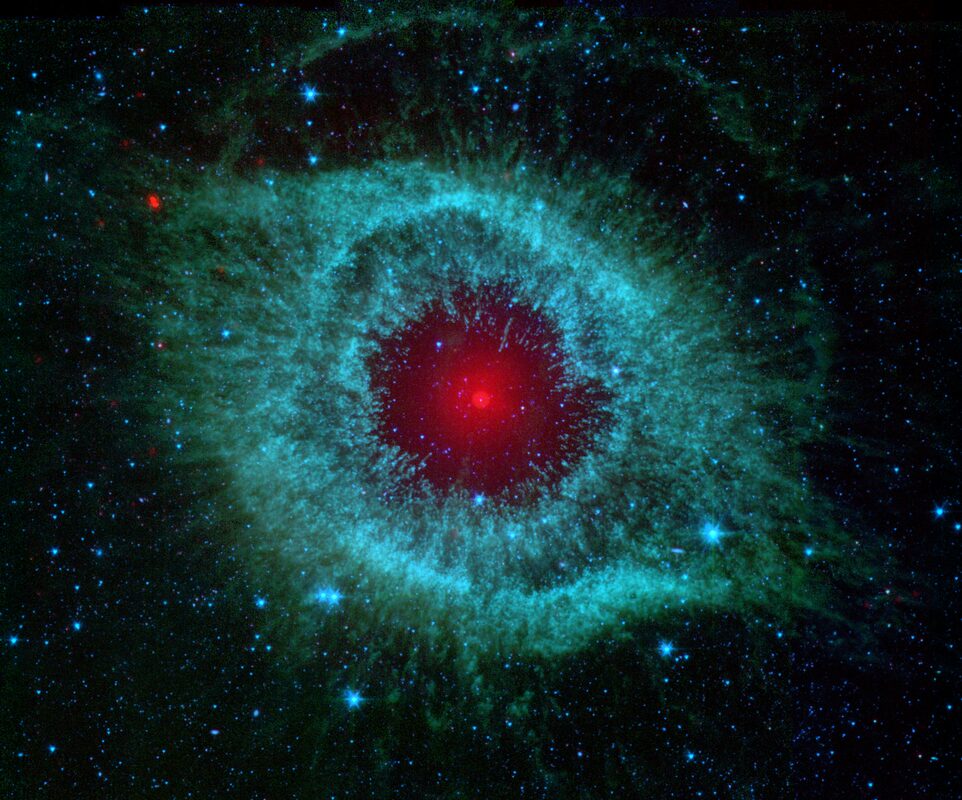
The Helix Nebula has been photographed so many times, by so many instruments, that it's easy to assume there's nothing new to find in its glowing rings of gas. A team led by Yale astronomer Pieter van Dokkum just proved that assumption wrong — and they did it with a telescope that isn't even finished being built.
In a paper published in Nature on August 12, 2026, van Dokkum and seven co-authors report the detection of 22 distinct bow shocks scattered through the eastern outer reaches of the Helix Nebula, a planetary nebula roughly 650 light-years away in the constellation Aquarius. Each bow shock marks a spot where a clump of gas, flung outward when the nebula's central star was dying, is now plowing into the thin interstellar medium surrounding it — compressing gas ahead of it into the same kind of curved shock front a boat's hull carves through water.
Large-scale bow shocks, formed where a star's own wind slams into the interstellar medium, are a familiar sight around evolved stars. What the team found in the Helix is different: a network of many small, compact shocks, each tied to an individual clump of ejected gas rather than to the star's wind as a whole — and, in the outer Helix, it had gone largely unnoticed until now. "Instead, we found this extraordinary network of bow-shaped structures," co-author Roberto Abraham said. "It was immediately clear that the faint outer Helix was telling us a story that had largely been missed." What's new is both the number of structures and what that number reveals: a fossil record of destruction in progress, spread out in space in a way that lets astronomers read it like a timeline.
A Telescope Built for Exactly This
The instrument responsible is MOTHRA, based at El Sauce Observatory in Chile — and notably, it isn't complete. The array is still being built out, yet even in its partial state it was sensitive enough to pick up faint, extended H-alpha emission from gas the Helix Nebula shed near the end of its central star's life. That's the wavelength emitted when hydrogen atoms get excited by a shock and then relax, and it's the signature that let the team trace each clump's outline against the surrounding dark.
"We are seeing material shed near the end of a star's life being broken apart and returned to the galaxy," van Dokkum, the Sol Goldman Family Professor of Astronomy at Yale, said of the find. Co-author Roberto Abraham, of the Dragonfly Focused Research Organization and the University of Toronto, worked alongside van Dokkum and six other researchers — William P. Bowman, Seery Chen, Steven R. Janssens, Deborah M. Lokhorst, Imad Pasha, and Carter Rhea — on the analysis.
Reading the Shocks Like Tree Rings
Here's where the paper gets genuinely clever. The 22 bow shocks aren't uniform. Measured across a span of 0.4 to 1.4 parsecs from the central star — roughly 1.3 to 4.6 light-years — the radius of curvature of each shock shrinks by a factor of about 100. Closer to the star, the shocks are tight, sharp, well-defined arcs. Farther out, they progressively fuzz out into patchy, ragged structures that barely look like shocks at all.
That gradient is the key. A clump of ejected gas doesn't just travel outward in a straight line at constant shape — it gets battered as it goes, sheared apart by the drag of the interstellar medium it's slamming into. The clumps closest to the star, having traveled less distance and endured less punishment, still look crisp. The clumps farthest out are the old-timers, worn down and on the verge of dissolving entirely into the diffuse gas around them.
Because the researchers could measure that decay as a function of distance, they could back out a timescale for the whole process: about 10,000 years from a clean, sharp-edged clump to disintegration into the interstellar medium. That's a genuinely rare thing to pin down directly — most of what we know about how stars enrich the galaxy with the raw material for future stars and planets comes from theory and simulation, not a stopwatch.
Why It Matters
Every element heavier than hydrogen and helium that makes up the Earth, and us, was cooked inside a star and then had to get back out into interstellar space to eventually become part of something else — a molecular cloud, a protoplanetary disk, a planet. Planetary nebulae like the Helix are one of the main delivery mechanisms for that recycling, particularly for stars in the mass range of our own Sun, which shed their outer layers in their final act rather than exploding as supernovae.
The trouble is that the "delivery" step — how shed stellar material actually breaks down and mixes into the surrounding medium — has mostly been inferred rather than observed, because it happens slowly and at low surface brightness, exactly the kind of signal that's easy to miss. A Nature News & Views commentary published alongside the study frames the discovery as direct evidence of ejected stellar shells breaking up and mixing into the surrounding gas, connecting the observation to the broader physics of how galaxies stay chemically enriched over cosmic time. Having an actual measured timescale — not just a theoretical one — gives modelers a real data point to check their simulations of galactic chemical evolution against.
It's also a demonstration of what low-surface-brightness astronomy, van Dokkum's specialty, can still find in objects that have been imaged to death. The Helix Nebula is one of the most photographed objects in the sky, and it took a purpose-built, still-unfinished instrument tuned to catch faint diffuse emission to notice that its outskirts were full of tiny wrecks in progress.
What Comes Next
An independent write-up from Sky & Telescope describes the same 22 structures, noting that unlike the large-scale bow shocks commonly seen around evolved stars, these are compact and tied to individual clumps of gas — shocks nearer the central star large, thin, and sharply defined, and those farther out smaller, fuzzier, and increasingly fragmented, a progression the outlet reports researchers interpret as evidence the clumps are being steadily eroded as they travel. Van Dokkum has said the find is "only the beginning" of what MOTHRA will be able to show once the array is complete, though the researchers have not detailed specific plans for follow-up observations.
Sources
- Numerous bow shocks in the outer Helix Nebula (arXiv:2608.11443)
- A dying star offers a rare glimpse of how the universe recycles its raw materials - Yale News
- Bow shocks reveal how a dying star returns matter to interstellar space | Nature
- The Helix Nebula is Hurling Clumps of Gas through Space - Sky & Telescope
