
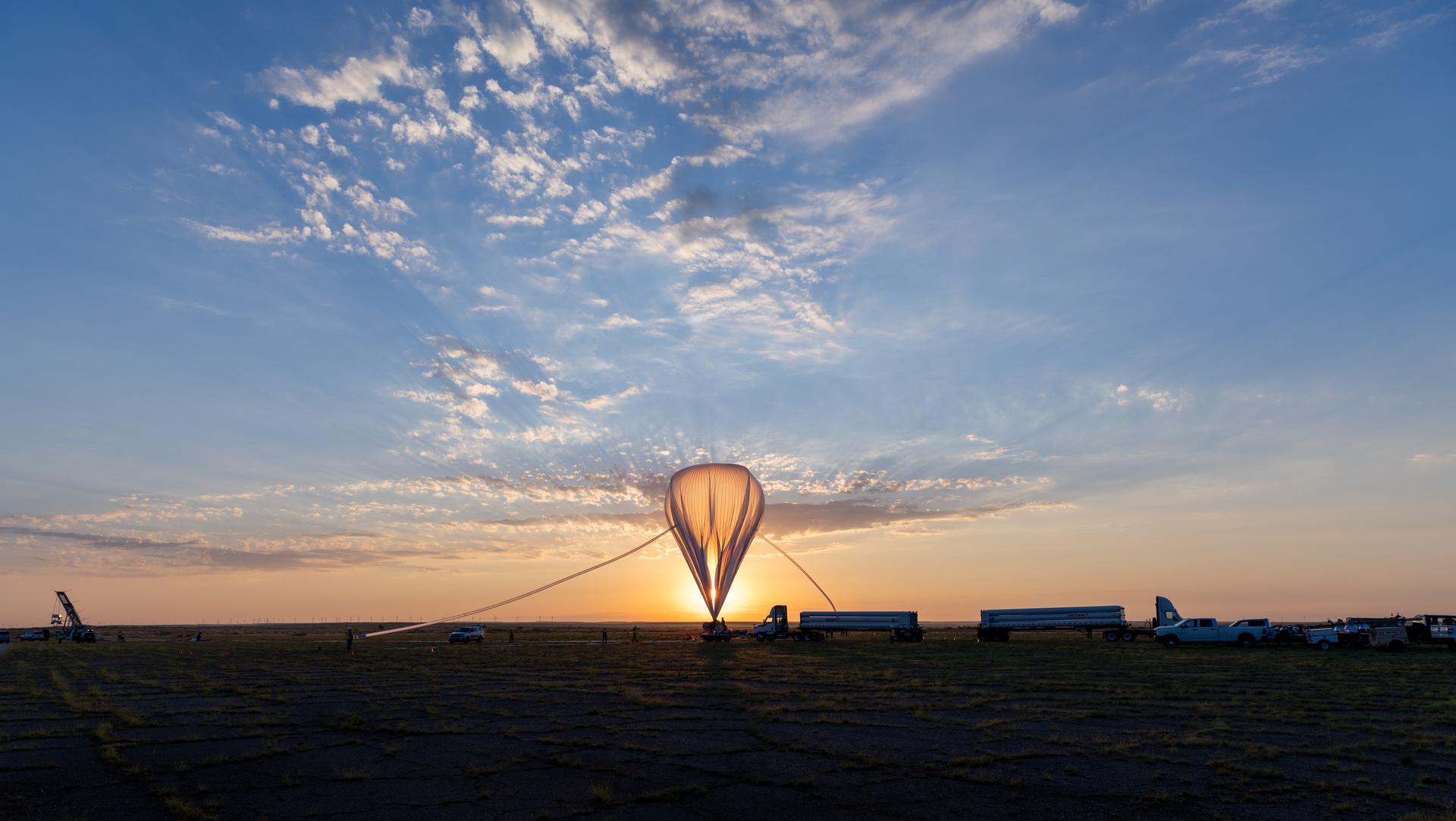
Every August, a patch of dry grassland outside Fort Sumner, New Mexico, turns into one of the more unusual proving grounds in American aerospace. There's no gantry, no countdown clock ticking toward ignition — just a launch crew, a spool of polyethylene film thinner than a sandwich bag, and a payload train that, in a few hours, will be drifting 36 kilometers over the desert. On August 13, 2026, NASA announced that its Columbia Scientific Balloon Facility (CSBF), based in Palestine, Texas, is preparing to send up six such balloons from Fort Sumner this campaign — and one of them carries a milestone two decades in the making.
That flight is the 20th launch of the High-Altitude Student Platform, or HASP, a program that has become something like a rite of passage for university students who want to fly real hardware before they've finished their degrees. This year's HASP gondola will carry 17 student-built payloads, ranging from CubeSat prototypes to larger instrument packages, each one designed, built, and tested by the students who conceived it.
What's Actually Flying
HASP isn't the only mission going up this campaign. Alongside the student platform, CSBF is also flying a technology-demonstration payload called BOOP! and a new instrument riding what NASA describes as a WASP-platform payload dedicated to observing the solar corona — the tenuous, superheated outer atmosphere of the Sun that becomes visible from Earth's surface only during a total eclipse. Balloon-borne platforms let instruments get above nearly all of the atmosphere's obscuring haze without the cost of an orbital launch, which is part of why Fort Sumner's high desert has hosted these campaigns for years.
The six flights are a joint effort between NASA's Balloon Program Office, NASA's Astrophysics Division, and the Louisiana Space Grant Consortium (LaSPACE), which has run HASP's student-facing side since the program's inception in 2006.
Two Decades of Flying Students, Not Just Instruments
The numbers behind HASP's run are worth sitting with. According to LaSPACE, which administers the program out of Louisiana State University, the platform has now flown 19 times since 2006, logging more than 249 hours at float altitude across those missions. In that span, more than 1,959 students from 57 institutions spanning 29 U.S. states and territories have had a hand in building something that actually left the ground — and kept flying for 15 to 20 hours at a stretch, carried by a zero-pressure balloon capable of hauling up to 24 student payloads at once.
Getting a payload onto the gondola isn't a formality. Teams go through a formal integration and testing process before their hardware is cleared to fly, and this year's cohort had to earn its spot: 14 teams took part in HASP's integration testing window from July 20 to 25, 2026, and 13 of them — roughly 93 percent — passed the first round. That's the kind of process built specifically to catch the wiring, thermal, or software problems that don't show up until a payload is actually strapped to a balloon platform and pushed through its paces.
How a Balloon Mission Actually Comes Together
The path from "student idea" to "payload at 36 kilometers" runs through months of preparation before a single balloon is ever filled. Teams design their instruments, build engineering models, and then bring hardware to integration testing, where CSBF and HASP staff verify that each payload can survive the mechanical loads, temperature swings, and power constraints of a stratospheric flight — and, just as important, that it won't interfere with its 16 or so neighbors sharing the same gondola. Only after that gauntlet does a payload get slotted into this year's flight manifest, with launches from Fort Sumner beginning in mid-August 2026.
Fort Sumner earns its spot on the balloon calendar for practical reasons: wide open land, predictable seasonal winds, and enough distance from population centers to give recovery teams room to track a descending payload train after the balloon is cut away. It's the same high-desert flatland that has hosted decades of NASA scientific ballooning, launching alongside CSBF's home base and balloon-fabrication operations in Palestine, Texas.
Why It Matters
HASP's real product isn't the data any single payload returns — it's the pipeline of people who come out the other end knowing how to build flight hardware. A CubeSat that fails on a college workbench costs a grade; a CubeSat that fails at 36 kilometers, in front of an integration review board and a launch crew, costs a team its flight slot and teaches a harder lesson about margins, redundancy, and testing before you trust something to the sky. Two decades and nearly 2,000 students in, HASP has quietly become a farm system for the aerospace workforce, filtering students from 57 different schools through the same rigorous, low-stakes-but-real gauntlet that NASA and its contractors will eventually put them through again, at much higher cost of failure.
The 13-of-14 pass rate in this year's integration round is a small data point, but it points at something worth watching: after 19 flights, the institutional knowledge about how to build a HASP-compliant payload has had two decades to diffuse outward, from program veterans to newer teams. That's the quiet return on two decades of running the same balloon up the same New Mexico sky every year — not a single dramatic result, but a steadily improving farm system feeding the next generation of people who build things that fly.
