
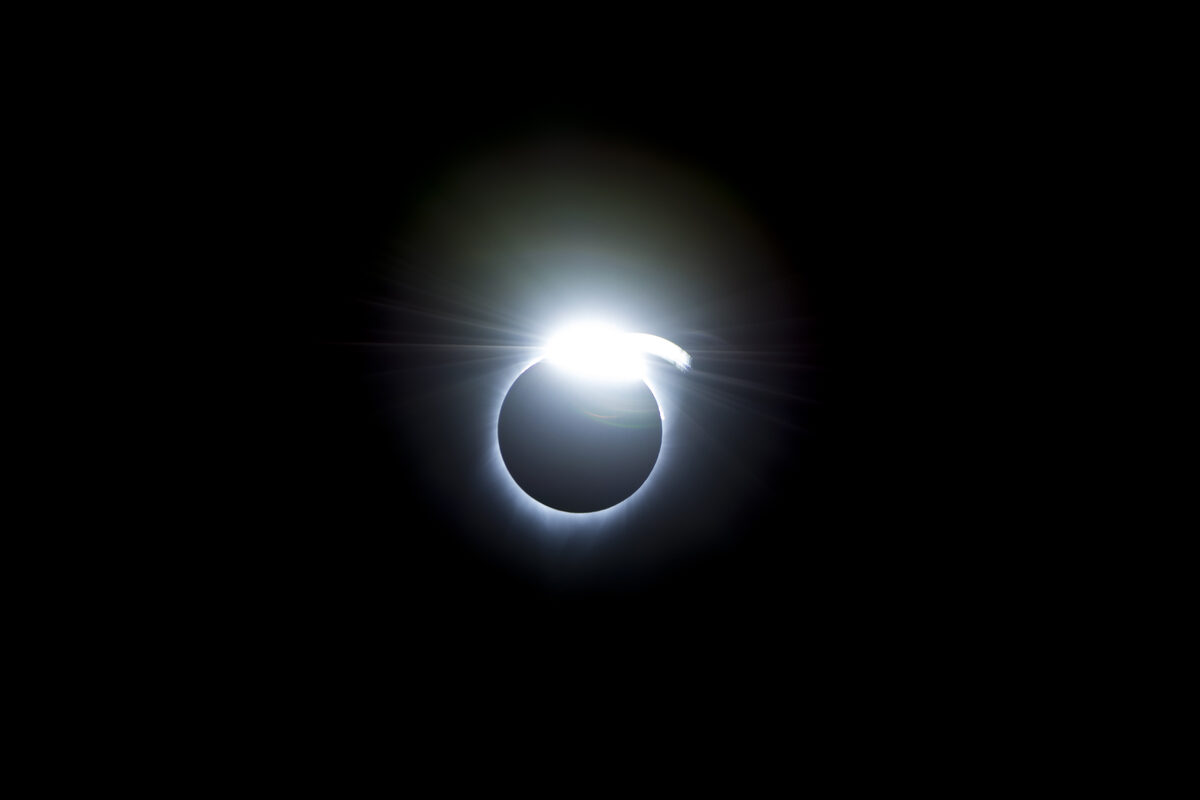
The solar corona is supposed to be white — a pale, silvery halo of superheated plasma that photographers spend years learning to capture correctly. So when NASA's Astronomy Picture of the Day (APOD) for August 17, 2026 went up showing a corona rendered in warm amber and gold, it looked, at first glance, like a processing error. It wasn't. The color was real, and the explanation behind it is a small lesson in atmospheric optics riding on the back of one of the most-anticipated eclipses in a generation.
The image comes from photographer Rui Santos of Living Impressions, who captured it during the total solar eclipse of August 12, 2026, from Benavente, Spain. Santos built the shot as an HDR composite from multiple exposures — a standard technique for eclipse photography, since the corona's brightness falls off steeply from the Sun's edge outward and no single exposure can hold detail across that whole range. What made this particular composite stand out wasn't the technique. It was the color.
Why the Corona Turned Gold
According to NASA's explanation accompanying the APOD release, two factors combined to shift the corona's usual white into gold. First was geometry: totality over Benavente occurred with the Sun low near the horizon, in setting-sun position. Light traveling that long a path through the atmosphere gets reddened for the same reason sunsets are orange rather than the neutral white of midday sun — shorter, blue wavelengths scatter out of the direct beam over a long horizontal path through the air, leaving the longer red and gold wavelengths behind. Second, and more unusual, was smoke. Wildfires burning near the region put smoke into the air over Benavente, and that smoke did the same job as the thick low-altitude atmosphere: it scattered blue light out of the image, reinforcing the golden cast the low Sun had already produced. NASA's writeup describes the smoke as acting like a second filter on top of the low-sun effect, deepening the gold that atmospheric scattering had already produced.
The most telling detail in the image is what didn't turn gold. Visible on the Sun's left edge is a hydrogen-alpha prominence — one of the looping filaments of plasma that erupt from the solar surface and are typically captured in a deep, saturated pink through hydrogen-alpha filters or simply by their own emission color. In Santos's composite, that prominence stayed pink even as the corona around it shifted gold. NASA's writeup notes the prominence's original bright pink color survived the same atmospheric filtering that turned the corona golden. The result is an image with two honest colors sitting side by side — proof that the gold corona isn't a filter effect applied to the whole frame, but a real optical signature tied to how and where the light traveled before it hit the camera.
The Eclipse Itself
The August 12 eclipse that produced this image was a significant event in its own right, independent of the color question. Its path of totality ran from northern Russia across the far north — including Greenland and Iceland along the way — and down across the Atlantic to mainland Spain and a small corner of Portugal, making landfall in Spain as Europe's first total solar eclipse since 1999 and the first to cross mainland Spain in more than a century. Totality reached its longest duration, up to two minutes and eighteen seconds, near Iceland, while in Spain the partial phase began around 7:30 p.m. local time, with totality arriving roughly an hour later, around 8:30 p.m. — consistent with the low, setting-sun geometry that shaped Santos's photograph. An estimated 15 million people stood within the path of totality, with hundreds of millions more across Europe, parts of North America, and northwestern Africa catching a partial eclipse. Photographers documenting the eclipse across multiple European vantage points — among them Rüdiger Ortiz-Álvarez and Wayra Ficapal — fed a wave of eclipse imagery that NASA has been working through in its APOD selections in the days since; this golden corona image, published August 17, followed an earlier APOD entry on August 13 that documented the same eclipse over Spain, from Zaragoza.
Why It Matters
Eclipse photography lives at an unusual intersection of astronomy and atmospheric science, and this image is a clean demonstration of why that matters. The corona's "true" color is white — that's a property of the plasma itself, set by its temperature and composition, not by where on Earth you're standing to look at it. But nobody actually observes true colors through an atmosphere; every eclipse photograph is, in part, a record of the sky the light passed through on its way down, whether that's ordinary air at a low sun angle or, in this case, smoke from wildfires burning hundreds of kilometers away. Distinguishing the intrinsic color of an astronomical object from the atmospheric conditions of the observation is a basic and recurring problem across astronomy, from ground-based telescopes correcting for atmospheric reddening to interpreting the colors of distant galaxies through interstellar dust. A single eclipse photograph that keeps a pink prominence next to a gold corona is, in miniature, a demonstration of how to tell those two signals apart — and a reminder that even one of the most photographed sky events in human history can still produce genuine surprises when local conditions on the ground shift the light on its way to the camera.
