
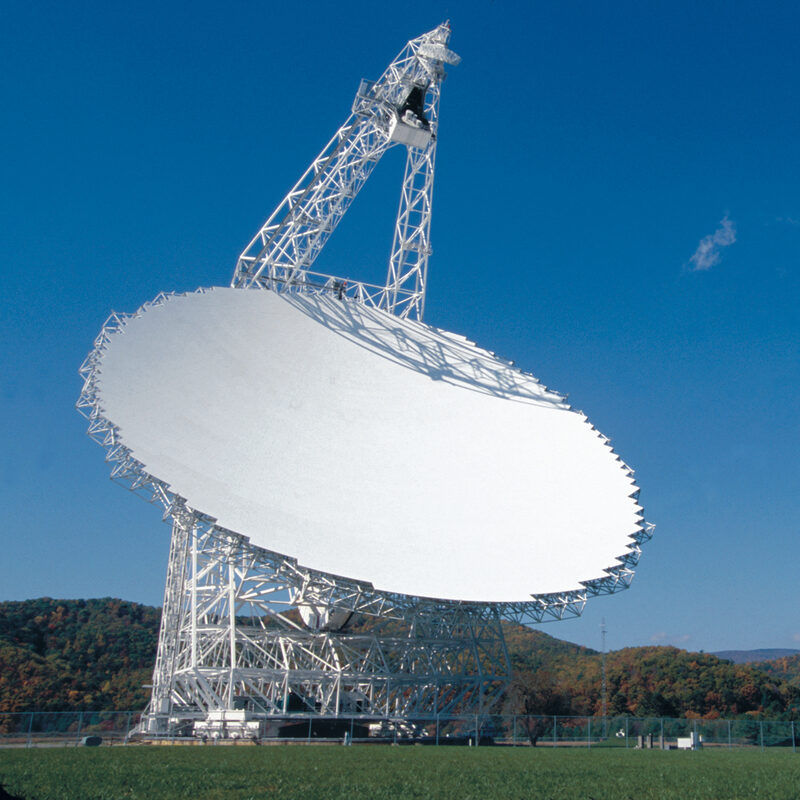
In November 1961, Frank Drake convened the first serious scientific conference on the search for extraterrestrial intelligence at the National Radio Astronomy Observatory in Green Bank, West Virginia. To organize the discussion, he wrote on a blackboard the product of seven terms that together estimate the number of communicating technological civilizations currently existing in the Milky Way. The equation bears his name, though he thought of it as a conference agenda rather than a scientific result. It remains the most compact framework for thinking about whether we are alone.
The equation: N = R* × fp × ne × fl × fi × fc × L. N is the number of communicating civilizations; R* is the rate of star formation in the galaxy; fp is the fraction of stars with planets; ne is the average number of planets per star that could support life; fl is the fraction of those where life actually develops; fi is the fraction where intelligent life develops; fc is the fraction that develop detectable technology; and L is the average lifetime of such a civilization in years. Multiply them together and you get N. In 1961, almost every term was a guess. In 2026, the first two and a half are not.
What exoplanet science has established
R* is well-determined: the Milky Way forms roughly 1-3 stars per year, with some uncertainty about the current rate versus the historical average. fp, the fraction of stars with planets, has been definitively answered by the Kepler space telescope: essentially all stars have planets. The fraction is close to 1. ne — the number of potentially habitable planets per star — is harder, and depends on how "habitable" is defined. Kepler statistics suggest that small rocky planets in the habitable zones of their stars are common: roughly 10 to 20 percent of sun-like stars may host an Earth-sized planet in the habitable zone, with higher rates for smaller M dwarf stars. The first three terms of the Drake Equation are now constrained by data rather than speculation.
The remaining terms are where the equation opens into genuine uncertainty. fl — the fraction of habitable planets where life arises — depends on whether life's origin is a near-inevitable chemical process given the right conditions or an extraordinarily improbable event. The discovery of amino acids in asteroid samples (Bennu, Ryugu), the prevalence of organic chemistry in interstellar space, and laboratory experiments showing that RNA-like polymers can form under plausible early-Earth conditions all support the optimistic view. But "life has appeared once in the places we know about" is a dataset of one, and drawing statistical conclusions from it is problematic.
The Fermi paradox and the Great Filter
The Fermi paradox — Enrico Fermi's 1950 question "where is everybody?" — sits in tension with optimistic Drake Equation estimates. If technological civilizations arise frequently and are long-lived, the galaxy should be filled with their signals, their probes, or their artifacts. It is not, as far as any search has found. The resolution most discussed in the academic literature involves the Great Filter — some barrier in the progression from simple chemistry to communicating civilization that most lineages fail to cross. The optimistic scenario places the filter in the past (life itself is rare, or intelligence is rare), which would mean we have passed it. The pessimistic scenario places it in the future: all civilizations tend to self-destruct, and we have not yet reached the dangerous stage. The SETI Institute's 65 years of observation, with increasingly sensitive telescopes and algorithms, has found no confirmed artificial signal.
What is different in 2026 compared to 1961 is not that the answer is clearer but that the framing is more precise. The uncertainty in N is now concentrated in three terms — fl, fi, fc — each of which has a scientific program that could constrain it. Atmospheric biosignatures from JWST could, in principle, detect life on nearby exoplanets without requiring technological civilizations. Laboratory studies of the origin of life continue to narrow the parameter space of plausible prebiotic chemistry. The Fermi paradox persists, but it is now a constraint on the unknown terms rather than a vague observation about the silence of the night sky.
Sources
- NASA Exoplanet Archive (Caltech/IPAC) — Kepler occurrence rate data and confirmed exoplanet catalog
- SETI Institute — The Drake Equation: history, terms, and current estimates
- Drake equation — Wikipedia (each term, Kepler constraints, and current estimates for N)
- Fermi paradox — Wikipedia (the Great Filter, SETI searches, and proposed resolutions)
