
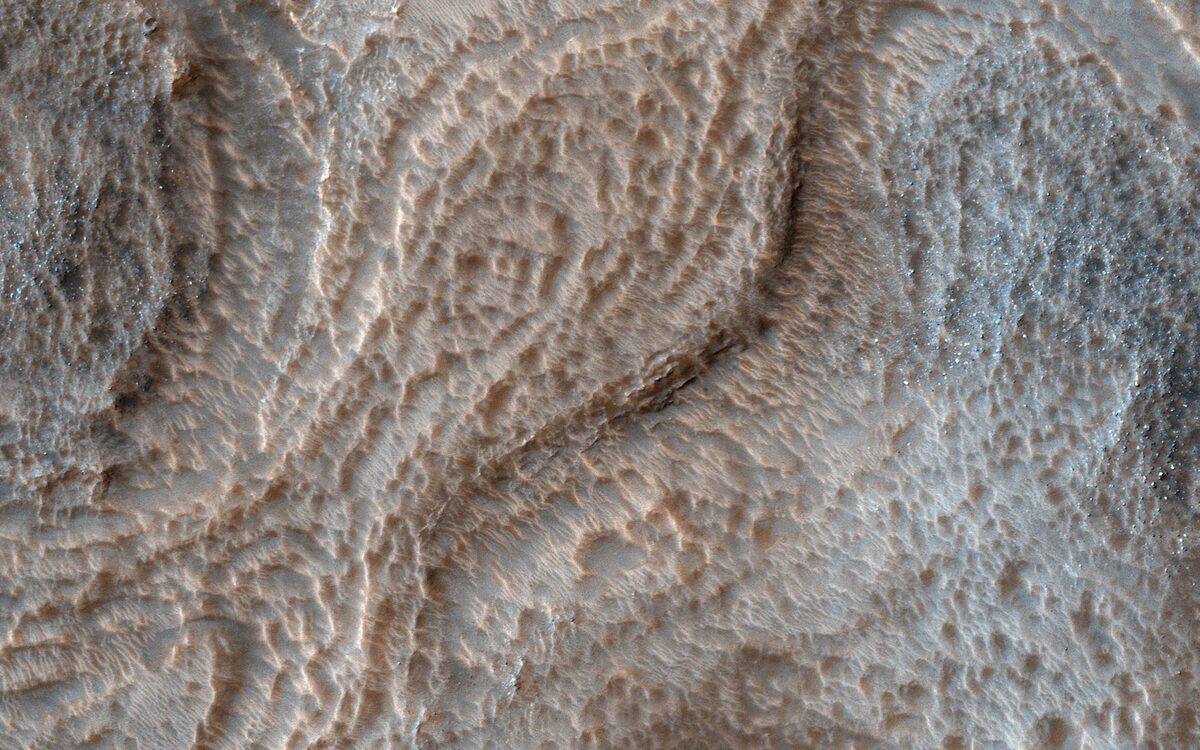
NASA's Curiosity rover has spent nearly a dozen years working its way up the lower flanks of Mount Sharp, a 3-mile-tall mound of layered rock at the center of Gale Crater. In that time it has photographed dune fields, ancient lakebeds, and mineral veins that speak to a wetter Martian past. Now it has found something that made even the mission's project scientist pause: a sea of tiny, honeycomb-shaped cracks stretching across an entire valley.
The discovery came from a 360-degree panorama Curiosity captured on sols 4,930 and 4,931 — June 19 and 20, 2026, in mission time — while surveying a region called Valle Grande. Spread across the valley floor and climbing up the sides of a small butte named Miraflores, the rover's cameras revealed polygon-shaped fractures packed together edge to edge, each one only 4 to 8 centimeters (1.5 to 3 inches) across. Miraflores itself is modest by Martian standards, rising just 20 feet (6 meters), but the honeycomb pattern coats its slopes as thoroughly as it does the flat ground around it.
"We've seen a lot of fascinating landscapes through Curiosity's eyes, but this sea of polygons took our breath away," said Ashwin Vasavada, the mission's project scientist, in NASA's announcement of the find.
According to NASA/JPL, it is the largest concentration of polygon features Curiosity has observed in a single location since it landed in Gale Crater on Aug. 5, 2012, and began climbing Mount Sharp in 2014.
What's Actually Making the Pattern
Polygonal fracture networks aren't new to Curiosity's traverse — the rover has documented smaller patches before — but the scale of the Valle Grande field has renewed a debate among mission scientists about how these shapes form in the first place. Researchers have not settled on a single explanation, and reporting on the discovery lays out three competing hypotheses.
The first is the most familiar to anyone who has watched a mud puddle dry out on Earth: as wet sediment loses moisture, it shrinks and cracks into roughly polygonal plates, the same process behind the cracked-earth patterns seen in dry lakebeds worldwide. The second candidate is thermal cycling — repeated freeze-thaw or hot-cold temperature swings that stress rock and soil until it fractures along regular lines, a mechanism seen in permafrost terrain on Earth. The third possibility doesn't require any temperature change at all: compaction. As layers of sediment pile up and compress, trapped water can be squeezed out of buried material, and the resulting shrinkage can crack the ground above it in a honeycomb pattern, even without the surface ever drying in open air.
Each explanation implies a different history for this patch of Mars. Mud cracking points to standing water evaporating at the surface. Freeze-thaw cycling points to a colder, more dynamic climate acting on ground ice or frost. Compaction-driven dewatering could happen underground, sealed away from the atmosphere entirely, and only exposed later by erosion. Untangling which of the three actually produced the Valle Grande honeycomb is now an active area of investigation for the Mars Science Laboratory team, and it isn't a question the panorama alone can answer — it will likely take closer inspection of the fracture edges, fill material, and surrounding rock chemistry to narrow down the culprit.
A Familiar Shape, an Unfamiliar Scale
What sets Valle Grande apart isn't the shape of the cracks — polygonal fracturing is a well-known geological process — but how much ground it covers. A few isolated polygons could plausibly form from a one-off drying or freezing event on a small puddle or patch of sediment. A field extensive enough to blanket an entire valley floor and wrap around a butte suggests something that happened at a much larger scale, whether that's a lake bed that dried out uniformly across a wide basin, a climate-driven freeze-thaw regime that acted regionally, or a thick buried sediment layer that compacted evenly over a broad area.
That's part of why the find matters to a mission whose central task has always been reconstructing Gale Crater's environmental history. Curiosity was sent to Mars specifically to determine whether the region could once have supported microbial life, and the honeycomb field is being framed as another data point in that long-running story — one more clue about how water, temperature, and sediment interacted in this particular corner of Mars, at whatever point in its past this ground was still being shaped.
Why It Matters
Every fracture pattern Curiosity documents is a small piece of evidence about the conditions that once existed on Mars — and specifically about water, the single resource most tied to the question of past habitability. If the Valle Grande honeycomb turns out to be a mud-crack network, it strengthens the case for standing or ponded water having covered a wide area of Gale Crater at some point. If it's a freeze-thaw signature instead, it tells a story about a colder, ice-influenced environment rather than open water. And if compaction expelling groundwater is the answer, it suggests processes happening below the surface, out of sight, that could have persisted even after the surface itself dried up. Each scenario reshapes the picture of what this part of Mars was like — and by extension, what conditions any ancient microbial life there would have had to survive. That's why a field of finger-sized cracks, unremarkable at a glance, is drawing this much attention from the team steering a nuclear-powered rover across another planet.
Sources
- NASA's Curiosity Mars Rover Discovers Field of Honeycomb Textures — NASA/JPL, July 29, 2026
- NASA's Curiosity rover finds a mysterious honeycomb landscape on Mars — ScienceDaily, July 31, 2026
- Curiosity rover spots field of giant honeycomb on Mars — but no giant space bees — The Register, July 30, 2026
