
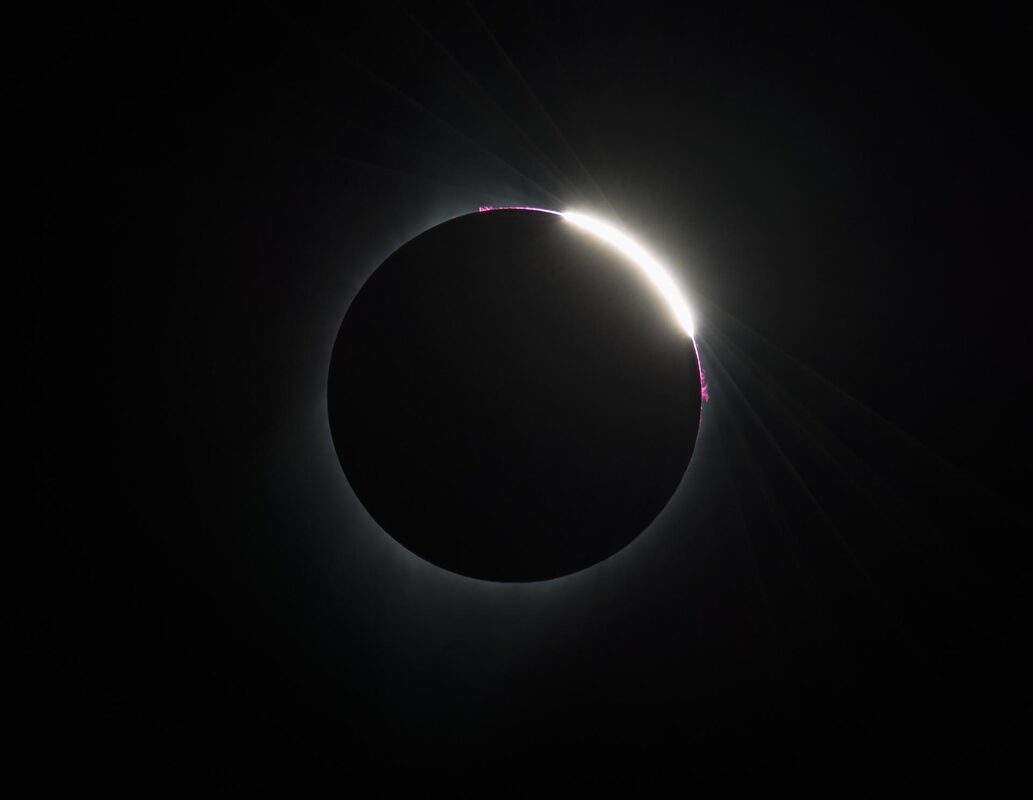
On Aug. 2, 2027, the Moon will cover the Sun over Luxor for 6 minutes and 22 seconds. According to Time and Date, as reported by Space.com, totality there begins at about 1:02 p.m. EEST. That is a long total eclipse, and it falls over a landscape full of temples and tombs built by people who watched the same sky.
That setting is behind a quieter question in archaeoastronomy. Did eclipses in Egypt's distant past change the course of its history, and can we use them to date that history more precisely? Two proposals, one about the end of the 4th dynasty of the pyramid age and one about the era of the pharaoh Merneptah, show both the appeal of the method and how hard it is to pin down.
A shadow over the Delta
The first case starts on April 1, 2471 BC, when a total solar eclipse crossed northern Egypt. In a paper posted to arXiv (first submitted Dec. 18, 2024, revised Jan. 7, 2025), Giulio Magli reconstructs its path. Space.com identifies him as an archaeoastronomer at the Polytechnic University of Milan. The band of totality was almost centered on Buto, a sacred city in the Nile Delta, and Memphis, the capital, was very close to totality, with more than 95 percent of the Sun covered.
The date matters because it is compatible with existing chronologies for Shepseskaf, the last pharaoh of the 4th dynasty. Shepseskaf ruled after a line of kings tied to the greatest pyramids, yet his own tomb was not a pyramid. It is a huge rectangular structure at South Saqqara. Astronomy magazine describes it as looking like a flat, table-like, half-completed pyramid. Magli's abstract says the tomb resembles the symbolic shrine at Buto, the same city that sat near the center of the eclipse's shadow.
From there Magli asks whether the eclipse helped cause a break with what he calls the tradition of solarized kings, which began with Khufu and tied the pharaoh closely to the Sun. Astronomy magazine summarizes the idea this way: pyramid building is associated with worship of the Sun, and a total eclipse may have triggered a religious crisis that led Shepseskaf to abandon the practice of his ancestors.
The idea is neat, and it lines up with the geography. But it has a large gap, which Space.com points out directly: no surviving Egyptian text records the eclipse. Astronomy magazine adds that the dates of Shepseskaf's reign are uncertain, because Egyptologists must count backward from unreliable lists of pharaohs, and that the eclipse's exact timing and location are also approximate because Earth's rotation has changed over thousands of years. The argument rests on a match between an astronomical event that certainly happened, a reign whose dates are uncertain, and an architectural choice that could have other explanations, among them a wish to be buried nearer his ancestral homeland, a dispute with priests, or simply a lack of funds. Magli's stated aim is to investigate the possibility, and that framing is the right one.
An annular eclipse and a biblical passage
The second proposal is more ambitious and has drawn more argument. In 2017, Colin Humphreys and Graeme Waddington of the University of Cambridge claimed that a passage in the biblical Book of Joshua, in which the sun and moon seem to stand still, could refer to an annular solar eclipse on Oct. 30, 1207 BC. An annular eclipse leaves a bright ring of Sun around the Moon instead of full darkness. Space.com reports that the researchers proposed the eclipse occurred during the second, third or fourth year of the reign of Merneptah, whom Space.com places at roughly 1213 to 1203 BC.
If the eclipse can be fixed in time and tied to events in a particular reign, it becomes an anchor that the surrounding chronology can be adjusted against. According to Space.com, Humphreys and Waddington propose that Ramesses II reigned from about 1276 to 1210 BC, with an uncertainty of about a year, a few years off the conventional 1279 to 1213 BC dates used by the British Museum. Three years may not sound like much, but in a field where reigns are fitted together end to end, a small shift for one major king matters to the reigns around him.
This is also where the proposal runs into trouble. Space.com calls it a controversial interpretation, not least because it depends on exactly how the ancient Hebrew text is translated, and notes that it has been challenged by Marinus Anthony van der Sluijs, whose paper argues that the passage describes the sun standing over Gibeon and the moon over the Valley of Aijalon at the same time, so not an eclipse at all. Reading an ancient text as a description of an eclipse means deciding what its words meant to the people who wrote them, and other readings are possible. Unlike the Saqqara case, the eclipse here is tied to a written source, but the argument depends on how that source is interpreted.
How eclipse dating works, and where it fails
Both proposals rely on the same strength. Space.com notes that astronomers can reconstruct where the Moon's shadow fell thousands of years ago, even when nobody left a record of it. When an ancient text reliably describes an eclipse, it can anchor a moment in history to a specific place and time.
The weak point is the other half of the match. In the Shepseskaf case, no record exists at all, so the link between the eclipse and the change in royal architecture is inferred. In the Merneptah case, a text exists, but whether it describes an eclipse is the very thing in dispute. That is why Space.com cautions that an eclipse can be like a timestamp on an undated photograph, but this one does not show that the Book of Joshua actually describes an eclipse. Careful researchers treat these ideas as hypotheses to test, not as revisions to the timeline.
Why It Matters
Egyptian chronology is built largely from lists of kings and reign lengths, which Astronomy magazine describes as unreliable in places, so an eclipse that can be firmly tied to a reign is one of the few tools that could supply an absolute date. Neither proposal has reached that standard yet, but each shows what the payoff would be if one did.
The 2027 eclipse offers a contrast. Space.com notes that for it there will be no ambiguity: the path, the time of arrival at Luxor and the length of darkness are already known. Visitors in Luxor will watch daylight fade for more than six minutes. That makes it easier to imagine why Magli considers it plausible that an event like the one in 2471 BC, which Astronomy magazine notes would have been impossible to predict, could have shaken a theology built around the Sun.
If you go next August, the spectacle will be enough reason. Knowing that the shadow may once have helped decide where a pharaoh was buried gives it more weight.
