
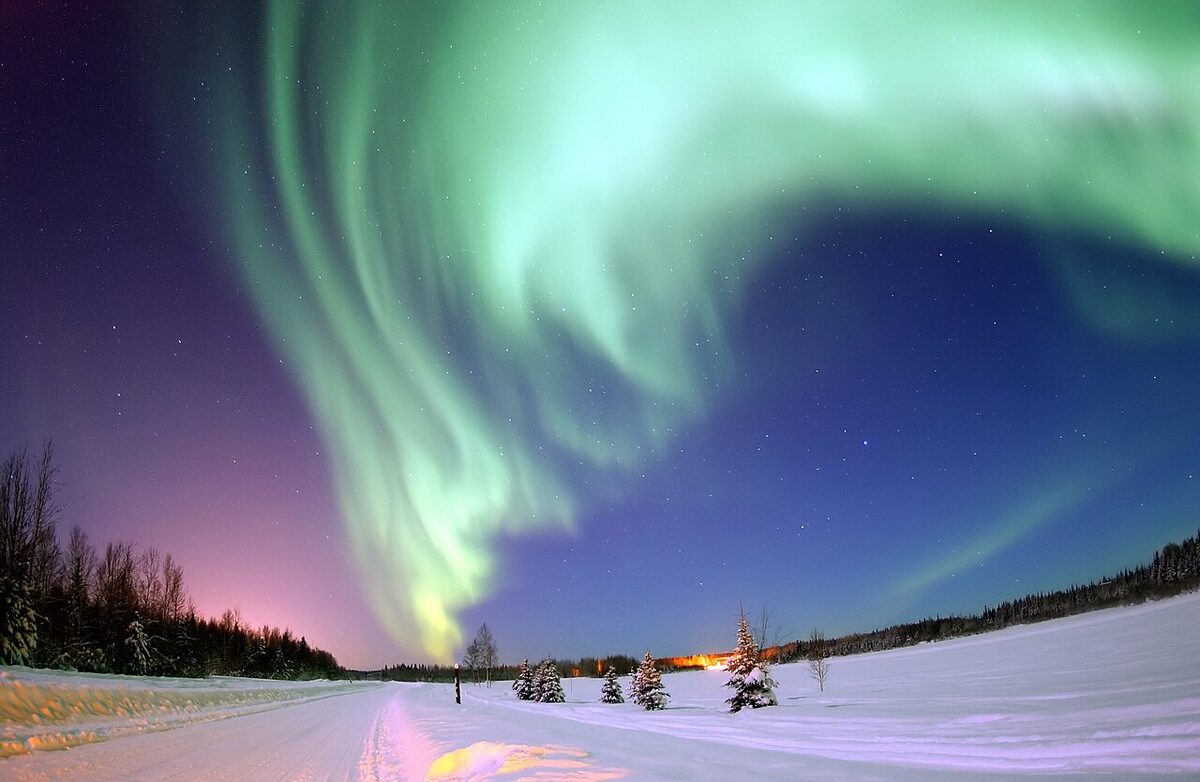
If you assumed the great aurora season was over once the news declared the Sun had hit its maximum, the sky has a more complicated answer. The official peak of Solar Cycle 25 arrived in October 2024, but solar physicists increasingly describe this cycle as double-peaked — a second hump of activity that stretches the elevated conditions well into 2026. The headline number, sunspot count, is past its high. The thing aurora chasers actually care about, the chance of a strong geomagnetic storm on any given night, has faded less than the calendar suggests.
Why "past the peak" doesn't mean "over"
Auroras are driven by the Sun flinging charged material at Earth — chiefly coronal mass ejections, the billion-tonne eruptions that, when aimed our way, compress the magnetosphere and pour energy into the upper atmosphere, where it excites oxygen and nitrogen into the greens and reds of the aurora. CME frequency does track the sunspot cycle, so 2026 will see fewer of them than the 2024–25 crescendo. But two things keep the odds alive. First, the declining phase of a solar cycle is historically prone to producing some of the most intense geomagnetic storms on record, often driven by fast solar wind streaming from long-lived coronal holes rather than by sunspot eruptions. Second, NOAA's Space Weather Prediction Center forecasts geomagnetic activity in 2026 as down from the peak but still well above the long-term average for much of the year. Elevated, not exhausted.
The spectacle is also a warning light. The same geomagnetic storms that paint the sky drive currents through the ground and through everything connected to it — power grids, pipelines, satellites, and the radio and GPS signals that aircraft and ships rely on. A severe storm can trip transformers, degrade navigation, and force satellite operators to scramble; the most extreme on record, the 1859 Carrington Event, set telegraph lines sparking. So a vivid aurora is the visible, benign face of a phenomenon with a dangerous one — which is precisely why an agency like NOAA forecasts space weather at all. For an observer it is pure reward; for a grid engineer it is a cue to watch the infrastructure. Both are reading the same Sun.
How to actually catch one
Aurora hunting rewards preparation over luck. The single best habit is to watch the forecast: the Space Weather Prediction Center publishes short-term geomagnetic outlooks and a planetary index, Kp, that estimates how far from the poles the aurora is likely to reach. A Kp of 5 or higher is worth acting on at mid-latitudes; the highest storms can push the lights into skies that almost never see them. When a strong CME is flagged, you typically have a day or two of warning as it crosses the Sun–Earth gap.
On the ground, the rules are simple and unforgiving. Get away from city light and find a clear view to the north — the aurora often sits low on the horizon from mid-latitudes even when it's blazing overhead farther north. Go out in the hours around local midnight, when your location faces the most active part of the magnetosphere. Give your eyes twenty to thirty minutes to adapt and keep bright screens out of view. And take a photo even when you see only a faint gray arch: modern phone cameras, with their long night-mode exposures, routinely pull out vivid color the eye can't register, which is both a delight and a reminder that the camera is the better aurora detector. The cycle is winding down, but the descending years can still surprise — and a quiet sky one night says nothing about the next. Keep a space-weather alert handy, watch the Kp forecast, and be ready to drive north on short notice; in the descending years of a solar cycle, the best displays tend to reward whoever is simply positioned to catch them.
