
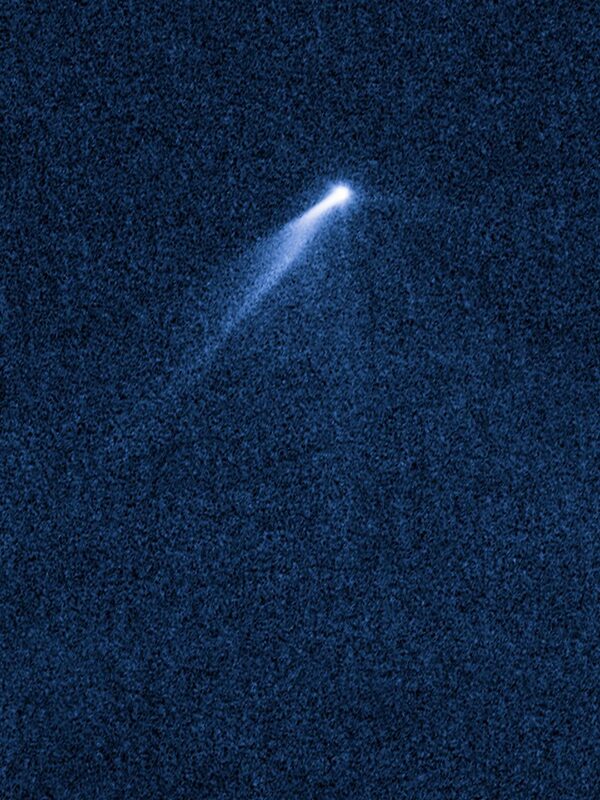
Astronomers have been tracking asteroid 6993 (1995 BJ4) since 1954. Its orbit sits in the outer main belt and is not unusual in any way. For seven decades it looked like an ordinary rock. This summer it grew a tail.
The activity was caught on UT 2026 August 5. A machine learning model scanning the Zwicky Transient Facility (ZTF) alert stream flagged an image of the object with 99.9 percent confidence that something was off. Researchers went back through earlier data and found the tail as early as June 25. The team, which includes researchers at Northern Arizona University and other institutions, described the discovery in a preprint posted to arXiv on October 22. EarthSky reports that the paper has not yet been peer reviewed, and the arXiv listing says it is to be published in ApJ Letters.
The interesting question is not that an asteroid is active. That happens. The question is why, and the answer depends on how big this one is.
A Large Object With a Small Club of Peers
The preprint gives 6993 a diameter of 11.85 km, which EarthSky rounds to about 12 km (7.5 miles). That makes it larger than 99 percent of asteroids. The preprint also gives a geometric albedo of 0.166 ± 0.030, which the authors describe as unusually high.
Main-belt comets are objects on asteroid-like orbits that show comet-like activity, most likely from ices sublimating as they warm. They are a small group: EarthSky counts about 20 known. If sublimation turns out to be what is happening on 6993, the authors say it would hold two records in that group. It would be the largest known main-belt comet, and it would have the largest perihelion distance, at 2.853 au.
That second record matters as much as the first. Perihelion is the point in an orbit where an object gets closest to the Sun, and so the point where it gets warmest. An object that sublimates ice while never coming closer than 2.85 au from the Sun would push the known limits of where that kind of activity can switch on.
Three Ways to Make a Tail
An asteroid can shed dust for a few broad reasons. The team looked at three.
Rotational instability. A fast-spinning asteroid can throw off material from its surface. The authors conclude the activity is likely not primarily driven by this. 6993 rotates once every 3.9 hours, which EarthSky says is not fast enough to explain what the observations show.
Impact. Something hit it. A collision would throw out a cloud of debris that slowly spreads and fades. One observation fits this picture: the object appeared slightly brighter in June and July than in August and September. EarthSky describes that dimming as a possible sign of collision dust dispersing.
Sublimation. Sunlight warms buried ice, which turns to gas and carries dust out with it. This is how comets work, and it is the hypothesis that would make 6993 a record-holder.
The preprint does not choose between the last two. It calls the activity consistent with either impact or sublimation. The fading brightness points somewhat toward a one-time event. Sublimation has not been ruled out.
How Big Is the Tail?
EarthSky describes a narrow, straight tail extending at least 32 arcseconds beyond the main body. That is a modest feature in the sky, but enough for survey imaging to resolve.
The detection method deserves some attention too. ZTF produces a constant stream of alerts, and nobody looks through every one of them by eye. A machine learning model trained to recognize the fuzzy appearance of active asteroids flagged this object. The team then checked earlier ZTF observations and traced the tail back to June 25.
The Orbit
The JPL Small-Body Database record shows a quiet orbit:
- Semi-major axis: 3.11 au
- Eccentricity: 0.0821 (nearly circular)
- Perihelion distance: 2.85 au
- Aphelion distance: 3.36 au
- Inclination: 2.4°
- Orbital period: about 2,000 days
- Next perihelion passage: JD 2461411.7, in early 2027
- First observation: 1954
The current orbit solution is dated August 11, 2026, less than a week after the activity was flagged. Because the orbit is so close to circular, 6993's distance from the Sun changes only modestly over its roughly 5.5-year trip, from about 2.85 au at perihelion to about 3.36 au at aphelion.
Why It Matters
Main-belt comets are one of the few ways to look directly at ice that may survive in the asteroid belt today. With only around 20 known, adding one that is roughly 12 km across would stand out. If sublimation is confirmed, it would mean a sizable, long-observed body can carry enough near-surface ice to switch on at 2.85 au.
If the cause turns out to be an impact, the object is still useful. The tail was caught within weeks of the earliest visible activity, with archival ZTF data going back to late June, which gives researchers a record of how the debris behaves over time.
The way the activity was found is also part of the story. A machine learning classifier fed by a wide-field survey alert stream spotted activity on an object that had been catalogued for more than 70 years.
What Happens Next
The authors recommend monitoring 6993 as it approaches perihelion in January 2027. The logic is simple. As EarthSky puts it, if sunlight is vaporizing ice, astronomers might see activity increase. If the tail continues to fade, that would lend support to the impact explanation.
Until then, keep in mind that the record-setting label depends on an "if," and that EarthSky notes the paper has not yet been peer reviewed. The plan for settling it is clear, though, and the next test is only a couple of months away.
