
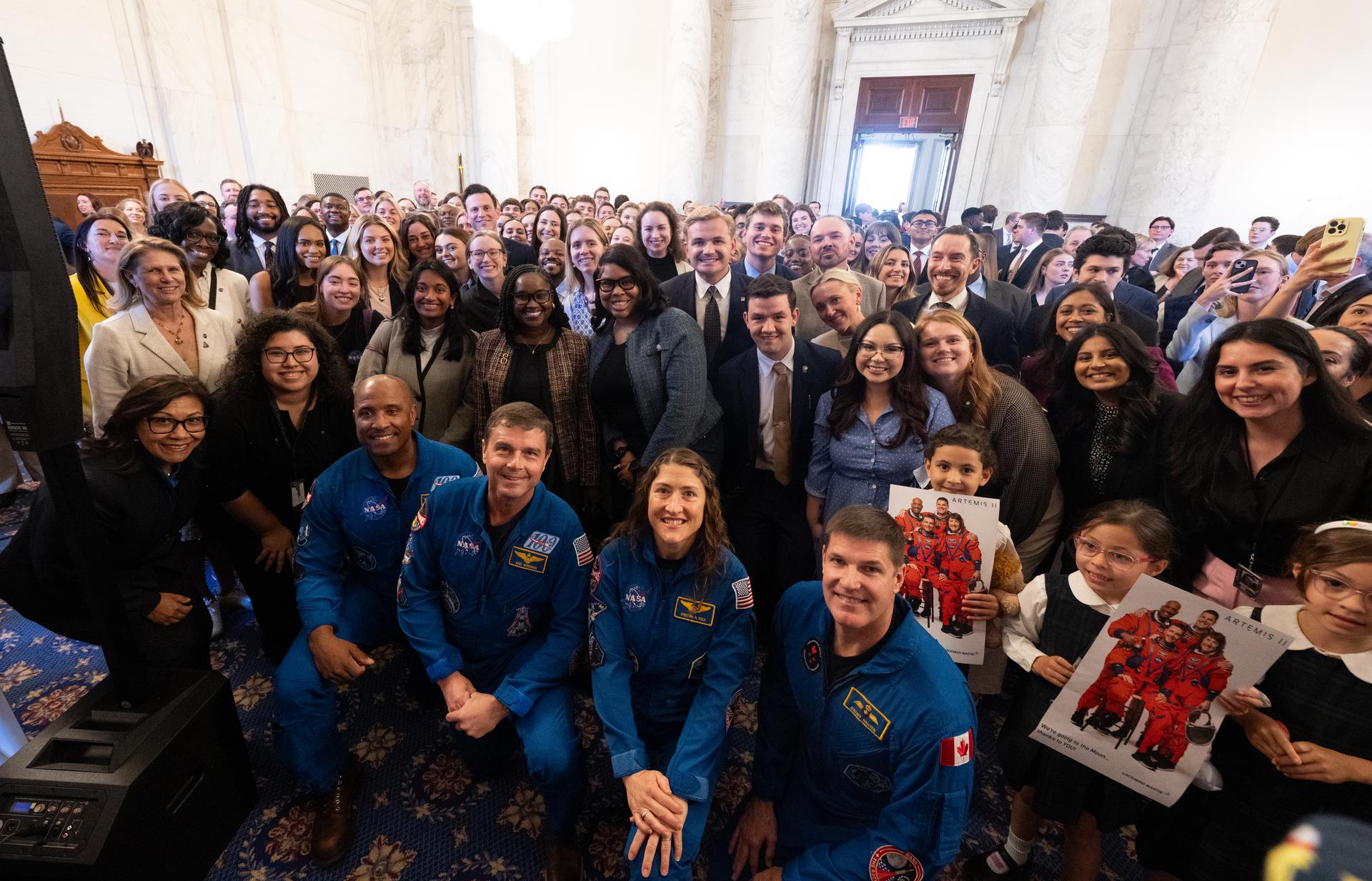
On August 28, President Trump will stand at Johnson Space Center in Houston and pin the Congressional Space Medal of Honor on four astronauts who, four months earlier, flew farther from Earth than any human being since 1970. Reid Wiseman, Victor Glover and Christina Koch of NASA, along with Jeremy Hansen of the Canadian Space Agency, will become only the 31st through 34th people to receive the award since Congress created it in 1969.
The ceremony is scheduled for 11 a.m. EDT and will be streamed live at nasa.gov/live. NASA Administrator Jared Isaacman is expected to attend alongside the crew. It is, by any measure, a small club they are joining — a medal that, under the law creating it, the president may award "in the name of Congress to astronauts who distinguish themselves through exceptionally meritorious efforts and contributions to the welfare of the nation and mankind," and one that has gone to fewer than three dozen people in 57 years, including Neil Armstrong and Alan Shepard.
What the Crew Actually Did
Artemis II launched April 1, 2026, and splashed down ten days later on April 10. It was the first crewed flight of NASA's Orion spacecraft and, more significantly, the first mission to carry astronauts beyond low Earth orbit and around the Moon since the Apollo program ended in the early 1970s. Unlike Apollo 8 or the ill-fated Apollo 13, Artemis II was not attempting a landing — its job was to validate that Orion's life support, navigation and deep-space systems work with a human crew aboard before NASA commits astronauts to an actual lunar touchdown on a future Artemis mission.
The flight path took the crew within 4,067 miles of the lunar surface on April 6, close enough to use the Moon's gravity to sling Orion into a free-return trajectory back to Earth — the same basic maneuver Apollo-era engineers relied on when a direct return wasn't an option. That trajectory carried the spacecraft to a maximum distance of 252,756 miles from Earth, edging past the distance record Apollo 13's crew set by accident in 1970 when a damaged service module forced them to loop around the Moon rather than land. Over the full ten days, Wiseman, Glover, Koch and Hansen covered 695,081 miles.
Numbers like these can start to blur together, but the comparison worth holding onto is this: for more than half a century, the farthest any human had traveled from home was set by an accident during a mission that nearly ended in tragedy. Artemis II reset that record on purpose, as a planned test flight, with a crew of four rather than three.
Who's Getting the Medal
Reid Wiseman commanded the mission, with Victor Glover serving as pilot. Christina Koch rounds out the NASA contingent as mission specialist, and Jeremy Hansen, a Canadian Space Agency astronaut, flew as the fourth crew member aboard Orion.
The Congressional Space Medal of Honor is distinct from NASA's own internal honors; it is a Congressional award, administered by NASA but bestowed in the name of Congress, and it requires a level of achievement rare enough that the agency does not hand it out on a regular cadence. Roughly 30 people have received it since its creation in 1969 — a list that includes the first Moon walkers and other Mercury, Gemini and Apollo-era figures whose flights redefined what was technically possible. The Artemis II crew's addition will bring that list to 34.
Why It Matters
Medal ceremonies are, on their face, symbolic — nobody's orbital mechanics change because Congress issues a commendation. But the timing and substance here matter for reasons beyond pageantry. Artemis II was the proof-of-concept flight NASA needed before it can respectably send a crew toward an actual lunar landing under the Artemis program. A clean ten-day mission with no major anomalies validates the life-support, navigation, heat-shield and abort systems on Orion with real people aboard, which is a different and higher bar than any uncrewed test can clear.
It's also a marker of how long the gap had grown. NASA and other outlets covering the ceremony describe the Artemis II crew as the first people in more than 50 years to travel beyond the Moon. Everyone born since roughly the early 1970s — which is to say, the overwhelming majority of the world's population — has lived through more than five decades in which no person left the relatively narrow band of space just above Earth's atmosphere. Artemis II ends that stretch, and does so with a diverse crew and an international partner riding along, which is itself a departure from the all-American, largely military-test-pilot rosters of Apollo.
Awarding the Congressional Space Medal of Honor now, rather than years down the line, also signals how NASA and the current administration want the mission remembered: not merely as a test flight buried in the run-up to a landing, but as a milestone in its own right, comparable to the achievements of the medal's earlier recipients. Whether the broader Artemis program delivers a landing on schedule is a separate question — one that depends on hardware, budgets and schedules well beyond a single ceremony. But the flight itself, and the record it set, is now a matter of history rather than plans.
