
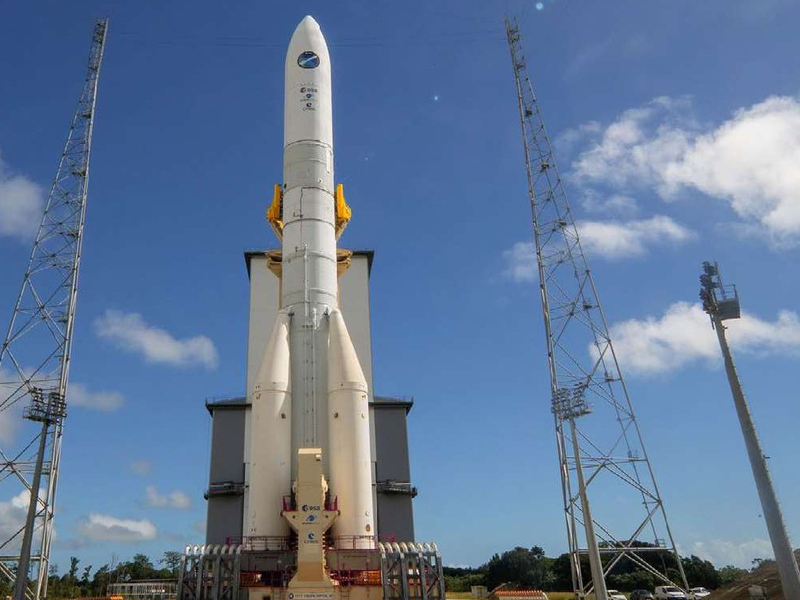
At 11:53 UTC on June 17, an Ariane 64 rocket cleared the launch pad at Europe's Spaceport in French Guiana and began climbing toward low Earth orbit. By the time all 36 Amazon Leo satellites had separated, one hour and fifty-one minutes later, it had set a record: the heaviest payload in the history of the Ariane program, and the first flight of a new generation of solid-rocket boosters that will define the vehicle's commercial ceiling for years to come.
The mission, designated VA269, was the eighth Ariane 6 launch overall and the third of 2026. It was also the third consecutive Ariane 6 mission dedicated to Amazon's broadband megaconstellation — a constellation still officially called Amazon Leo but widely recognized as the successor to the Project Kuiper effort the company spent years building toward.
What changed: the P160C boosters
The version of Ariane 6 flying on June 17 was not quite the same rocket that flew before it. The four solid-propellant strap-on boosters flanking the core stage were P160C units — a new variant carrying up to 156 tonnes of propellant each, compared to the P120C boosters used on earlier missions. The upgrade translates to approximately a 10% increase in thrust at liftoff and raises the rocket's payload capacity to low Earth orbit to approximately 22 tonnes.
For Amazon's purposes, that extra capacity mattered: the June 17 mission carried four more satellites than the previous Ariane 6 Amazon Leo flights. Thirty-six satellites, all tucked under a 20-meter fairing, separated sequentially over less than 30 minutes once the upper stage had reached its target orbit. The full mission from liftoff to final deployment ran 1 hour and 51 minutes.
The P160C development was a strategic bet. Ariane 6 entered service later than planned, and its commercial manifest was assembled in a market where SpaceX's Falcon 9 had already established price points that European launch services struggled to match on a direct cost-per-kilogram basis. The boosters represent an engineering answer to part of that problem: more capacity per flight means the per-satellite cost can drop even if the rocket's sticker price doesn't change dramatically.
Amazon Leo and what it's building
Amazon Leo — the constellation — is trying to do in broadband what Starlink has done, with a different operational and business model. Where SpaceX's Starlink built its constellation primarily on its own launches, Amazon has contracted across multiple launch providers, including Arianespace, ULA, and SpaceX itself. The strategy spreads launch risk across providers and keeps the company from being hostage to any single vehicle's schedule.
The June 17 launch is part of a deployment sequence that has been accelerating through 2026. The constellation needs hundreds of satellites in orbit before it can begin offering service commercially, and the pace of launches this year suggests that timeline is compressing toward a realistic initial service date. Amazon has not publicly announced a service start date, but the launch cadence implies an operational network is closer than it was at the start of the year.
What this means for Ariane 6
The Ariane 6 program had a difficult beginning. Development ran over schedule and over budget. The rocket's first launch in July 2024 — after multiple delays stretching back years — successfully reached orbit but suffered an anomaly with the upper stage's Vinci engine during a planned re-ignition intended to deorbit the stage. The issue meant payloads could reach orbit, but the rocket couldn't yet execute the end-of-life disposal maneuver that regulatory bodies and responsible operators require. A fix was implemented on subsequent missions.
Since then, the cadence has stabilized. Three launches in 2026 through June, including a record-setting payload, represents a program that has moved past its teething phase. For Arianespace, the commercial relationship with Amazon is significant not just for the revenue but for the operational experience: back-to-back missions of similar configuration allow the launch teams to build the kind of procedural fluency that reduces turnaround time and increases reliability.
Europe's long-term launch independence — the political and industrial imperative that justified the development cost — depends on Ariane 6 becoming a rocket that major customers choose not just because they have to, but because the price, reliability, and schedule performance make it genuinely competitive. Lifting a record payload on upgraded boosters for one of the most commercially significant satellite customers on the planet is one step in that direction. The next will be whether the cadence can hold.
The fourth Amazon Leo mission aboard Ariane 6 is expected before the end of 2026. By then, the rocket will have logged more flights than in its entire first year of service, and the P160C boosters will have proven themselves across at least two missions. For a program that spent years fighting doubt, that's meaningful progress — even if the launch market it's competing in has grown more challenging, not less, since Ariane 6 was designed.
Why It Matters
Europe's ability to launch its own payloads to orbit without depending on another nation's rockets is a strategic priority that has driven Ariane program investment for decades. Ariane 6 was the answer to a market that had shifted dramatically since Ariane 5 was designed — but its early difficulties raised real questions about whether it could compete. Lifting the heaviest payload in Ariane history on the debut of upgraded boosters, on a commercial contract from one of the world's largest technology companies, is the kind of operational milestone that matters. Whether it translates into a competitive commercial manifest over the next five years will determine whether European launch independence means something practical or remains a prestige program.
