
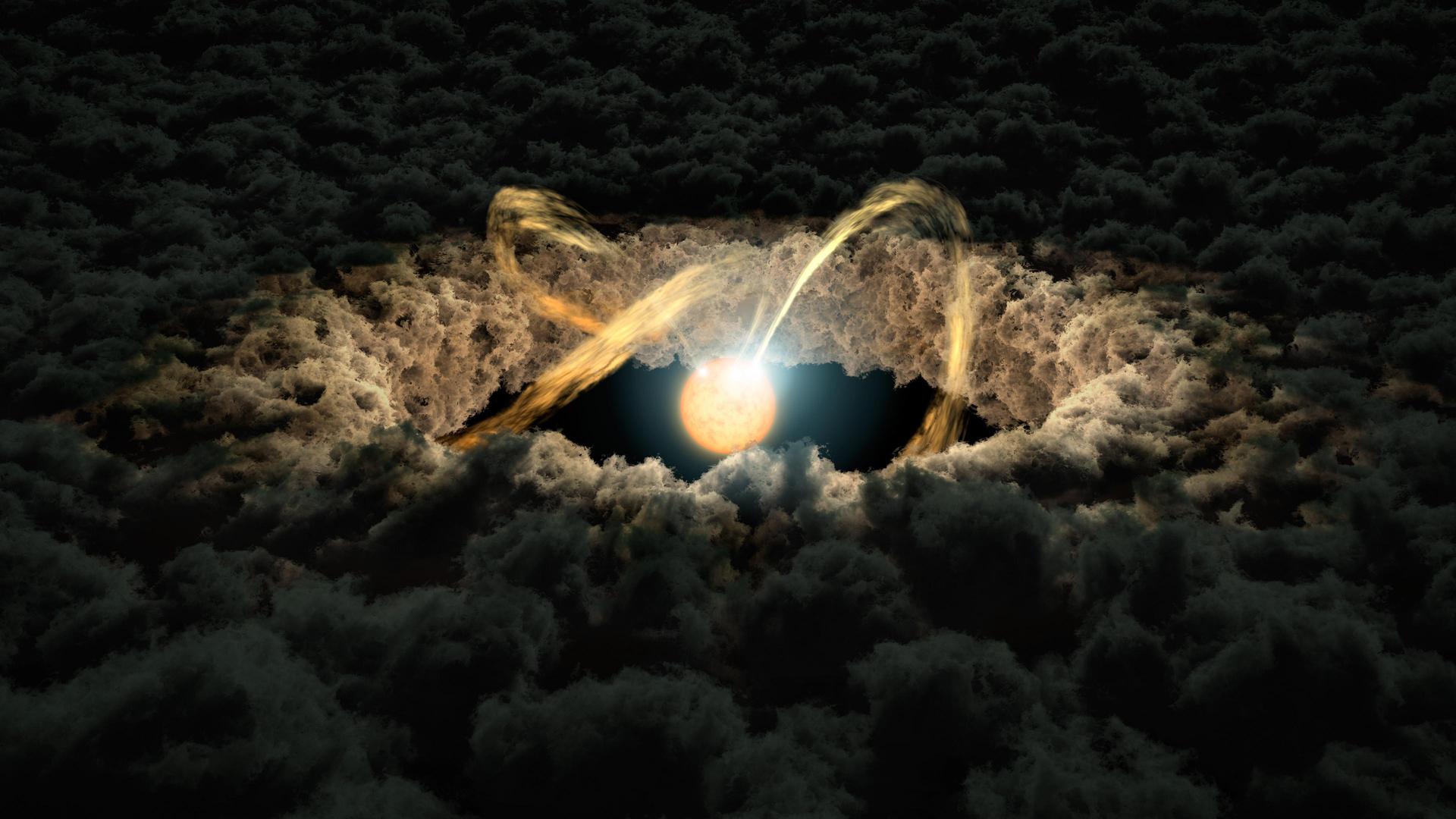
Astronomers have long predicted that a young giant planet should disturb the gas around it as it forms. Now a team using the Atacama Large Millimeter/submillimeter Array (ALMA) has seen that disturbance at the exact position of a planet they can also see directly. The planet is WISPIT 2b, about 5 Jupiter masses, roughly 430 light-years away, embedded in the disk of gas and dust where it formed.
The result comes from a team led by Myriam Benisty of the Max Planck Institute for Astronomy (MPIA). It has been published in the Astrophysical Journal Letters. The central finding is a gas swirl located right at WISPIT 2b. Earlier work had inferred planets from patterns in disks. Here the kinematic fingerprint and a visible planet coincide.
A system with more than one planet
WISPIT 2b is not alone. Universe Today's account of the work places WISPIT 2b about 57 astronomical units from its star. A second planet, WISPIT 2c, orbits much closer in, at 15 AU, and is estimated at 8 to 12 Jupiter masses. The two planets have left different marks on the disk: 2c carved out a cavity, while 2b carved a gap.
WISPIT 2c was announced in March 2026, detected with the VLT's SPHERE instrument and with GRAVITY+. The MPIA release, reposted by Astrobiology.com, adds that the H-alpha emission from WISPIT 2b shows it is still accreting gas from its surroundings, meaning material is still falling onto a forming planet.
What ALMA actually measured
ALMA is an array of 66 dishes, and its longest baselines reach 16 kilometers. The observations were planned by the team of Stefano Facchini and taken in September 2025, November 2025 and March 2026.
The images show gas motion along the line of sight. In the published maps, blue and red mark gas moving toward and away from us. Near WISPIT 2b, that pattern is disrupted by a swirl. Because the planet is separately visible in direct imaging, astronomers can point to the planet and to its effect on the gas in the same place.
The companion paper: gaps in the gas
A separate paper, led by van der Marel and posted to arXiv on September 4, 2026, looks at the same disk from a different angle. It reports gas gaps in the 12CO intensity and in the disk's rotation curve. Those gaps are cospatial with the previously detected protoplanets.
The authors say the gaps are consistent with eccentric gaps opened by massive planets. They also note that the outer disk lacks that eccentricity, which they say could be explained by a third planet. That is a possibility the paper raises, not a detection. The paper was resubmitted to Nature Astronomy on July 20, 2026, so it has not yet completed peer review as a journal article.
Why It Matters
Much of what we know about planet formation comes from indirect clues: rings, gaps and cavities in disks that models say a planet could have made. Those clues leave a question open. Is a planet really responsible, and is it where the models say it is? A directly imaged planet sitting at the center of a matching gas disturbance answers that for this system and gives modelers a real case to test against.
The system also lets astronomers compare two planets in one disk. One has cleared a cavity and one a gap, and both can be tied to features in the gas. The 12CO gaps in the companion paper line up with the protoplanets, so the two studies support each other. The gas swirl and the gap structure point the same way.
There are limits. The swirl result is a single system, and the companion paper's suggestion of a third planet is only an explanation for one feature of the outer disk. Further observations would be needed to test it.
