
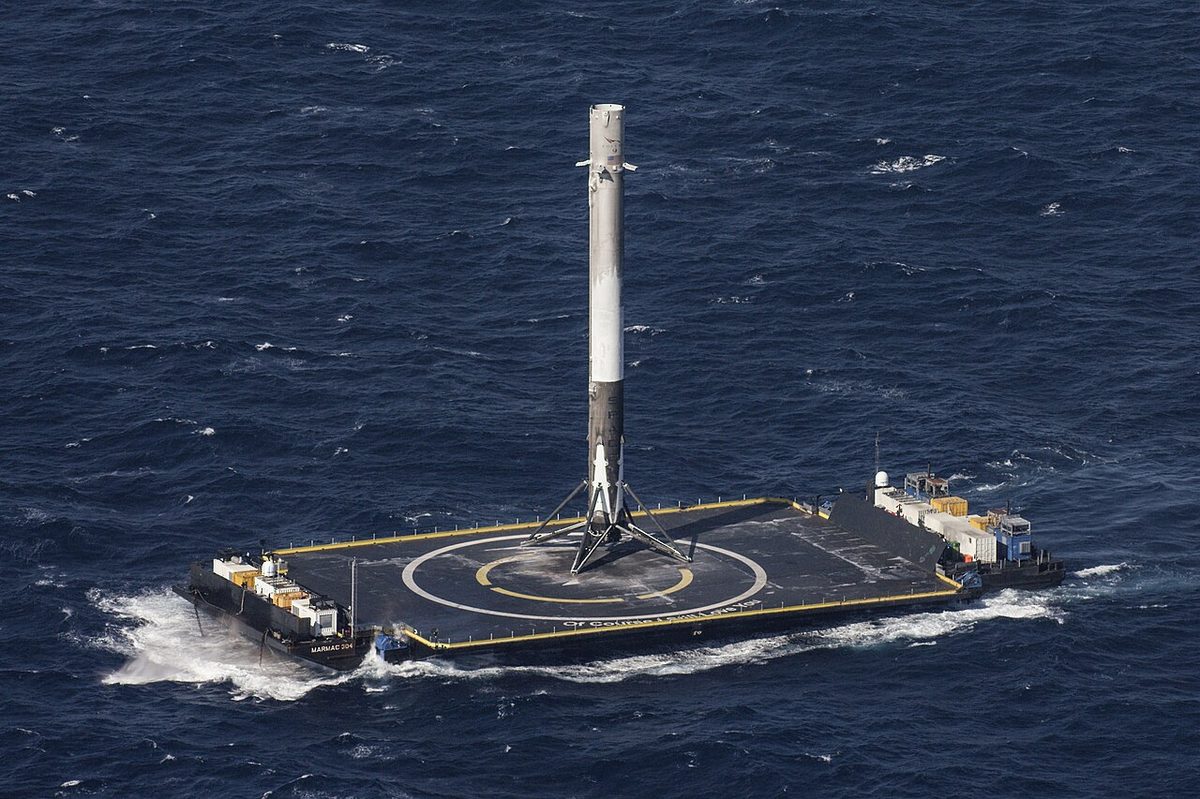
The idea sounds like something from a science fiction screenplay: park a decommissioned oil platform in the Pacific, bolt on the appropriate equipment, and use it as a floating rocket recovery station. But the U.S. Air Force is not writing fiction. It is soliciting industry input on exactly this concept, calling for Sea-based Recovery Stations — maritime platforms that could catch returning rocket boosters far from any coastline, adding a dimension of operational flexibility that land-based infrastructure simply cannot provide.
The initiative sits at the intersection of two converging realities: the explosion of reusable rocket technology driven largely by SpaceX, and the Pentagon's increasingly urgent need to diversify its space launch infrastructure away from the handful of fixed pads at Cape Canaveral and Vandenberg Space Force Base. If a launch pad is damaged, contested, or simply congested, the ability to operate from international waters with mobile infrastructure becomes militarily significant rather than merely interesting.
Why Oil Rigs?
Offshore oil platforms are extraordinarily over-engineered structures. Designed to withstand decades of storms, heavy machinery, and the corrosive brutality of open ocean, they represent a class of industrial infrastructure that costs billions to build new but can be acquired for a fraction of that figure as aging rigs are decommissioned. The North Sea alone has hundreds of platforms approaching end-of-life. The Gulf of Mexico has hundreds more in federal waters.
For rocket recovery, the geometry works. A large drilling platform's deck can span 100 meters or more — ample space for a returning booster equipped with grid fins and landing legs to target. The structural load capacity, designed for drilling equipment and massive pipe payloads, is well within the range required by a returning first stage. And unlike SpaceX's drone ships, which are converted barges with relatively limited deck area, a converted oil rig would offer significantly more space and stability.
The Air Force concept envisions these platforms operating beyond the territorial waters of the United States, which introduces both advantages and complications. Operating in international waters means no overflight agreements required, no FAA airspace coordination with commercial traffic, and flexibility to position recovery assets wherever a mission trajectory dictates. It also means operating under maritime law, with all the logistics that implies — crew rotation, fuel supply, weather routing, and the perpetual challenge of maintaining precision mechanical systems in a salt air environment.
Launch Diversity as a Strategic Requirement
The Pentagon's dependence on two primary launch sites is not a new concern, but it has grown more acute. Space launch has gone from a once-a-month enterprise to a near-weekly one, and the cadence is still accelerating. Commercial operators compete for pad time alongside national security missions. A single pad anomaly, natural disaster, or — in a worst-case planning scenario — adversary action against fixed infrastructure could interrupt the launch schedule in ways that ripple through military communications, navigation, and reconnaissance capabilities.
Sea Launch, the commercial consortium that operated a converted oil platform called the LP Odyssey (formerly Ocean Odyssey) from the late 1990s through 2014, demonstrated that offshore launch is technically feasible. The platform successfully launched 36 missions from the equator, where the Earth's rotation provides an extra velocity bonus for geosynchronous orbits. The program ultimately failed commercially rather than technically, but the engineering lessons it generated are directly relevant to the Air Force's current concept.
Modern reusable rockets complicate the picture in ways Sea Launch never had to manage. Catching a returning first stage requires precision approach guidance, a flame-trench or equivalent exhaust management system, and mechanical catching arms — the technology SpaceX calls "Mechazilla" at Starbase. Retrofitting this onto an oil platform is not trivial, but the structural bones of a large semi-submersible or jacket-type platform are arguably better suited to the task than a converted barge.
Space Force's Commercial Entanglement
The initiative explicitly envisions the Sea-based Recovery Stations serving both Space Force national security launches and private spaceflight companies simultaneously — a dual-use model that reflects the Pentagon's evolving approach to commercial space. Rather than maintaining dedicated government infrastructure, the strategy leans toward shared facilities where military missions provide the anchor tenant revenue that makes commercial operation viable, while benefiting from the cost efficiencies that commercial competition drives.
This mirrors the broader architecture of Space Force's launch strategy, which has moved away from government-owned and operated rockets toward the National Security Space Launch program — a competitive framework that currently has United Launch Alliance and SpaceX as primary providers, with additional companies in the development pipeline. Sea-based recovery fits naturally into this framework: government-funded platform conversion, commercially operated day-to-day, with Space Force launch rights built into the contract structure.
What Comes Next
The Air Force is in early-stage information gathering, soliciting responses from industry on technical feasibility, cost ranges, and timeline estimates. No contracts have been awarded, and no platforms have been selected. The concept faces regulatory complexity around maritime operations, environmental permitting for ocean activities, and the significant engineering challenge of marrying rocket-catching hardware to legacy oil rig structures that were designed for a completely different purpose.
But the fact that the Air Force is asking these questions formally — rather than exploring them in skunk works isolation — suggests the concept has cleared an internal threshold of credibility. In an era when SpaceX catches 70-meter-tall rocket boosters with robotic chopstick arms, the idea of landing one on an oil platform seems, if not routine, at least serious.
