
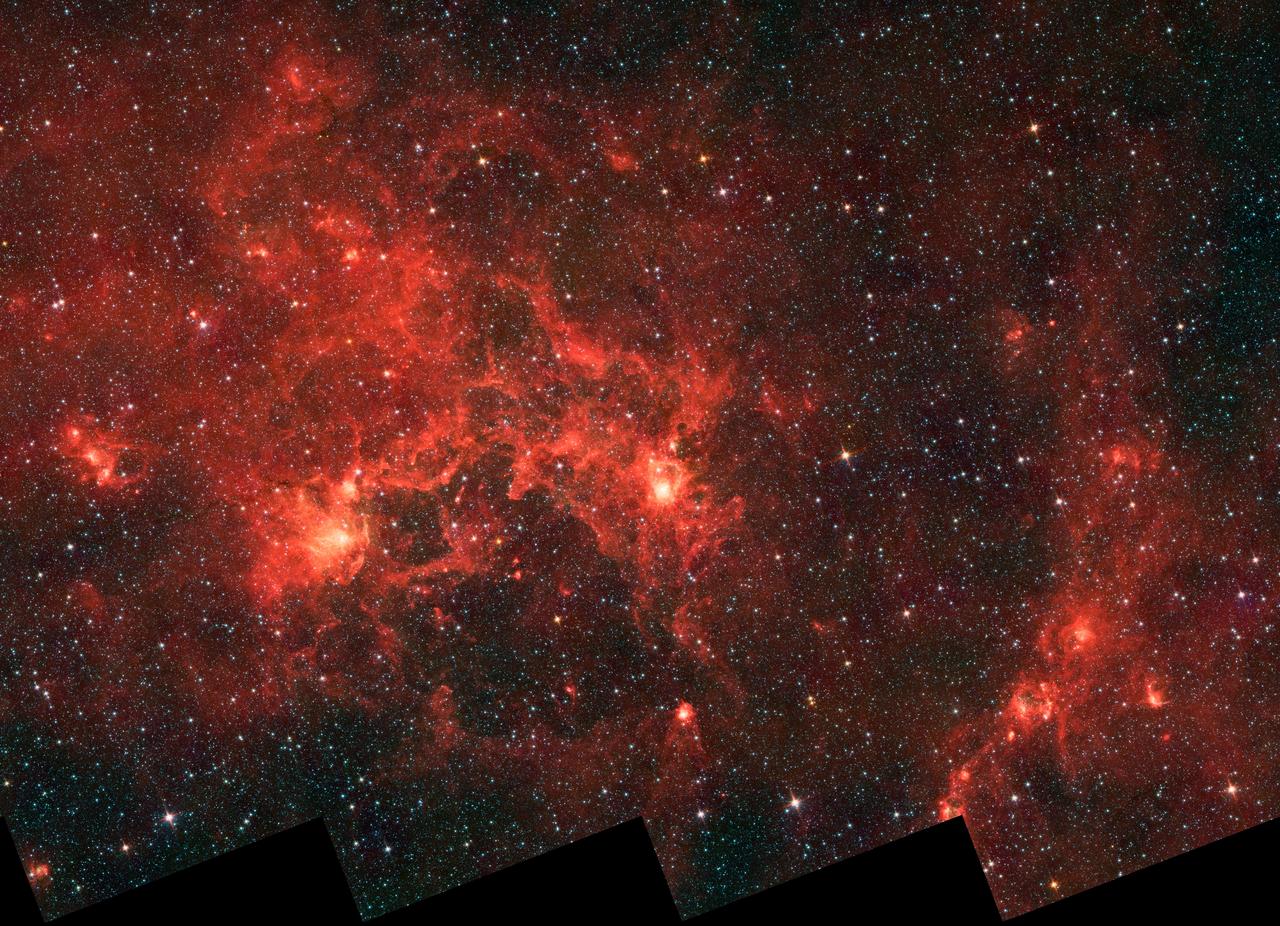
Despite decades of sky surveys and an ever-growing census of nearby stars, astronomers suspect that the Sun's immediate cosmic neighborhood still harbors undiscovered objects — dim, cool bodies that have so far evaded detection. Now NASA is turning to the public to help track them down.
The agency has launched a citizen science initiative inviting volunteers to search for hidden cosmic companions lurking in the solar neighborhood. The project asks participants to sift through astronomical data, looking for the telltale signatures of brown dwarfs and other faint objects that professional surveys may have overlooked. No telescope required, no advanced degree necessary — just a web browser and a willingness to stare at images of the sky until something moves.
The Objects That Refuse to Be Found
Brown dwarfs occupy an awkward middle ground in the cosmic taxonomy. Too massive to be planets but too lightweight to sustain the hydrogen fusion that powers true stars, these objects glow faintly from residual heat left over from their gravitational contraction during formation. They cool over time, growing progressively dimmer across millions and billions of years — which makes older brown dwarfs extraordinarily difficult to spot. At near-infrared wavelengths, they can be thousands of times fainter than the dimmest red dwarf stars, rendering them effectively invisible to many telescopes scanning at optical wavelengths.
The solar neighborhood — typically defined as the volume of space within roughly 30 to 50 light-years of the Sun — contains several hundred known stellar and sub-stellar objects. But completeness drops sharply at the faint end of the luminosity scale. Wide-field infrared surveys have turned up brown dwarfs by the hundreds across the sky, yet population models consistently suggest more should exist nearby than have actually been cataloged. The discrepancy could mean that cool, old T- and Y-class brown dwarfs are sitting in existing datasets right now, their faint signals buried in noise or confused with distant background galaxies.
Why Humans Still Beat the Algorithms
This is precisely the kind of problem where human pattern recognition excels. Automated data pipelines are powerful, but they operate on predefined criteria — if an object's characteristics fall outside the expected parameter space, or if it sits in a confused field near the galactic plane where source density is high, software may discard it as an artifact. Trained volunteers, by contrast, can flag anomalies that algorithms miss, particularly when examining image blinks: side-by-side comparisons of the same patch of sky taken at different epochs that reveal objects moving against the fixed background of distant stars.
NASA's citizen science project channels this approach by presenting participants with data and asking them to identify candidates for follow-up observation. The barrier to entry is deliberately low. Participants work through a web-based interface, evaluating images and flagging anything that looks like it might be a nearby, moving object rather than a stationary background source. The collective effort of thousands of volunteers can cover vastly more sky area than any single research team, making it a remarkably efficient method for winnowing haystacks of data down to a manageable shortlist of candidates worth pointing a bigger telescope at.
The Telescope Ecosystem Standing By
The initiative fits into a broader effort by NASA to leverage its flagship observatories alongside public participation. The James Webb Space Telescope, with its unprecedented infrared sensitivity, has been advancing the understanding of nearby stellar and planetary objects — including detailed observations of exoplanets orbiting in nearby systems that reveal atmospheric composition and thermal structure. Webb's ability to peer deep into the infrared makes it a natural complement to citizen science brown dwarf searches: once volunteers identify a promising candidate in existing survey data, Webb or other ground-based facilities could confirm and characterize it with spectroscopy, nailing down its temperature, composition, and distance.
Meanwhile, the Hubble Space Telescope continues to survey cosmic objects at various distances, contributing to the ever-expanding catalog of known objects in the local universe. Together, these observatories provide the multi-wavelength backbone that makes citizen-led discovery viable — wide-field surveys supply the initial data, volunteers sift it for candidates, and pointed follow-up observations from major facilities confirm the finds and extract the physics.
What a New Neighbor Would Tell Us
Finding additional brown dwarfs in the solar neighborhood would be considerably more than a bookkeeping exercise. Each new object constrains models of star formation and the initial mass function — the statistical distribution of masses with which objects form from collapsing molecular clouds. If the bottom end of this distribution is richer than current observations suggest, it has implications for the total mass budget of the Milky Way and for the frequency of free-floating planetary-mass objects drifting silently between the stars.
There is also the sheer proximity factor. Objects within 30 light-years are close enough for detailed characterization that would be impossible at greater distances. Their distances can be measured via parallax with high precision, their atmospheres can be studied spectroscopically season after season, and their motions through the galaxy can be tracked to reconstruct orbital histories stretching back millions of years. A newly discovered brown dwarf at, say, 20 light-years would instantly become one of the best-studied sub-stellar objects in existence, simply because it is close enough for current instruments to dissect in granular detail.
And then there is the more speculative but tantalizing possibility of finding something that does not fit neatly into existing categories at all. The gap between the lightest known brown dwarfs and the heaviest free-floating planets remains poorly populated observationally, and the boundary between the two classes is a subject of active and occasionally heated debate among theorists. A citizen scientist stumbling upon a five-Jupiter-mass object drifting through the solar neighborhood at 15 light-years would force a reckoning with how the planetary boundary itself is defined — and whether the distinction between "failed star" and "rogue planet" is even physically meaningful.
Why It Matters
NASA's citizen science initiative represents something increasingly uncommon in modern research: a genuine opportunity for non-specialists to make original, citable contributions to the astronomical record. Professional astronomy has grown enormously complex, with most cutting-edge work requiring access to billion-dollar orbital facilities, years of data pipeline development, and highly specialized domain expertise. Citizen science projects carve out a niche where human judgment still adds irreplaceable value, particularly in classification and anomaly detection tasks that resist full automation — the kind of work where a fresh pair of eyes notices what a finely tuned algorithm was never taught to look for.
The project also underscores how incomplete our map of the local cosmos remains. The solar neighborhood is the most thoroughly studied volume of space in the entire galaxy, and yet it almost certainly contains objects that have not been identified. That gap is not a failure of existing surveys — it is a reflection of just how faint and elusive the coolest sub-stellar objects truly are, radiating most of their diminishing energy at wavelengths that are difficult to observe from the ground and easy to confuse with instrumental noise in space-based data. Closing that gap requires not just better instruments, which are arriving steadily in the form of Webb and future planned facilities, but also more eyes on the data that already exists.
For participants, the pitch is straightforward: this is real data, attached to real science, with the real possibility of putting your name on a discovery paper. NASA's track record with citizen science programs includes confirmed discoveries that professional astronomers subsequently validated and published in peer-reviewed journals. The current project continues that tradition, offering the public a seat at the table in one of astronomy's most fundamental and enduring endeavors — figuring out what, exactly, lives in our cosmic backyard, and whether any of it has been hiding in plain sight all along.
