
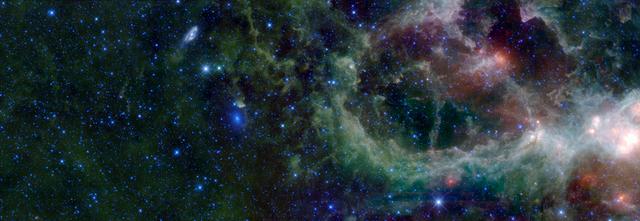
In June 2026, astronomers using South Africa's MeerKAT radio telescope made a discovery that fundamentally extends our reach into the early universe: they detected the most distant hydroxyl emission ever observed through a naturally amplified cosmic laser. This exceptional signal, located in a galaxy approximately 8 billion light-years away, exhibits record-breaking luminosity, opening a new observational window into how galaxies collided, merged, and evolved in the ancient cosmos.
The find represents more than a mere distance record. Hydroxyl megamasers—intense, amplified emissions of hydroxyl molecules—have long served as cosmic signposts, marking regions of intense star formation and galactic activity. But until now, astronomers could only detect them relatively nearby in cosmic terms. This detection, made possible by MeerKAT's unprecedented sensitivity at radio wavelengths, reveals that the most luminous hydroxyl emissions may have been operating throughout cosmic history, hidden in dusty galaxies that optical telescopes cannot penetrate. The discovery promises to rewrite our understanding of how galaxies grew and evolved during the first few billion years after the Big Bang.
What Are Hydroxyl Megamasers?
To understand the significance of this discovery, it helps to first understand what hydroxyl megamasers are and why they matter to astronomers studying the early universe.
Hydroxyl is a simple molecule consisting of one oxygen atom bonded to one hydrogen atom—the same molecule responsible for water's chemical behavior. In the dense, gas-rich environments of certain galaxies, particularly those undergoing violent collisions, hydroxyl molecules can be stimulated to emit radiation at radio wavelengths in a process called maser amplification. Unlike the lasers familiar from laboratories and technology, which emit visible light, masers emit at longer radio wavelengths.
The "mega" in megamaser refers to the extraordinary luminosity of these objects. While ordinary hydroxyl masers emit radiation at levels comparable to stellar light sources, megamasers can outshine entire galaxies at radio wavelengths. They are cosmic lasers of almost unimaginable power, generated not through technological intervention but through the natural astrophysical processes unleashed when galaxies collide.
These collisions trigger specific conditions. As two gas-rich galaxies merge, their interstellar gas clouds compress and heat. Black holes at the centers of these galaxies may become active, feeding on infalling material and releasing tremendous energy. Shock waves propagate through the gas. These violent processes create the precise conditions—specific densities, temperatures, and radiation fields—needed for hydroxyl molecules to amplify radio waves. The result is a hydroxyl megamaser: a beacon of extraordinary brightness that can be detected across billions of light-years.
Because hydroxyl megamasers are preferentially produced in galaxy mergers and actively feeding supermassive black holes, they serve as tracers of star formation and black hole evolution. Observations of hydroxyl megamasers in the nearby universe revealed that these objects cluster around regions of intense star formation and active galactic nuclei. But nearly all known hydroxyl megamasers are relatively local—at distances of a few billion light-years at most. The MeerKAT discovery shatters that distance record.
The MeerKAT Discovery
South Africa's MeerKAT radio telescope, an array of 64 dishes spread across the Karoo region, was specifically designed to detect faint radio signals from distant galaxies. Its unprecedented sensitivity—its ability to detect extraordinarily weak signals—makes it ideal for probing the early universe at radio wavelengths.
In June 2026, MeerKAT's observations revealed a hydroxyl emission of exceptional brightness in a galaxy 8 billion light-years away. At this distance, the light we observe left that galaxy when the universe was less than 6 billion years old—when cosmic structures were still assembling, when galaxies were colliding and merging at higher rates than they do today. Yet despite this vast distance, MeerKAT detected the hydroxyl emission with sufficient clarity to confirm its properties and measure its luminosity.
The discovery is remarkable for its exceptional luminosity. It represents the highest luminosity ever recorded for a hydroxyl emission at this distance, underscoring the powerful physical processes at work in that distant galaxy. The fact that MeerKAT could detect such an object at such distance reveals something profound: the most luminous hydroxyl emissions may have existed throughout cosmic history, but previous radio telescopes simply lacked the sensitivity to find them at early cosmic times.
The discovery emerged from the natural capabilities of cosmic distance measurement. The 8-billion-light-year distance places this object far across cosmic space. Yet the physics at work is the same: colliding galaxies, compressed gas, amplified radio waves, a natural beacon shining across the cosmos.
Implications for Early Galaxy Evolution
This detection fundamentally expands the toolkit for studying the early universe. The early universe was a dynamically active place. Galaxies collided and merged frequently. Supermassive black holes were actively feeding. Star formation rates were orders of magnitude higher than they are today. To understand how the universe evolved from the nearly-uniform, nearly-featureless primordial state just after the Big Bang to the rich, structured cosmos we observe today, astronomers must find ways to observe the populations of distant, dusty galaxies that participated in these transformations.
Optical and infrared observations struggle in these environments. Dust—grains of silicates and carbon in the gas between stars—absorbs optical and infrared light, rendering dusty star-forming galaxies invisible to traditional optical telescopes. Radio waves, by contrast, pass through dust almost unimpeded. Radio-wavelength observations therefore provide an unobstructed view of star formation hidden from optical view. Hydroxyl emissions, as natural radio beacons, serve as precise markers of these obscured regions.
The MeerKAT detection demonstrates that hydroxyl astronomy can now probe the epoch when the universe was young, when such mergers were common. Because these objects light up in response to energetic galaxy interactions and active black holes, each detection reveals something about the conditions of the early universe: the abundance of gas-rich galaxies, the rates at which they merged, the power of their central black holes.
Why It Matters
This discovery matters on multiple levels. On the practical front, it validates MeerKAT's design and capabilities. The telescope's sensitivity—its ability to gather photons from faint, distant sources—enables entirely new science. As follow-up observations reveal whether other distant hydroxyl emissions exist, MeerKAT may establish a new population of cosmic signposts for tracing early galaxy evolution and supermassive black hole growth.
More broadly, the discovery illuminates the power of radio astronomy for studying the early universe. While optical and infrared telescopes like JWST observe the light that escapes dusty star-forming regions, radio observations like these reveal the engines driving star formation: the colliding galaxies, the compressing gas, the amplified radiation. Together, multiwavelength observations paint a complete picture.
Perhaps most importantly, the discovery reminds us that the universe still holds surprises. The detection of an exceptionally luminous, most distant hydroxyl emission suggests that the early universe may be filled with even more exotic cosmic objects than current theory predicts. As radio telescopes grow more sensitive, and as surveys deepen, more such discoveries are likely. Each detection brings us closer to understanding how galaxies assembled, how black holes grew, and how the universe evolved from simplicity to complexity across 13.8 billion years of cosmic history.
Sources
- South African telescope detects record-breaking signal from the early universe – Phys.org
- MeerKAT discovers record-breaking cosmic laser halfway across the universe – South African Radio Astronomy Observatory (SARAO)
- South African telescope detects record-breaking signal from the early universe – The Conversation
