
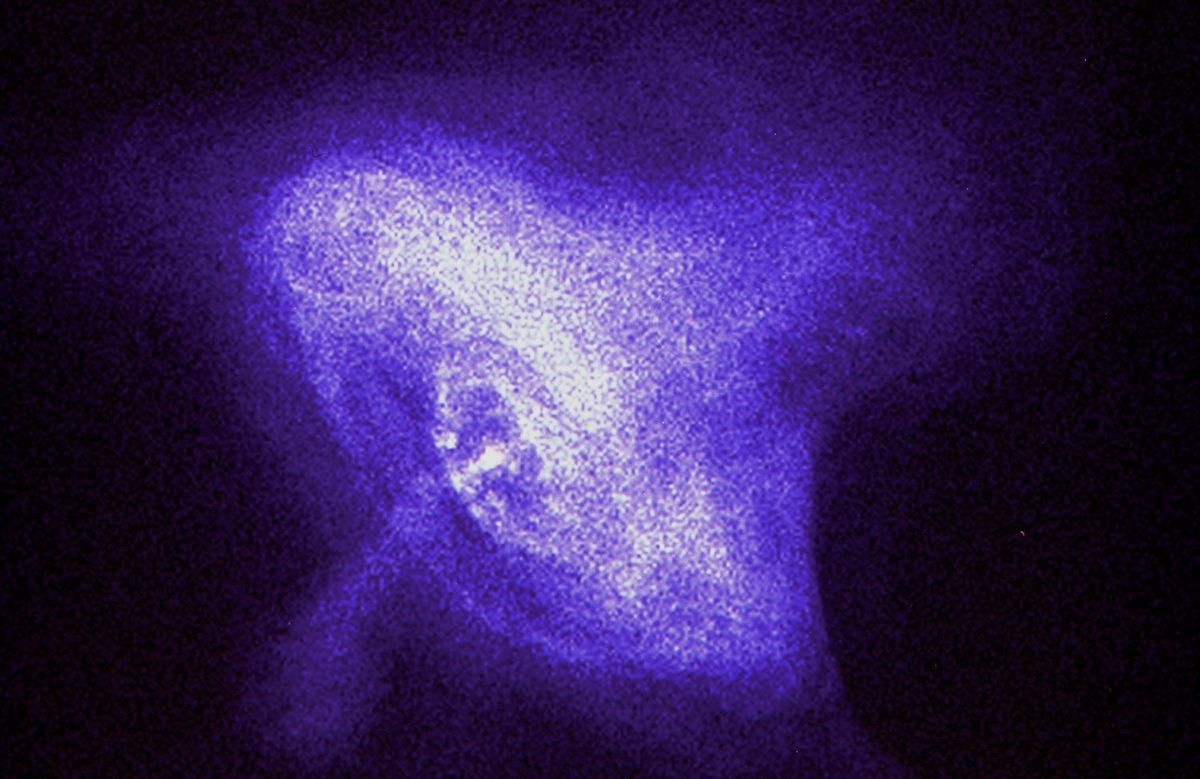
If you were to approach a magnetar within a few hundred kilometers — which you would never do, and which in any case would be impossible to survive — the magnetic field would be strong enough to pull the iron from your hemoglobin through your body before any other process had time to kill you. This is not a metaphor or a colorful exaggeration. It is a straightforward consequence of field strengths approaching 1015 Gauss — roughly a quadrillion times stronger than Earth's geomagnetic field, and some 1,000 times stronger than an ordinary neutron star's.
Magnetars are the most intensely magnetic objects known to exist in the universe. There are only about 30 confirmed examples in the Milky Way. They erupt without warning in events that, for brief moments, release more energy than the Sun will emit in 100,000 years. And despite decades of observation and theoretical development, astrophysicists still argue about how exactly they form — and what will become of them.
What a Magnetar Actually Is
A magnetar is a specific variety of neutron star — itself already one of the most extreme objects in nature. When a massive star, typically 8 to 20 times the mass of the Sun, exhausts its nuclear fuel and collapses, the result can be a neutron star: a ball of degenerate matter roughly 20 kilometers across that contains 1.5 to 2 solar masses, packed so densely that a teaspoon of it would weigh roughly 10 million tons on Earth. The collapse compresses the progenitor star's magnetic field through a process related to conservation of magnetic flux, concentrating it to extraordinary values.
Most neutron stars end up with magnetic fields in the range of 108 to 1013 Gauss — already incomprehensible by any human-scale reference. Magnetars somehow amplify this further by orders of magnitude, reaching 1014 to 1015 Gauss. The leading mechanism proposed to explain this is a turbulent dynamo process in the first seconds after collapse, when the interior of the nascent neutron star is a convective, rapidly rotating inferno of superfluid neutrons and superconducting protons. Under the right conditions — particularly if the initial rotation rate is fast enough — this dynamo can generate and sustain fields far beyond what simple flux compression would produce.
The result is a star whose magnetic energy exceeds its rotational energy, which inverts the usual physics of neutron stars. Ordinary pulsars spin down gradually as they radiate rotational energy into the surrounding space. Magnetars spin down far more rapidly — most have rotation periods of a few seconds, much slower than the milliseconds of recycled pulsars — and they spin down because the magnetic field is dragging against the interstellar medium with such force that it brakes the rotation over timescales of thousands of years.
How Magnetars Erupt
The defining feature of magnetars in observation is their outbursts. These come in two flavors: the relatively modest short bursts, lasting less than a second, that occur sporadically and are detectable by X-ray and gamma-ray satellites; and the rare giant flares, which are among the most energetic events in the known universe short of gamma-ray bursts and supernovae.
The December 2004 flare from SGR 1806-20 is the most famous example. It released more energy in 0.2 seconds than the Sun emits in 250,000 years, and the pulse of high-energy radiation it sent toward Earth was strong enough to measurably ionize the upper atmosphere at a distance of 50,000 light-years. Had it occurred within 10 light-years of Earth — a purely hypothetical scenario, since no magnetar is known to be anywhere near that close — it would have caused significant damage to the ozone layer and delivered radiation doses detectable at the surface. The event was observed in real time by multiple satellites and triggered an automatic shutdown of some X-ray telescope instruments because the flux saturated their detectors.
The mechanism behind these flares is thought to involve starquakes — fractures in the crystalline crust of the neutron star driven by the stress imposed by the ultrastrong magnetic field. As the internal magnetic field evolves and its configuration shifts, it exerts increasing mechanical stress on the rigid crust. When a stress limit is exceeded, the crust cracks, analogous to the way tectonic stress releases in an earthquake. The sudden rearrangement of magnetic field lines dumps enormous amounts of energy into the surrounding magnetosphere, producing the characteristic hard X-ray and gamma-ray spike.
The Fast Radio Burst Connection
The most exciting recent development in magnetar astrophysics is their apparent connection to fast radio bursts — millisecond-duration flashes of radio waves, first detected in 2007, that originate from cosmological distances and briefly outshine entire galaxies at radio wavelengths. For over a decade after their discovery, fast radio bursts were one of astrophysics' deepest mysteries: too brief and too bright to fit any conventional model.
In April 2020, a magnetar in our own galaxy — SGR 1935+2154, located about 30,000 light-years away — produced a bright radio burst simultaneously with an X-ray flare. The event, detected by CHIME, STARE2, and other radio observatories, was not as bright as extragalactic fast radio bursts but was clearly in the same phenomenological class. It provided the first compelling observational evidence that at least some fast radio bursts are produced by magnetars — likely through the same starquake-and-magnetic-reconnection mechanism that drives their X-ray outbursts, but channeled into coherent radio emission.
This doesn't close the case — there are repeating fast radio bursts and non-repeating ones, and it's possible that different source classes contribute. But the SGR 1935+2154 event was the breakthrough that crystallized the leading theoretical consensus around magnetars as the primary driver.
What We Still Don't Know
Formation remains contested. Not all neutron stars become magnetars — the fraction appears to be around 10 percent — and the conditions that trigger the dynamo amplification of the magnetic field are still poorly constrained by observation. There's an emerging suggestion that magnetars may preferentially form from very rapidly rotating progenitor cores, but teasing that out requires better statistics than the current sample of 30 confirmed magnetars provides.
The interior physics is almost entirely theoretical. Neutron star cores may contain strange quark matter, hyperons, or color superconducting phases of quark-gluon plasma — states of matter that can only be probed indirectly through the star's bulk properties (mass, radius, spin-down rate). Gravitational wave observations of neutron star mergers, like the landmark GW170817 event, are beginning to constrain the nuclear equation of state. But magnetars add another layer of complexity because the extreme magnetic field modifies the equation of state in ways that are difficult to disentangle from other parameters.
The next generation of X-ray observatories — ESA's Athena, and potentially a future large-area high-energy telescope — will observe dozens of magnetar bursts with spectral resolution and timing precision that current instruments cannot achieve. Each outburst is, in a sense, a controlled experiment in the physics of matter and energy at densities and field strengths unachievable in any terrestrial laboratory. The universe is running these experiments continuously. We are getting better, slowly, at reading the results.
